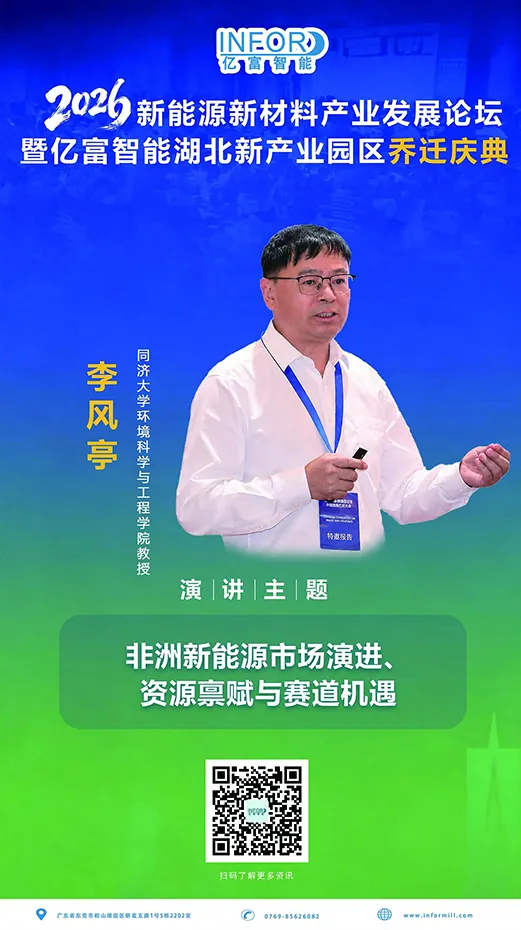
As China's new energy supply chain shifts from competing on capacity to going abroad, and from material innovation to global applications, an industry forum linking Chinese manufacturing with overseas markets is moving from the agenda to Gucheng. Li Fengting, professor at the College of Environmental Science and Engineering of Tongji University, Fellow of the African Academy of Sciences and Director of the UN-Habitat-Tongji University Institute of Climate and Environment for Africa, has confirmed his attendance at the 2026 New Energy and New Materials Industry Development Forum and INFOR Hubei Industrial Park Opening Ceremony, where he will speak on "Africa's New Energy Market: Evolution, Resource Endowment and Opportunities".
A champion of South-South cooperation who put Africa on the map of Chinese new energy exports
Li Fengting is a professor and doctoral supervisor at the College of Environmental Science and Engineering of Tongji University, a Fellow of the African Academy of Sciences, a Fellow of the Chemical Industry and Engineering Society of China, and a UN-Habitat water treatment expert. He is Director of the UN-Habitat-Tongji University Institute of Climate and Environment for Africa and Director of the China Meteorological Administration's Shanghai Key Laboratory of Urban Climate Change and Response.
His research covers climate change and carbon neutrality technologies, environmental functional materials, high-purity chemicals for new energy and clean production, key materials for solid-state batteries, climate change and water resources in Africa, and South-South cooperation mechanisms. Since 2005 he has made more than fifty trips to countries including Liberia, Kenya, Tanzania, Ethiopia, Morocco, Uganda and Côte d'Ivoire; co-published reports such as the African urban water management report and the green economy report with UNEP and UN-Habitat; published more than 450 papers in Nature and leading environmental, materials and chemical engineering journals; holds more than 150 Chinese and US invention patents; and has transferred his results to more than 60 companies for industrial application.
He is also a bridge-building scholar of China-Africa green cooperation, linking Chinese technology, African settings and sustainable development in the Global South into a practical chain of cooperation, from clean water and waste valorization to solar-plus-storage and clean manufacturing of new energy materials.
African new energy: from a power-short continent to a blue ocean for solar and storage
Africa does not lack resources; it lacks the system capability to turn resources into electricity and electricity into industry. Prof. Li's view is direct: the opportunity in African new energy lies not in exporting individual components but in the alignment of resource endowment, the power gap and Chinese manufacturing capability:
• Resources: more than 40% of the world's solar potential, concentrated high-quality sunshine and widely distributed battery minerals such as lithium, cobalt, manganese and copper;
• Rigid demand: frequent power cuts and costly diesel generation across sub-Saharan Africa make off-grid and microgrid solar-plus-storage a necessity rather than an option;
• Market evolution: from aid-built power plants and module exports toward combined tracks of solar plus storage, mining electrification and local assembly;
• China's position: materials, cells, inverters, grinding and dispersion equipment and EPC services are going abroad along the whole chain, shifting from selling products to building systems.
As he often stresses: "Africa is not a low-end market but a system testing ground on a blank sheet of paper; whoever first works out standards, O&M and localization will hold the ticket to the next round of globalization."
An external perspective to complement the forum's new energy materials theme
Once new energy materials are made, where do they go? Prof. Li will offer a set of coordinates at the forum:
- Market coordinates: where South Africa, Egypt, Morocco, Kenya and Nigeria each stand on the solar-plus-storage curve;
• Resource coordinates: how African minerals and green power can support China's sodium-ion, solid-state and lithium-ion material systems;
• Equipment coordinates: how intelligent grinding and dispersion equipment companies such as INFOR can go abroad together with material and cell makers;
• Risk coordinates: which pitfalls in financing, grids, localization, community relations and policy change must be built into the model in advance.
This also fits the positioning of INFOR's new industrial park, not only serving domestic production lines but becoming an equipment rehearsal ground for new energy material companies before they go abroad.
November in Gucheng: a new park opens and the overseas perspective joins the agenda
Drawing on thirty years of South-South cooperation, Prof. Li will lay out the real landscape of Africa's solar and storage market: which markets are moving first, where the resources are richest and where equipment companies need to establish a presence early. For INFOR and the material companies attending, the value of the talk is not that Africa is far away but that the next round of orders may come from Africa.
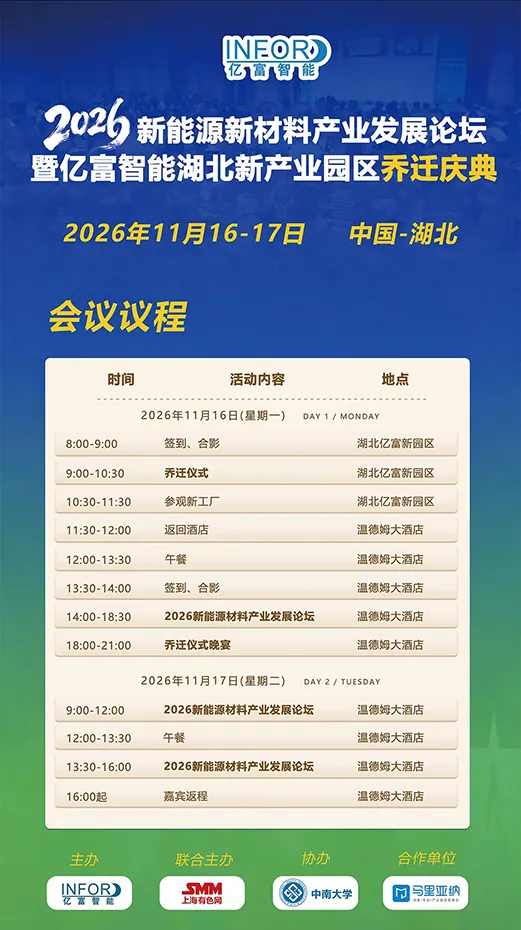
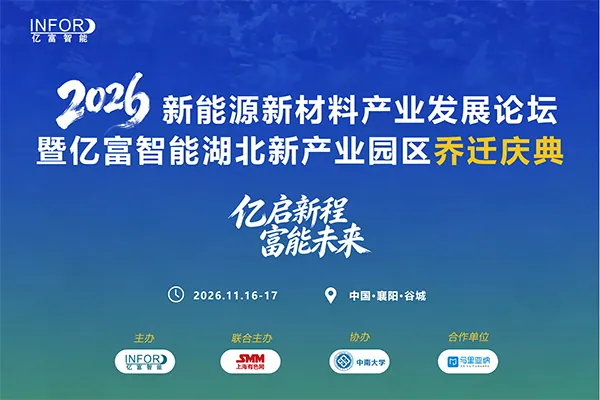
2026 New Energy and New Materials Industry Development Forum and INFOR Hubei Industrial Park Opening Ceremony
Date: 16-17 November 2026 | Venue: Gucheng, Xiangyang, Hubei, China
Speaker: Prof. Li Fengting (Professor, College of Environmental Science and Engineering, Tongji University; Fellow of the African Academy of Sciences; Director of the Institute of Climate and Environment for Africa)
Topic: Africa's New Energy Market: Evolution, Resource Endowment and Opportunities
Host: Guangdong INFOR Intelligent Equipment Co., Ltd.
Co-host: Shanghai Metals Market (SMM)
Co-organizer: Central South University
Supported by: Gucheng County People's Government