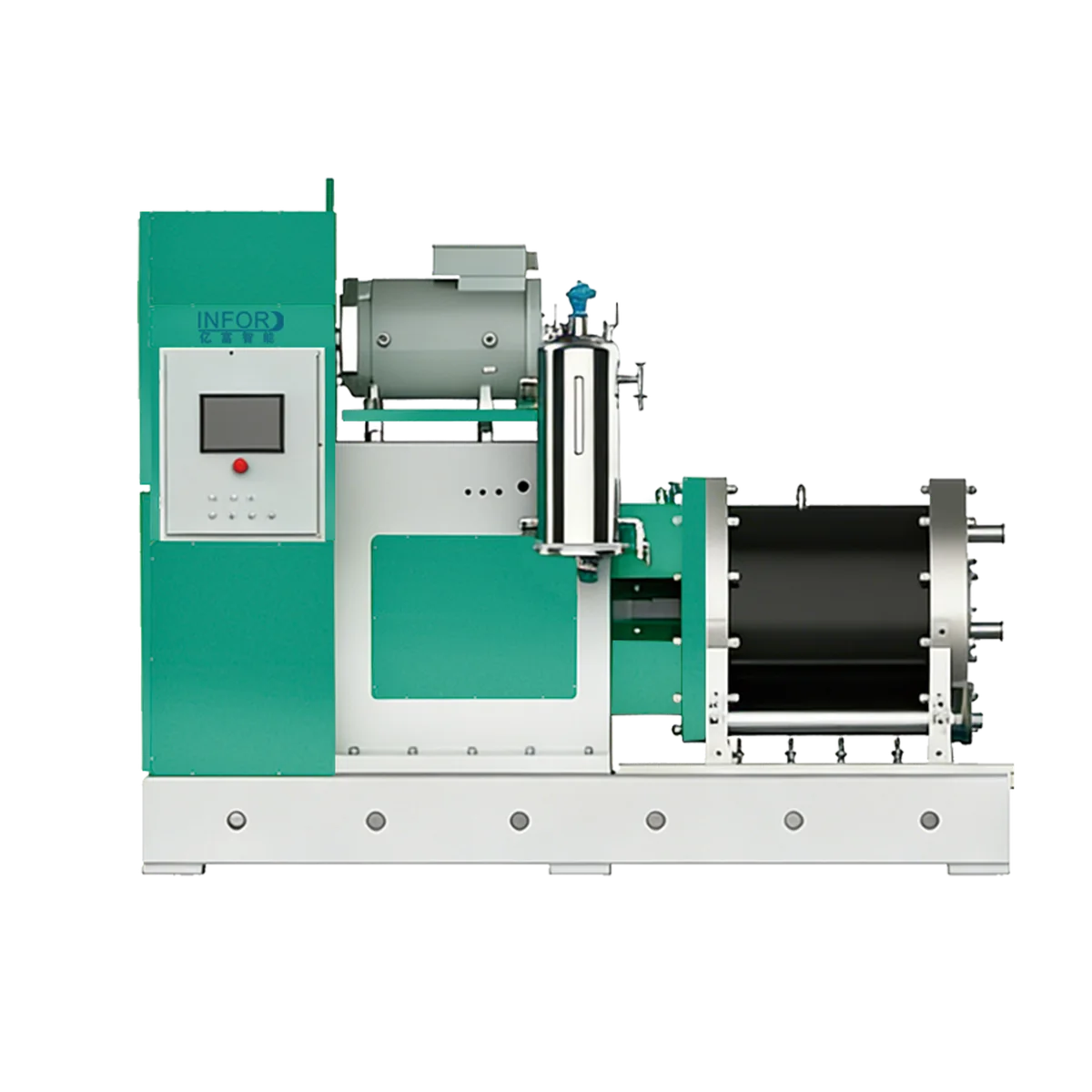
Bead mill throughput is set by eight things: chamber volume, motor power and the energy the target needs, feed quality, solids content and viscosity, bead size and filling, the separation system, cooling, and the operating mode. Fineness is the biggest lever: the finer the target, the more energy each kilogram needs, and the less product per hour a mill of given power can make.
Bead mill throughput factors at a glance
| Factor | Effect on throughput | What to check |
|---|---|---|
| Chamber volume and motor power | Sets the grinding energy available per hour | Size the mill from a test result, not from a catalogue flow |
| Target fineness (D50, D90) | Finer target, more energy per kg, lower output | Agree how fineness is measured before comparing mills |
| Feed quality | Lumps and oversize waste grinding time | Pre-disperse and homogenise before the mill |
| Solids content and viscosity | High viscosity slows bead motion and flow | Optimise solids and dispersant in the lab |
| Bead size and filling | Smaller beads give more contacts but need good separation | Match bead size to the target and the separator |
| Separation system | A clogging screen limits flow and causes stops | Screen open area, or a screen-free centrifugal separator |
| Cooling | Heat-sensitive slurries force lower power or flow | Chamber cooling and chiller capacity |
| Operating mode | Single pass, multi-pass or circulation change output | Circulation suits narrow distributions |
1. Chamber volume, motor power and specific energy
A bead mill turns motor power into bead collisions. The energy put into each kilogram of product, the specific energy, decides how fine it gets. For a given material and target, the specific energy needed is roughly fixed, so hourly output scales with the power the mill can usefully apply. That is why INFOR sizes production mills from a test result: the test gives the energy per kilogram, and the mill size follows from the output you need. The terms are explained in the bead mill glossary.
2. Target fineness
Going from micron to sub-micron, and from sub-micron to nano, multiplies the energy per kilogram. A mill that makes a micron-range coating at high flow may make far less nano-grade battery slurry per hour. Always compare throughput at the same target and the same measuring method.
3. Feed quality and pre-dispersion
If dry lumps or coarse agglomerates reach the mill, it spends energy wetting and breaking them instead of grinding. A well-mixed, homogenised premix from a dispersion tank lets the mill do only what it is good at.
4. Solids content and viscosity
Higher solids means more product per litre, but viscosity rises with solids and with fineness, and thick slurry slows the beads and the flow. The best solids content is found in the lab, usually together with the dispersant. For very viscous slurries, see the high-viscosity section in the comparison of vertical and horizontal bead mills.
5. Bead size and filling
Smaller beads give many more contact points and reach finer sizes, but they need a separator that can hold them back. Filling also matters: too few beads waste energy, too many raise heat and wear. See how to calculate bead filling and how to choose grinding media.
6. Separation system
The separator lets product out and keeps beads in. A screen with small slots can clog at high flow or with fine beads, which caps throughput and causes stops. Screen-free centrifugal separation, used on INFOR's LPM vertical and dual-power mills, removes that limit. See bead mill separation systems compared.
7. Cooling
Almost all motor power ends up as heat. If the product cannot exceed a set temperature, cooling capacity, not motor power, becomes the limit. Chamber and seal cooling and a correctly sized chiller keep the mill at full power.
8. Operating mode
Single-pass operation is simple but can leave a wide distribution. Multi-pass and circulation operation give every particle a similar number of passes and a narrower distribution; circulation mode is common for battery slurries.
INFOR catalogue flows
| Mill | Chamber sizes | Catalogue feed flow | Grinding media |
|---|---|---|---|
| NCP pin-rod (horizontal) | 6-1000 L | 300-12,000 L/h | 0.2-2.0 mm |
| LPM vertical, screen-free | 60-1000 L | 2,000-8,000 L/h | 0.05-2.0 mm |
| Experimental LPM (vertical lab) | 1-30 L | 150-1,500 L/h | 0.05-2.0 mm |
Catalogue flow is the slurry flow through the chamber, not finished output. Product pages: NCP, LPM, experimental vertical mill. INFOR runs free material tests at its Dongguan and Hubei test bases; send your material, target fineness and output through the contact page.