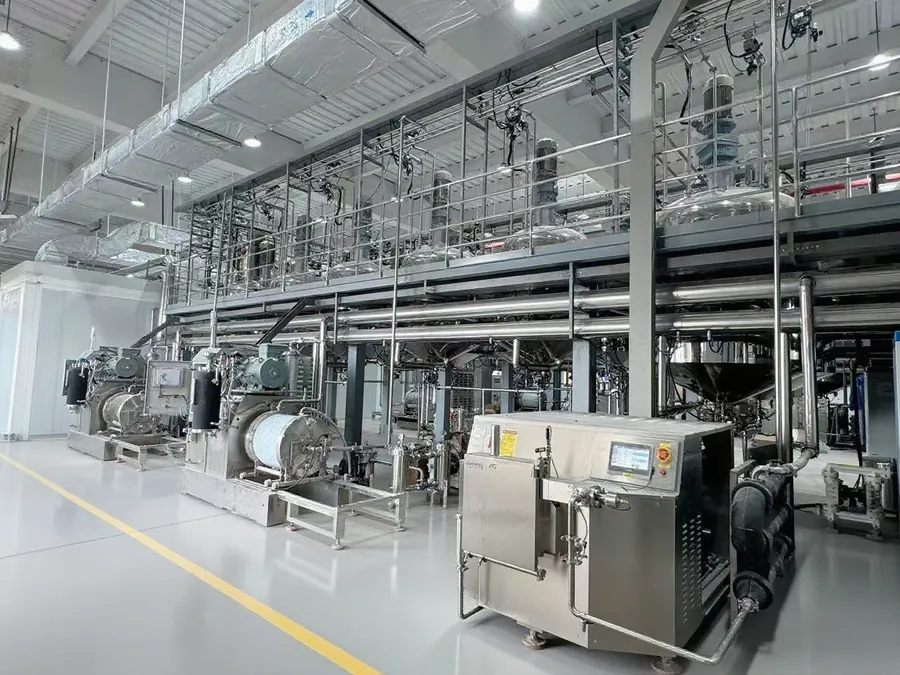
Carbon nanotubes (CNTs) are one of the most effective conductive additives for lithium battery electrodes, but only when they are properly dispersed. As produced, CNTs form tight bundles and agglomerates held together by strong van der Waals forces. The goal of dispersion is to separate those bundles into individual tubes and keep them separated, without breaking the tubes so short that they no longer form a conductive network. This guide explains how a bead mill does that, which settings matter, and how to check the result.
Why carbon nanotube dispersion is difficult
- Strong agglomeration: the tubes bundle tightly and resist wetting by the solvent.
- High viscosity at low solids: a few percent of multi-walled CNTs can already make a thick, thixotropic paste, and single-walled CNT pastes often run below 1% solids.
- Tube damage: too much energy shortens the tubes, which raises electrical resistance even when the paste looks well dispersed.
- Contamination: metal particles from equipment wear are a serious risk in battery-grade paste.
The CNT conductive paste process, step by step
- Precise dosing of solvent (NMP for cathodes, water for anodes), dispersant and CNT powder.
- High-shear pre-dispersion to wet the powder and break large agglomerates.
- Multi-stage nano sand milling to separate the bundles into individual tubes.
- Iron removal, filtration and deaeration.
- Filling.
Pre-dispersion matters. Feeding dry or poorly wetted CNT agglomerates straight into a bead mill wastes energy and can block the separation system; a good pre-mix makes bead milling faster and more consistent.
Key bead mill settings for CNT paste
| Setting | What to aim for | Why it matters |
|---|---|---|
| Energy input | Enough to debundle, then stop at the target | Excess energy cuts the tubes and raises resistance |
| Bead size | Relatively small beads | Many gentle impacts suit debundling better than a few hard ones |
| Tip speed | Moderate speed with more passes or recirculation | Gentler on the tubes than very high speed |
| Cooling | Stable slurry temperature | CNT paste is viscous and heats up quickly |
| Separation | High-flow system that resists clogging | Viscous paste easily blocks fine screens |
| Wetted parts | Wear-resistant, corrosion-proof materials | Keeps metal contamination at battery-grade levels |
For more on choosing beads, see how to choose bead size for a bead mill.
Multi-walled vs single-walled carbon nanotubes
Single-walled CNTs are thinner, more flexible and much harder to disperse. They are used at very low loadings, so the paste is dilute and over-processing is a real risk. Multi-walled CNTs are easier to disperse but are used at higher loadings, which makes the paste more viscous. For background, see structure and application of single-wall carbon nanotubes.
How to check CNT conductive paste quality
- Viscosity, and how stable it stays over time
- Fineness (grind gauge) and particle size distribution
- Electrical performance: resistivity of a dried coating, or electrode resistance
- Storage stability: no settling or re-agglomeration
- Magnetic and metal impurities, controlled at ppm level for battery use
- SEM images to confirm individual, undamaged tubes
Common mistakes in CNT dispersion
- Skipping pre-dispersion and loading agglomerates straight into the mill.
- Chasing fineness at the cost of tube length.
- Ignoring slurry temperature.
- Using equipment that is not built for high-viscosity, low-contamination paste.
INFOR equipment for carbon nanotube conductive paste
The CNT conductive paste bead mill (NCT-15 to NCT-150, 15-150 L grinding chambers) has a CNT-specific rotor, dynamic screen discharge for high flow, a full stainless-steel exterior and an anti-explosion, anti-crack barrel treatment.
For complete plants, the CNT conductive paste production line covers the whole process, from precise dosing and high-shear pre-dispersion through multi-stage nano sand milling to iron removal, filtration, deaeration and filling. See the 10,000-ton CNT conductive paste line.
INFOR runs free material tests at its Dongguan and Hubei test bases. Send your CNT type, solvent and target viscosity and resistivity through the contact page.