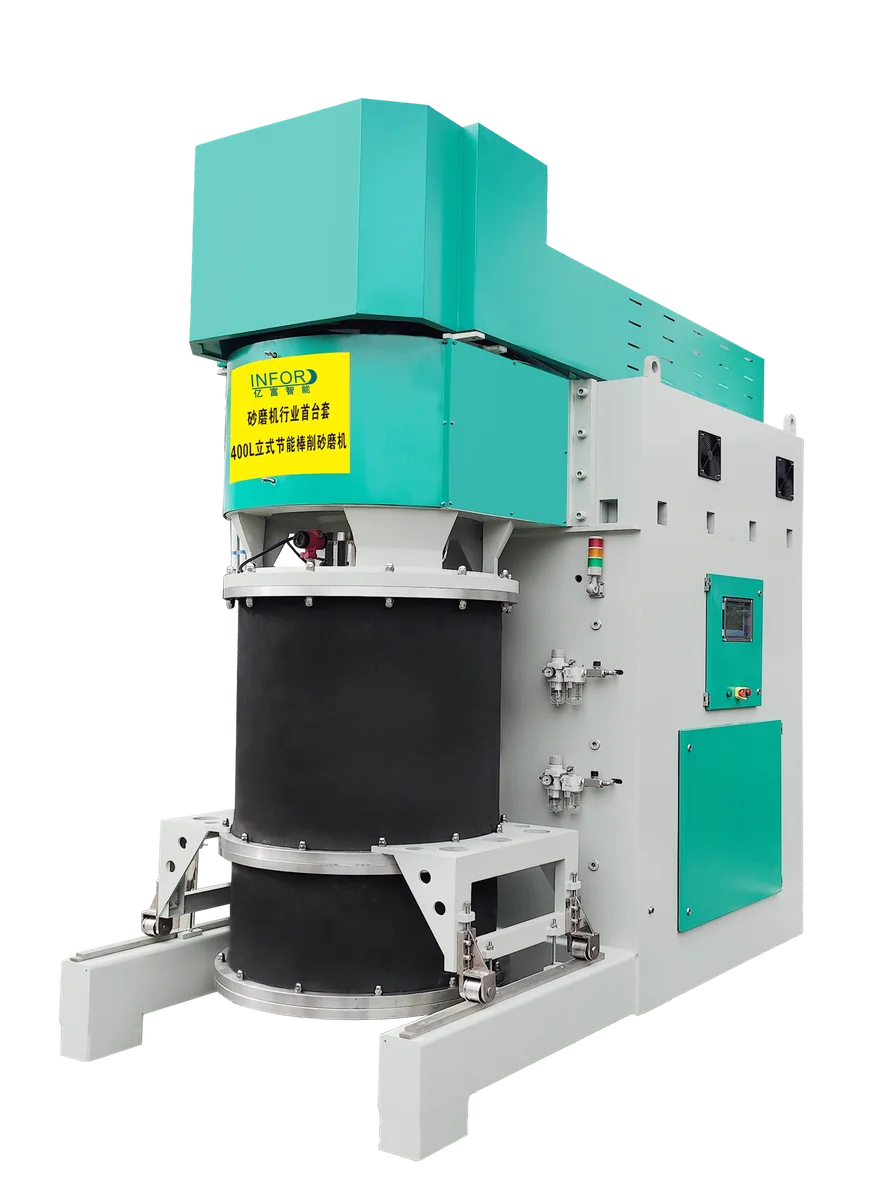
A bead mill separation system lets the ground product leave the chamber while keeping the grinding beads inside. There are three main types: static screens, dynamic gap or rotating screen separators, and screen-free centrifugal separators. The finer the beads, the harder separation becomes, and for micro-beads of about 0.1 mm and below, screen-free centrifugal separation is usually the most reliable choice.
The three separation systems compared
| Type | How it works | Strengths | Limits |
|---|---|---|---|
| Static screen (cylinder or slotted screen) | Product passes through slots smaller than the beads | Simple, low cost, easy to inspect | Clogs with fine beads, high viscosity or high flow |
| Dynamic gap / rotating screen | A narrow gap or rotating screen keeps beads back and is kept clear by motion | Handles higher flow than a static screen | Gap or slot still limits the smallest bead size |
| Screen-free centrifugal separator | A rotating wheel throws heavy beads outwards; product leaves through the centre | No screen to clog, works with micro-beads, classifies particles | More complex design; separator speed must suit the material |
Static screens
A static screen is a slotted cylinder or plate at the outlet. Its slots must be smaller than the smallest bead, so fine beads need very fine slots, which have little open area and block easily as viscosity rises. Static screens suit coarser beads and lower flows.
Dynamic gap and rotating screen separators
Here the separating element moves, which helps keep it clear and allows higher flow. INFOR's CNT paste bead mill uses dynamic screen discharge for high flow. The slot or gap still sets the smallest usable bead, so these designs are usually paired with beads of a few tenths of a millimetre and up.
Screen-free centrifugal separation
A centrifugal separator is a fast-turning wheel at the outlet. Beads are much denser than the product, so they are thrown back into the grinding zone, while finer particles follow the liquid through the centre. Because there is no screen, there is nothing to clog, and the separator also acts as a classifier: finer particles leave first, which narrows the size distribution.
INFOR builds screen-free separation into two mill families. The LPM vertical bead mill is optimised for 0.05-0.3 mm micro-beads and runs 60-1000 L chambers at catalogue feed flows of 2,000-8,000 L/h. The vertical and horizontal dual-power mills drive the separator wheel and the rotor with separate motors and shafts, so each speed can be set for the material, and they use 0.03-0.1 mm micro-media.
How to choose a separation system
- Bead size: micro-beads of about 0.1 mm and below point to screen-free separation; coarser beads work with screens.
- Viscosity and solids: thick, high-solids slurries clog screens; centrifugal separators tolerate them better.
- Throughput: high flow needs a large open area or a screen-free design.
- Distribution: the classifying effect of a centrifugal separator helps when a narrow distribution matters.
- Cleaning and changeovers: screens are easy to inspect and replace; check how the separator is cleaned.
Screen problems and their fixes are covered in bead mill screen clogging: causes and prevention; how bead choice interacts with separation is in how to choose grinding media. INFOR runs free material tests at its Dongguan and Hubei test bases; send your material, target fineness and output through the contact page.