Semiconductors and display panels are advancing rapidly, and photoresist is a key material in both. Behind the scenes of photoresist production, the vertical bead mill plays a vital role.
Photoresist: a hidden enabler of high technology
Photoresist is a light-sensitive liquid mixture. In semiconductor manufacturing it works like a precise painter, defining circuit patterns on silicon wafers through lithography. These patterns determine chip performance and function and directly affect speed, storage capacity and other key indicators. In display panels, photoresist is equally indispensable for high-resolution, high-contrast screens.
Producing photoresist is not easy. It places very high demands on dispersion and grinding, because particle size and distribution directly affect lithographic precision and quality. Uneven or oversized particles can distort patterns or cause short circuits, reducing yield and performance.
The vertical bead mill: a key tool for photoresist
With its distinctive advantages, the vertical bead mill has become the equipment of choice for photoresist production.
High grinding efficiency
Vertical bead mills use advanced grinding technology to reach the required fineness quickly. Driven by a high-speed agitator, the grinding media collide and rub intensely with the material, breaking large particles into fine ones. Compared with conventional equipment, grinding efficiency is several times higher, greatly shortening production cycles.
Precise particle size control
Particle size control is critical in photoresist production. By adjusting agitator speed, bead size and loading precisely, a vertical bead mill controls particle size accurately, grinding to nano scale with a uniform distribution that meets the high-precision requirements of photoresist.
Good heat dissipation
Grinding generates a lot of heat, and if it is not removed photoresist performance suffers. The vertical bead mill's efficient cooling system keeps the process at a stable temperature, improving quality and extending equipment life.
Easy cleaning and maintenance
Photoresist production demands very clean equipment, as any residue affects the next batch. The vertical bead mill's well-designed structure with automatic lifting makes internal parts easy to remove and clean, so residues can be cleared quickly and thoroughly. Maintenance is also simple, reducing operating cost.
INFOR has long invested R&D in photoresist grinding. The overall performance of its vertical bead mills gives more uniform particle size, significantly higher lithographic precision, better yield and much higher productivity. INFOR has completed high-standard development work with several companies and has production cooperation with several industry leaders with good results.
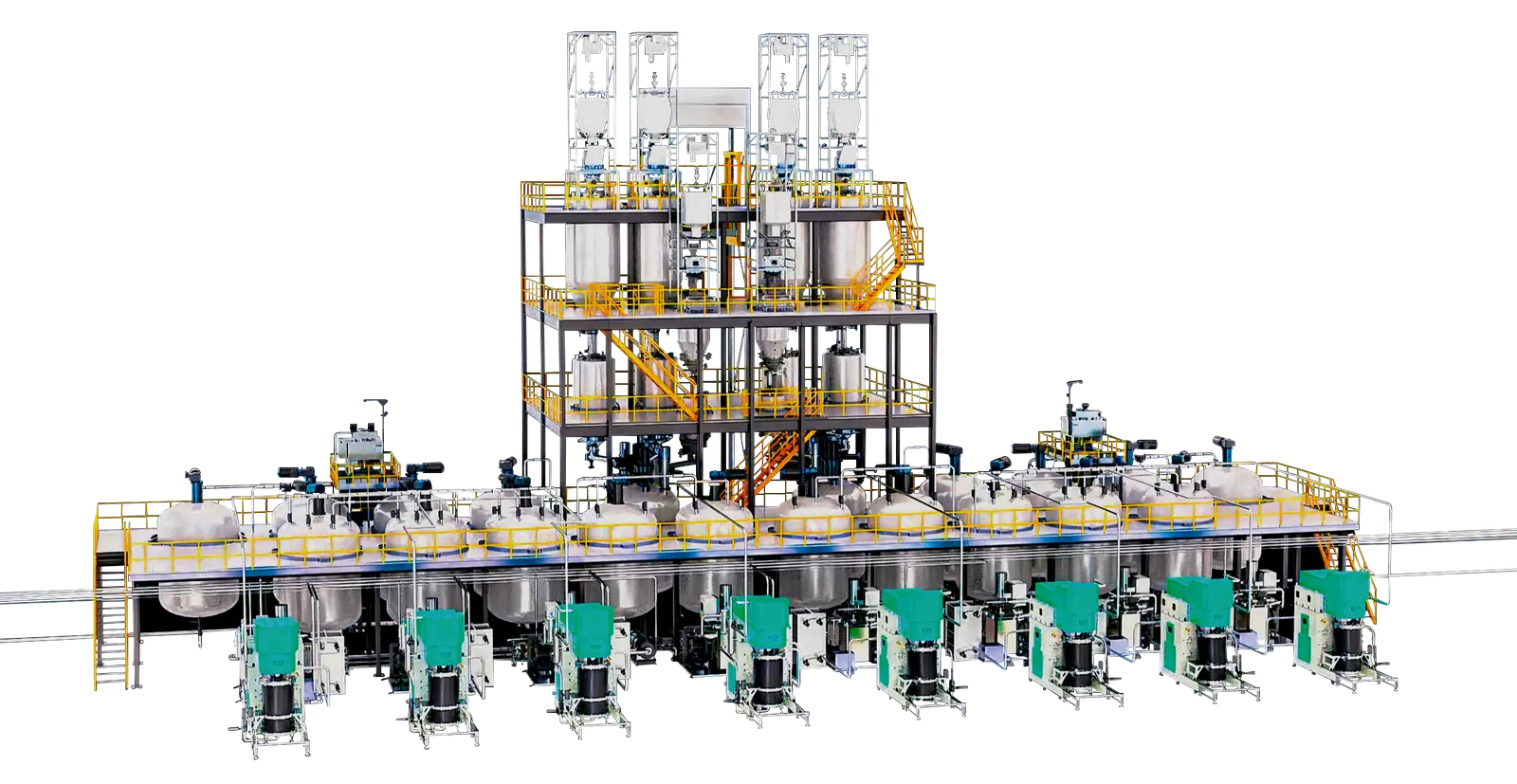
INFOR vertical bead mills have become a powerful tool for companies competing in the photoresist industry.
As semiconductors and display panels advance, requirements for photoresist performance and quality keep rising, which will drive continued innovation and upgrades in vertical bead mills.
INFOR vertical bead mills play an irreplaceable role in the photoresist industry, providing reliable performance and quality for production. As technology advances, vertical bead mills and the photoresist industry will continue to progress together. If you are interested in photoresist production or vertical bead mills, we would be glad to discuss it with you.