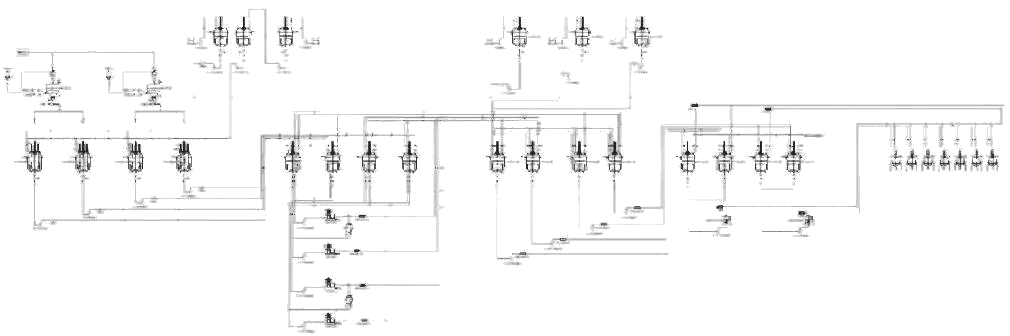
Bead mills disperse and grind the ceramic powders used in MLCCs and other electronic ceramics, such as barium titanate, to sub-micron sizes with a narrow distribution, because thin dielectric layers cannot tolerate coarse particles or agglomerates. Contamination control is just as important: worn metal or bead material changes the electrical properties. INFOR supplies ceramic-lined horizontal mills, screen-free vertical mills and complete ceramic material lines.
What the process needs
| Requirement | Why it matters | How the bead mill meets it |
|---|---|---|
| Sub-micron, narrow distribution | Thin dielectric layers need fine, uniform particles | Small beads, circulation mode, centrifugal classification |
| No agglomerates | Agglomerates cause defects in thin layers | Good premix and enough dispersion energy |
| Very low contamination | Impurities change dielectric properties | Zirconia beads, ceramic chambers and rotors |
| Gentle grinding where needed | Over-grinding can damage crystal structure | Controlled energy and temperature |
| Scale-up from lab | Formulations are developed in small batches | Lab mills of the same design |
MLCC slurry
MLCC dielectric slurry combines ceramic powder, solvent, binder and dispersant. The bead mill breaks agglomerates and adjusts particle size so the slurry can be cast into very thin, defect-free sheets.
Other electronic ceramics
Piezoelectric ceramics, ceramic substrates, electrode pastes and ceramic separator coatings have similar needs: fine, uniform particles and minimal contamination.
Contamination control
Ceramic-lined chambers and rotors, yttrium-stabilised zirconia beads and controlled bead wear keep impurities down. See zirconia beads vs glass beads.
Recommended INFOR equipment
| Stage or need | INFOR equipment | Why |
|---|---|---|
| Lab development | Experimental vertical mill and experimental horizontal mill | All-ceramic grinding zone; small batches |
| Ultra-fine production | LPM vertical bead mill | 30-1000 nm, 0.05 mm micro-beads, screen-free |
| High-energy nano grinding | NCT turbine bead mill | Ceramic-lined chamber, narrow distribution |
| Complete plant | Ceramic material production line | Dosing, dispersion, grinding and storage |
Related: vertical bead mills for ceramic materials, bead mills for separator ceramic coating slurries and vertical bead mills for photoresist production. INFOR runs free material tests at its Dongguan and Hubei test bases; send your material, target fineness and output through the contact page.