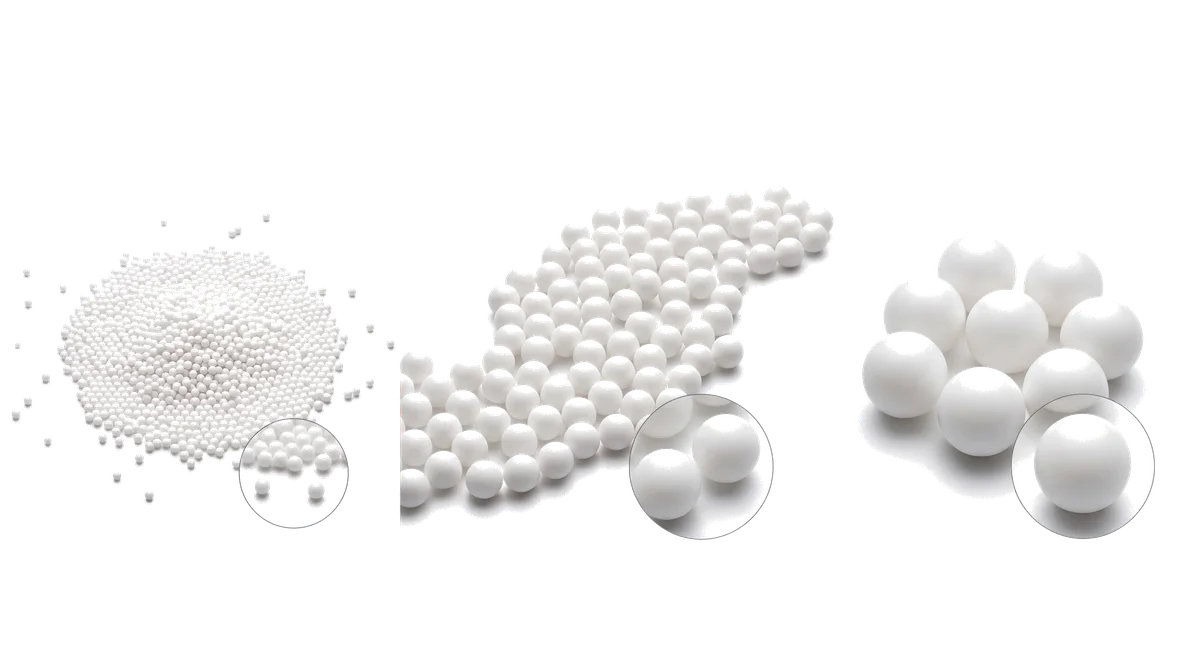
Zirconia beads are the standard grinding media for fine and nano grinding: at about 6 g/cm³ they are more than twice as dense as glass beads (about 2.5 g/cm³), so each impact carries more energy, and they wear far more slowly, which keeps contamination low. Glass beads are cheaper and can suit coarse grinding of low-viscosity products where traces of glass are acceptable.
Grinding media compared
| Property | Yttrium-stabilised zirconia | Zirconium silicate | Glass |
|---|---|---|---|
| Density | about 6.0 g/cm³ (INFOR: 6.03) | about 4 g/cm³ | about 2.5 g/cm³ |
| Impact energy | High | Medium | Low |
| Wear rate | Low | Medium | High |
| Contamination risk | Lowest | Medium | Glass and alkali residue |
| Typical use | Nano grinding, battery materials, electronic ceramics, high viscosity | General paints, inks, coatings | Coarse, low-viscosity grinding |
Why density matters
At the same size and speed, a denser bead hits harder, so it breaks particles faster and copes better with viscous slurries, which slow light beads down. That is why zirconia beads reach finer sizes in less time and why glass beads struggle in thick pastes.
Wear and contamination
Every bead wears, and the worn material ends up in the product. Zirconia beads lose little mass, so contamination and bead consumption stay low. For battery materials, electronic ceramics and pharmaceuticals, low wear and a ceramic-lined chamber are usually requirements. See preventing metal contamination in LFP cathode plants.
INFOR zirconia grinding beads
INFOR's grinding media are yttrium-stabilised zirconia beads (ZrO₂ + Y₂O₃ ≥95% / ≥5%) with a true density of 6.03 g/cm³, bulk density of 3.75 kg/L and Mohs hardness 9, in sizes from 0.1 to 2.2 mm, 25 kg per drum. The bulk density is the figure to use when you calculate the bead charge.
How to choose bead size
- Coarse feed or a micron target: larger beads break particles faster.
- Sub-micron and nano targets: smaller beads give many more contact points.
- Two-stage grinding: coarse beads first, then small beads for the final size.
- The separator must hold the beads back: micro-beads of about 0.1 mm and below are usually run in screen-free mills.
INFOR's mills cover the range: NCP runs 0.2-2.0 mm beads, LPM 0.05-2.0 mm, and the dual-power mills 0.03-0.1 mm micro-media. See bead mill separation systems. INFOR runs free material tests at its Dongguan and Hubei test bases; send your material, target fineness and output through the contact page.