Hello everyone, I'm Yan Tao, Carlos in English. I'm responsible for the African market at Guangdong INFOR Intelligent Equipment Co., Ltd.
Before going abroad, I studied for a master's degree in digital media at Goldsmiths, University of London, and got used to understanding things through the lens of content, users and communication. But this time, walking from the exhibition halls in Dubai to a construction site in Sohar, Oman, I suddenly realized that overseas markets can't be explained with slide decks. You only truly begin to understand them after you've stepped in yourself, stood in the dust and shaken the customer's hand.
What I want to be is the person standing between INFOR's equipment and our overseas customers: someone who understands our machines and processes on one side, and on the other understands why a customer's country is building plants, why they chose a particular production line, and where they are getting stuck.
This Middle East trip was the first time since I started in foreign trade that “Chinese manufacturing going global” turned from a slogan into concrete scenes.
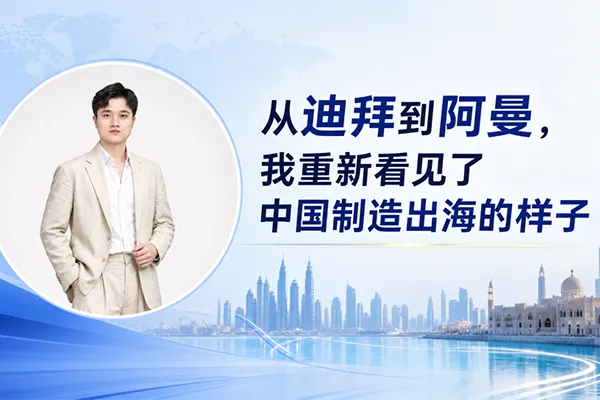
A trip “heavier” than I expected
From September 27 to October 3, my colleague and I traveled from Dubai to Oman. It was only seven days, but they were packed.
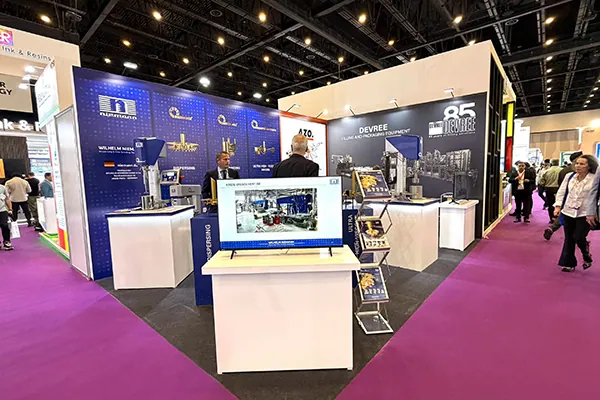
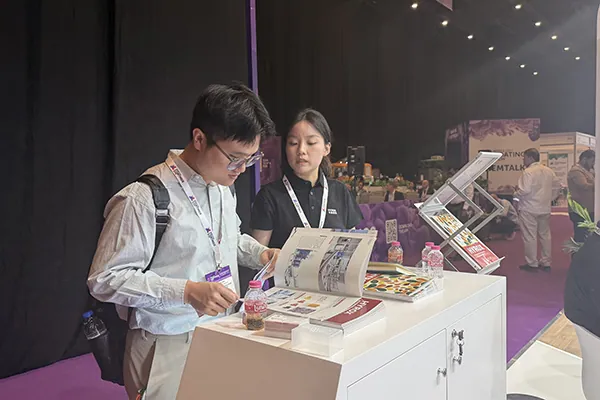
The first three days were in Dubai at the Middle East Coatings Show. It wasn't a quick walk around the halls; we staffed the booth, studied our competitors and talked with customers in earnest.

Two things struck me most on site:
First, Chinese companies really have arrived, and in large numbers.
More than half of the exhibitors were from China. In our own segment, grinding and dispersion equipment, there were somewhere between a dozen and twenty peers from China and abroad. Some brought complete machines, some built custom stands, and some had people stationed at standard booths to talk to visitors. Standing in the aisles, you could clearly feel that the competitive pace of the domestic Chinese market has followed us to the Middle East.
Second, overseas customers no longer need to be “educated” about Chinese manufacturing.
Some visitors came straight to Chinese booths to ask about processes. Others opened with “Do you have reference projects in Africa?” or “Can you support a complete line?” At that moment I felt a little proud. In the past we had to explain what Chinese manufacturing was; now customers already know the Chinese supply chain can deliver.
But take one step back from that pride, and what you find is pressure.
Because everyone is strong, customers don't just ask “What's your price?” They ask: “Do you understand my material? Do you understand my target particle size? Do you understand how the rest of my line should be configured?”
The last three days, in Oman, actually moved me more than the show.
We went to the Sohar Free Zone to visit the overseas project of a leading Chinese new energy materials company. The office building has already been topped out, two plant buildings are going up, and the carbonization area and finished-product area are laid out separately. Phase I is 100,000 tonnes and is expected to start production in July 2027, with a further 200,000 tonnes planned for Phase II. The kilns, steel structures and auxiliary equipment are, for the most part, all coming from China.
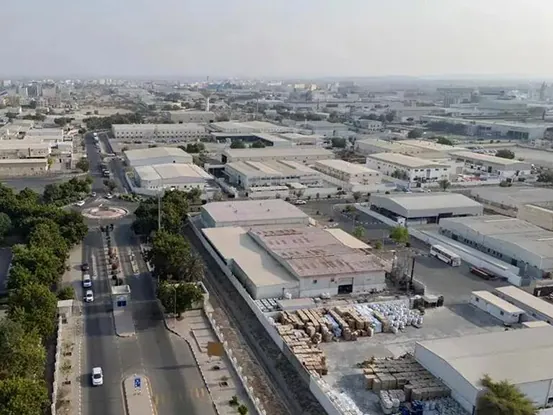
I stood in a workshop with no equipment installed yet. The wind was strong, and the smell of dust mixed with welding fumes.
It was a strange feeling. Not “Wow, what a huge project,” but a sudden realization:
This is no longer about a single bead mill crossing the ocean.
This is an entire segment of Chinese industrial capability being moved to another country that is in the middle of its own transformation.
Chinese manufacturing going global, as I see it: not “cheaper,” but “able to deliver on the ground”
My most direct takeaway from this trip is that overseas customers have long known about “Made in China.”
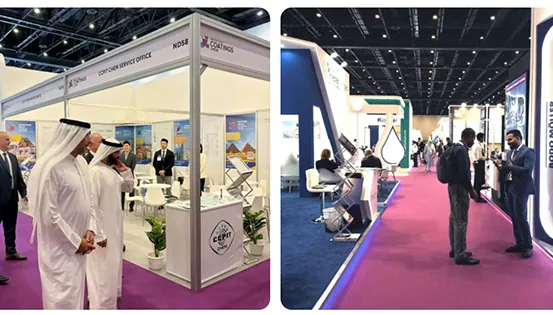
At the show, some customers didn't ask “How much is this machine?” Instead they asked “Do you understand my process?”, “Have you achieved this target particle size before?” and “If something breaks later, who takes care of it?”
That's when I understood that low prices alone no longer hold up.
The real advantages of Chinese manufacturing that I saw come from five things working together:
First, a complete industrial chain. From grinding media and mechanical seals to motor controls and vessel welding, everything can be sourced together in China, so customers don't have to piece together parts from all over the world.
Second, strong engineering capability. In a market like Oman, where the industrial base is still thin, customers don't want just a bead mill; they want someone to help them get the whole line running.
Third, fast response. What overseas projects fear most is waiting. When a parameter changes, engineers in China can turn around new drawings overnight, often with a tighter response time than overseas suppliers.
Fourth, strong iteration. Particle size, solids content and viscosity requirements for new energy materials change every year, and equipment makers that don't iterate get dropped by their customers.
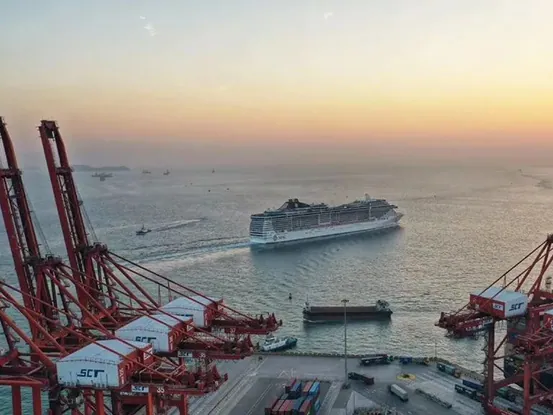
Fifth, a willingness to go from 0 to 1 with the customer. In the early days of building a plant overseas, nobody dares to guarantee profits. But Chinese companies are willing to get involved early, run process trials and station engineers on site.
So I believe the real competitiveness of Chinese manufacturing abroad isn't “I'm cheaper than you,” but this:
We can roll products, equipment, engineering, process know-how and after-sales service into one solution that actually works on the ground.
Price only gets you in the door; the ability to deliver is what keeps the customer.
Back to myself: moving beyond the quotation and into the process
In my trip report I wrote a lot about customer lists and competitor observations, but what I most want to remember are a few personal lessons.
First, don't just memorize equipment specs; learn the customer's process.
From now on, when I meet a customer, I don't want to open with “Our bead mill has a chamber volume of so many liters.”
I want to ask first: What material are you making? Whose equipment are you using now? Where is the bottleneck? Is your particle size stable? Does it drift when you change material batches?
Equipment is only the vehicle; the customer's problem is the way in.
Second, don't treat overseas markets as an extension of the domestic market.
Dubai isn't simply a booth moved abroad, and Oman isn't just a Chinese factory built somewhere else.
Religion, decision chains, distributor practices, acceptance criteria and after-sales expectations are all different.
The hardest part of going from 0 to 1 isn't the quotation. It's the first bit of trust, the first project and the first on-site emergency.
Third, I don't want to be just “Carlos the salesperson”; I want to be “Carlos the interface.”
On one side are INFOR's nano bead mills, dispersion systems and complete-line capabilities;
on the other are the plants actually being built by customers in Africa, the Middle East and North Africa.
What's missing in between isn't product; it's a translator,
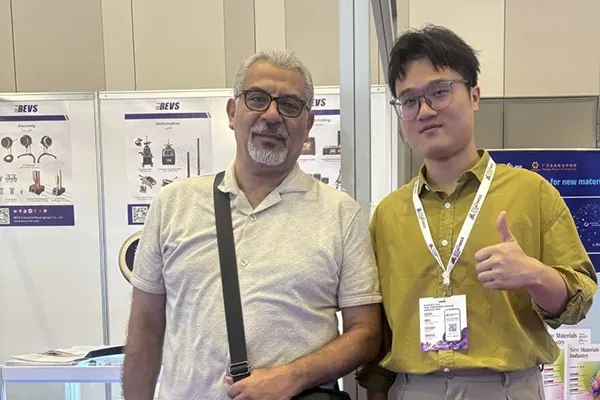
someone who translates industry language into equipment language, and equipment language into reasons the customer can sign off on.
So for my next stage, I've given myself three lines:
Understand the country, understand the industry, understand the process.
Stop just reciting specs, and translate the customer's problem into an INFOR solution.
Stop just waiting for inquiries, and stand beside customers at the early stage of new projects.
I want to work hard to become INFOR's bridge to overseas factories,
with China's equipment, technology and supply chain on one side, and on the other the emerging factories and real demand in the Middle East and Africa, in Oman, Saudi Arabia and Egypt.
Closing: starting with one machine, starting with one market
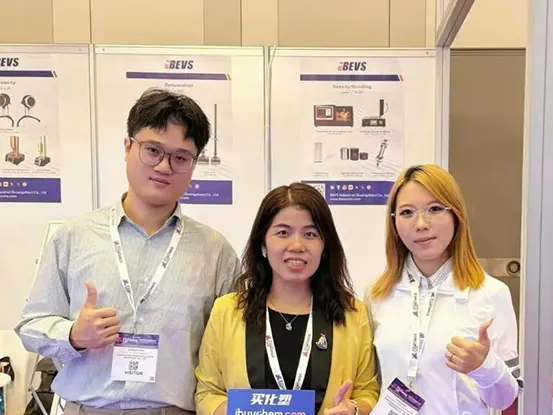
From the bustling crowds in the Dubai exhibition halls to the sound of welding at the Sohar site, this journey confirmed one thing for me:
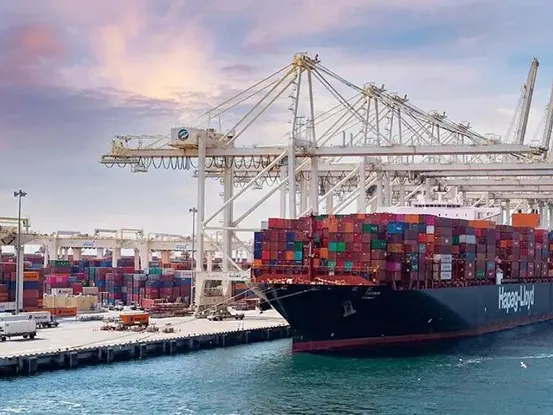
Chinese manufacturing is moving from exporting products to exporting industrial capability.
It happened with automobiles, it happened with anode materials, and it's happening with bead mills too.
For INFOR, this is both an opportunity and a tough battle.
For the customer, what they need isn't a machine, but someone who can help them get their plant up and running.
For me personally, this journey abroad has only just begun.
Next, I'll follow up one by one with the 20-plus potential customers we connected with at the show, compile a list of new projects in the Middle East, North Africa and Africa, and keep building more long-term relationships.
Starting with one machine, one customer and one market.
Slowly coming to understand an industry, and slowly finding where I should stand in this wave of globalization.
I'm Yan Tao, Carlos.
At INFOR, I work on the African market, and following the wind from the Middle East, I'm heading further in.