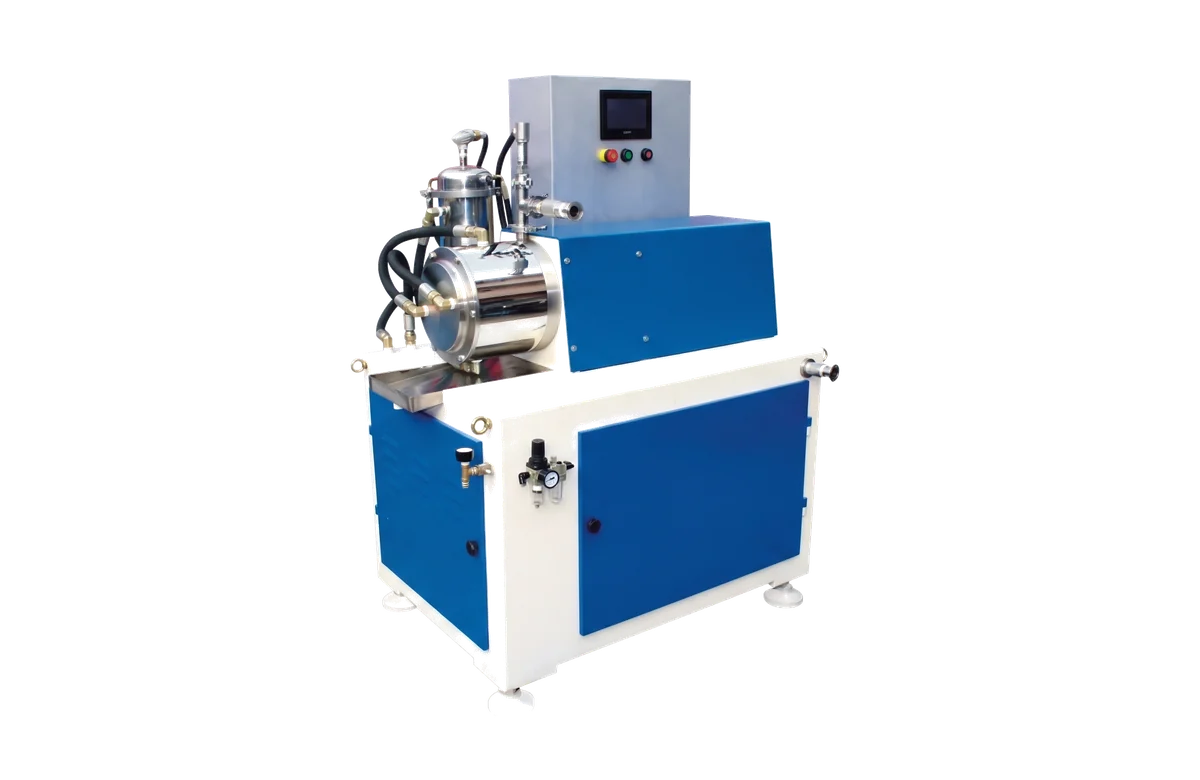
A bead mill screen clogs when beads or particles block its slots faster than flow can clear them. The usual causes are worn or broken beads smaller than the slot, viscosity rising as the product gets finer, flow set too high, oversize lumps in the feed, and heat that thickens or dries the slurry at the screen. Most clogging is prevented by matching slot width to bead size, controlling viscosity and temperature, and replacing worn beads; a screen-free separator removes the problem.
Causes of screen clogging and what to do
| Cause | Sign | Fix |
|---|---|---|
| Worn or broken beads below slot width | Bead fragments in the screen, pressure rises over weeks | Sieve or replace beads; use harder zirconia beads |
| Slot too wide or too narrow for the beads | Beads pass into product, or flow is poor from the start | Match slot to the smallest bead |
| Viscosity rises during grinding | Pressure rises late in the batch | Adjust solids and dispersant; add cooling |
| Flow set too high | Beads packed against the screen | Lower flow or increase open area |
| Oversize lumps in the feed | Sudden blockage after feeding | Improve pre-dispersion; screen the premix |
| Heat at the outlet | Skin or dried product on the screen | More chamber cooling; never let slurry dry in the mill |
Prevention
- Choose a slot width clearly smaller than the smallest bead, and check beads regularly for wear and fragments.
- Use dense, wear-resistant beads; yttrium-stabilised zirconia beads wear slowly and break less.
- Keep the premix free of lumps with proper dispersion before the mill.
- Watch inlet pressure and temperature: a steady rise is an early warning.
- Flush the mill with solvent or carrier before stopping, so slurry does not settle or dry at the screen.
Two ways to clean a clogged screen
Back-flushing in place: stop feeding, then flush clean solvent or carrier through the outlet in reverse at low pressure to lift particles out of the slots. It is quick but does not remove wedged bead fragments.
Removing and cleaning the screen: take the screen out, soak it in a suitable solvent, clean it with a soft brush or an ultrasonic bath, and check the slots for wear before refitting. Do not use tools that widen the slots. More service steps are in the bead mill maintenance checklist and bead mill troubleshooting guide.
Remove the screen altogether
Screen-free centrifugal separation keeps beads back with a rotating separator wheel, so there is no screen to clog. INFOR's LPM vertical bead mills use it with 0.05-0.3 mm beads, and the dual-power mills with 0.03-0.1 mm micro-media. See bead mill separation systems compared. INFOR runs free material tests at its Dongguan and Hubei test bases; send your material, target fineness and output through the contact page.