1. Overview
Olivine-type lithium manganese iron phosphate (LMFP) offers high energy density, low cost, safety and stability, and has attracted wide attention for lithium-ion batteries. However, the material suffers from low electronic conductivity and manganese dissolution. This article outlines the status of lithium-ion batteries, introduces the structure and performance of LMFP, reviews its applications and preparation methods, and analyses its uses across the industry chain.
With an energy density of about 127 Wh/kg at cell level and its theoretical specific capacity nearly reached, LFP is close to its limit, so the voltage plateau becomes the key to raising energy density further. LMFP and LFP have similar structures and comparable performance, but thanks to the higher voltage of manganese, LMFP has a higher voltage plateau and higher battery energy density than LFP.
2. Structure of LMFP
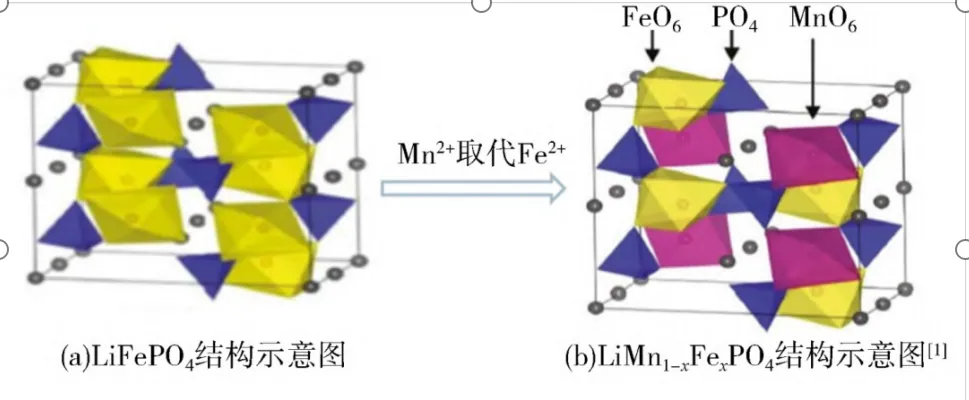
Because Fe2+ and Mn2+ have similar ionic radii and similar physical and chemical properties, substituting Fe for Mn produces a stable, homogeneous solid solution of LiMnPO4 and LiFePO4, LiMn1-xFexPO4. LMFP and LFP both have the olivine structure: P atoms form PO4 tetrahedra through strong P-O covalent bonds, and these tetrahedra are cross-linked with FeO6 (MnO6) octahedra, limiting changes in lattice volume and ensuring safety and stability. Figure 1(a) shows the structure of LiFePO4 and Figure 1(b) that of LiMn1-xFexPO4.
3. Advantages and drawbacks of LMFP
Compared with LFP batteries, LMFP batteries offer:
(1) Higher energy density: LMFP and LFP have similar theoretical capacity, but LMFP's higher voltage plateau gives about 10-20% more energy density;
(2) Better low-temperature performance: studies show that at −20 °C about 50% of the Fe plateau capacity and about 95% of the Mn plateau capacity can be delivered;
(3) Essentially equivalent safety.
Drawbacks:
(1) Lower conductivity: LFP is a semiconductor, and adding manganese widens the band gap, giving LMFP lower electronic conductivity and lithium-ion mobility;
(2) Slightly poorer cycling at room temperature and marked fade at high temperature due to manganese dissolution: because of the Jahn-Teller effect, manganese ions may dissolve during charge and discharge and react with the electrolyte, causing capacity loss.
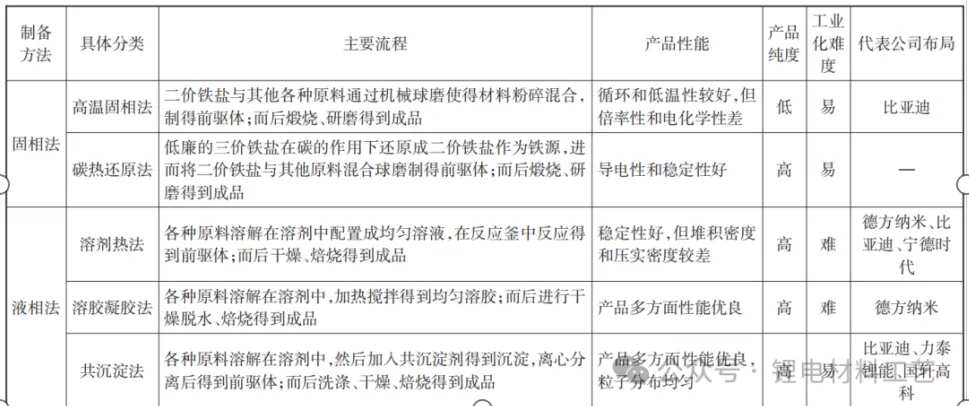
4. Preparation of LMFP. LMFP can be prepared by liquid-phase or solid-phase methods.
Liquid-phase methods include hydrothermal and sol-gel processes. They make it easier to control composition and give good product consistency, but the products have lower compaction density and higher investment per unit of capacity; such lines are similar to LFP lines and can be converted. Solid-phase methods include high-temperature solid-state and carbothermal reduction processes, which are easy to scale up industrially, with low investment per unit and high compaction density, but product consistency and element distribution are harder to control. The solid-phase method shares the back-end sintering equipment of LFP production, while the front end needs an additional iron-manganese mixing step, and consistency depends on process know-how.