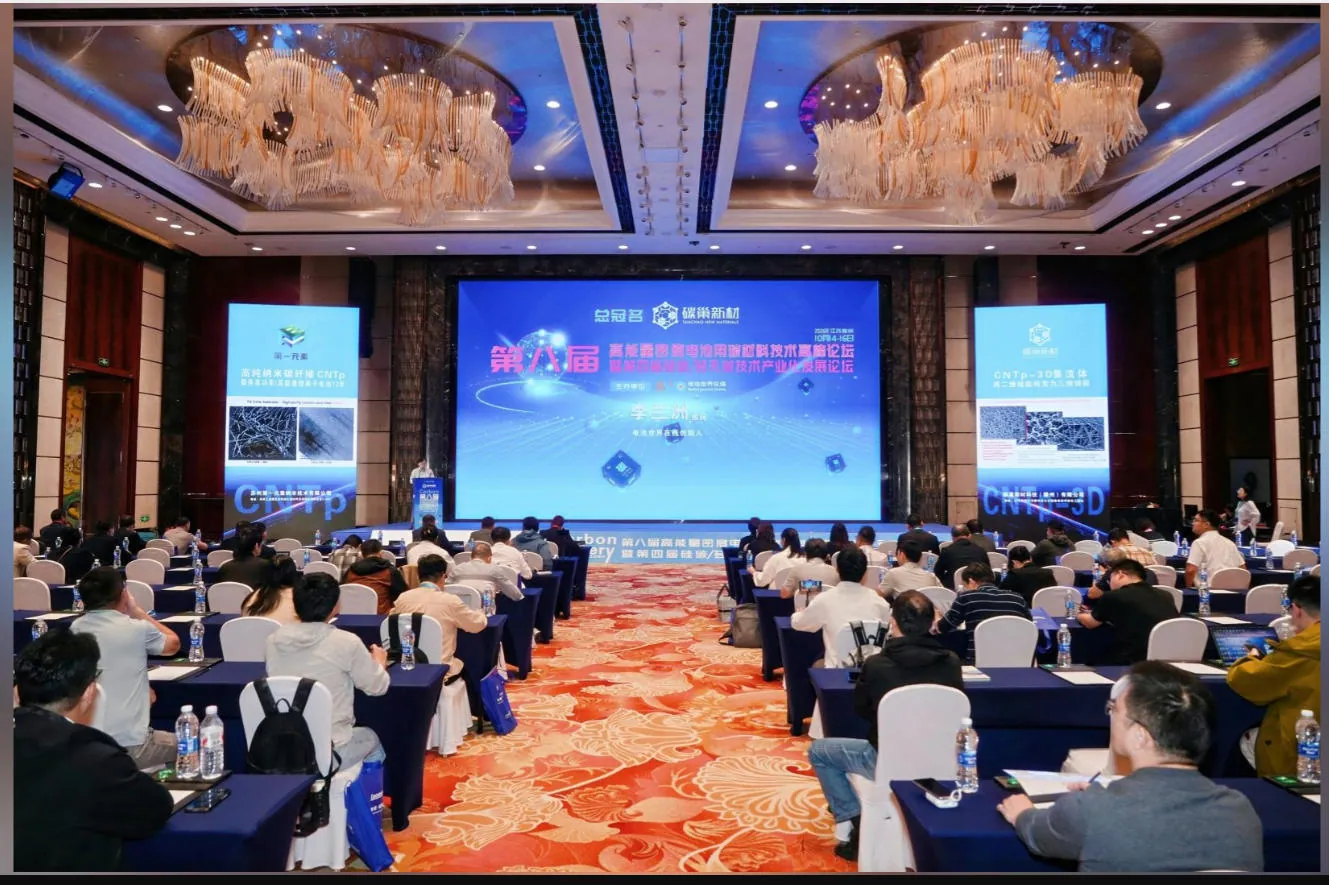
From 14 to 16 October, the 8th Summit on Carbon Materials Technology for High-Energy-Density Batteries and the 4th Silicon-Carbon/Porous Carbon Industrialization Forum were held at the InterContinental Changzhou.
Over the three-day agenda, silicon-carbon anodes, CVD silicon-carbon, sodium-ion hard carbon, porous carbon, single-walled carbon nanotubes and graphene conductive pastes took center stage. These are materials widely known to "dazzle in the lab and fail at scale."
The industry's message was more direct than ever: carbon materials have moved from battery "auxiliary materials" to key variables that determine energy density, fast charging and cycle life.
But to turn those variables into production capacity, materials first have to pass front-end dispersion and grinding. A slightly wider particle size distribution comes back many times over in electrode calendering and cycling performance.
That is exactly the problem INFOR came to Changzhou to solve.
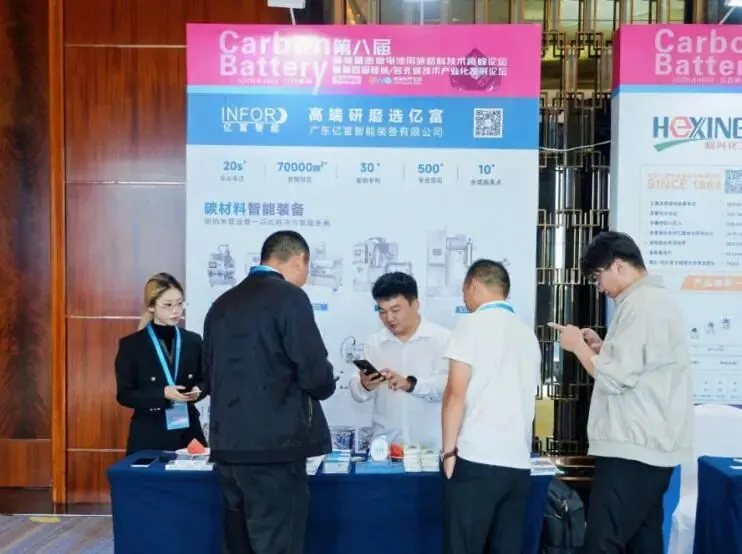
Real questions at the booth: carbon materials are not cathodes, and dispersion is harder than grinding
The word heard most at this year's forum was "uniformity." The question isn't how fine, but whether the material disperses fully and stays stable.
The most frequent questions we heard at booth A20 fell into four categories:
① Silicon-carbon anodes: nano-silicon agglomerates, and poor dispersion means failure at scale
Nano-silicon powder has a high specific surface area and agglomerates easily. If pre-dispersion is poor, what goes into the bead mill comes out "half-cooked": the surface is ground open but hard agglomerates remain at the core. Customers ask whether it can be ground below 100 nm, but what really matters is whether the primary dispersion rate is high enough and the zeta potential stable.
② Porous carbon precursors: high viscosity + high solids, where the separation structure makes or breaks the process
Phenolic resin-based and pitch-based porous carbon precursors often reach viscosities of several thousand to tens of thousands of cps. Under these conditions, conventional screen separation is a "time bomb": one clog and the entire batch of slurry is scrapped. Customers don't just want a mill that runs; they want one that doesn't clog or leak beads at high viscosity and runs continuously.
③ Biomass-based hard carbon: impurity control starts with the grinding media
Hard carbon is used in sodium-ion batteries, which have very low tolerance for metallic impurities. Biomass precursors already contain mixed impurities, and if the grinding media adds iron or chromium leaching, the downstream demagnetization step cannot recover it. This must be controlled from the start through chamber materials and media selection.
④ CVD silicon-carbon: locking in particle size distribution in post-deposition processing
CVD silicon-carbon particles have a distinctive morphology. If shear rate and residence time are not well controlled during downstream dispersion and grinding, the result is either over-grinding and breakage or residual oversized particles, and both directly ruin electrochemical performance.
Our answer: the process window for carbon materials is much narrower than for cathodes, so a bead mill cannot be treated as just a "size-reduction tool" but must act as a "dispersion control system."
In carbon materials, INFOR delivers an equipment solution that scales without failure
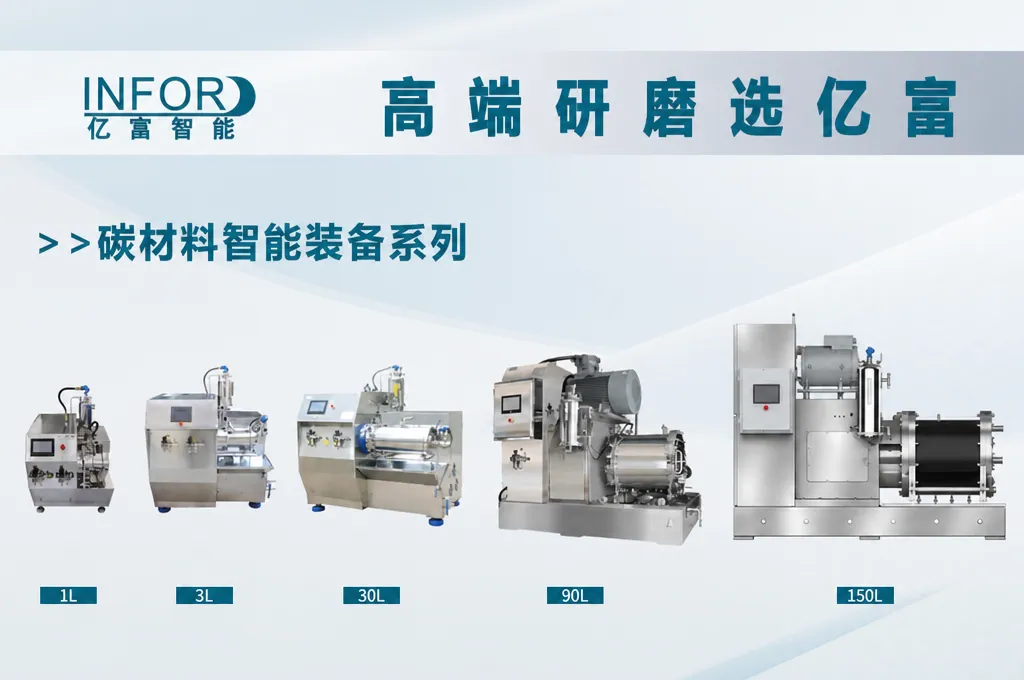
As silicon-carbon, porous carbon, hard carbon and conductive agents move from "lab-scale data" to "yield at a scale of tens of thousands of tonnes," INFOR showcased five capability lines at its booth:
🔹 Ultra-fine grinding solutions for silicon-carbon and porous carbon powders
The LPM series covers the full range from 1L to 2000L, so laboratory results can be transferred directly to production lines.
🔹 Dispersion systems for single-walled and multi-walled carbon nanotube pastes
Solves the persistent problem of high-aspect-ratio fibrous fillers that "agglomerate more the longer they are ground," preventing a conductive network from forming.
🔹 Wet process for graphene composite conductive pastes
Controls metallic contamination, the degree of layer exfoliation and batch-to-batch D50 drift.
🔹 Integrated crushing, dispersion and homogenization for hard carbon precursors
Reduces dust and moisture uptake during transfer, supporting consistency control in mass production of sodium-ion hard carbon.
🔹 Shared grinding platform for solid-state electrolytes, conductive agents and anode materials
One production line logic handles multiple carbon-based materials, helping customers reduce equipment idle time.
The on-site logic in one sentence:
For carbon materials, "just grind it finer" is not enough: particle size, morphology, dispersion state, metallic contamination, temperature rise and energy consumption all have to be right, with no compromises.
As materials evolve faster, equipment must stay ahead
The Changzhou forum has ended, and one clear signal we observed:
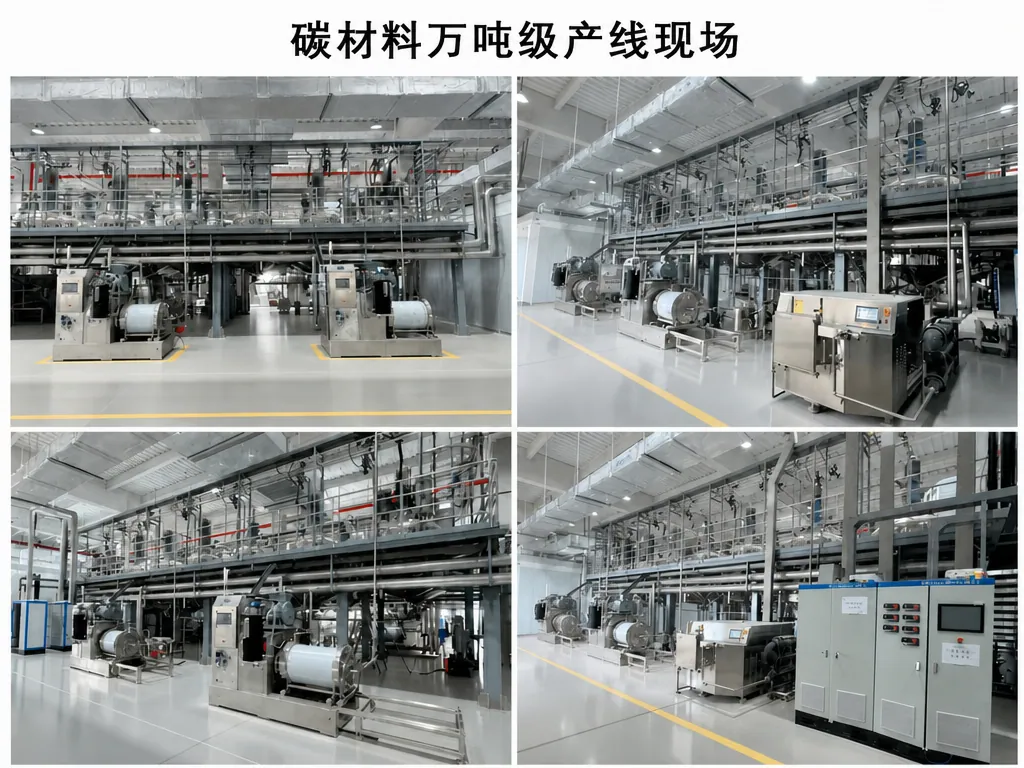
The carbon materials industry is redefining equipment suppliers as process partners. Front-end crushing, dispersion and grinding are no longer supporting operations but core process steps that determine specific surface area, dispersion uniformity, batch consistency and manufacturing cost per tonne.
As material technology evolves ever faster, INFOR continues to answer every upgrade with robust equipment.
Our Changzhou trip is complete. Next stop: Shaoxing, where we invite you to join our next round of process validation!