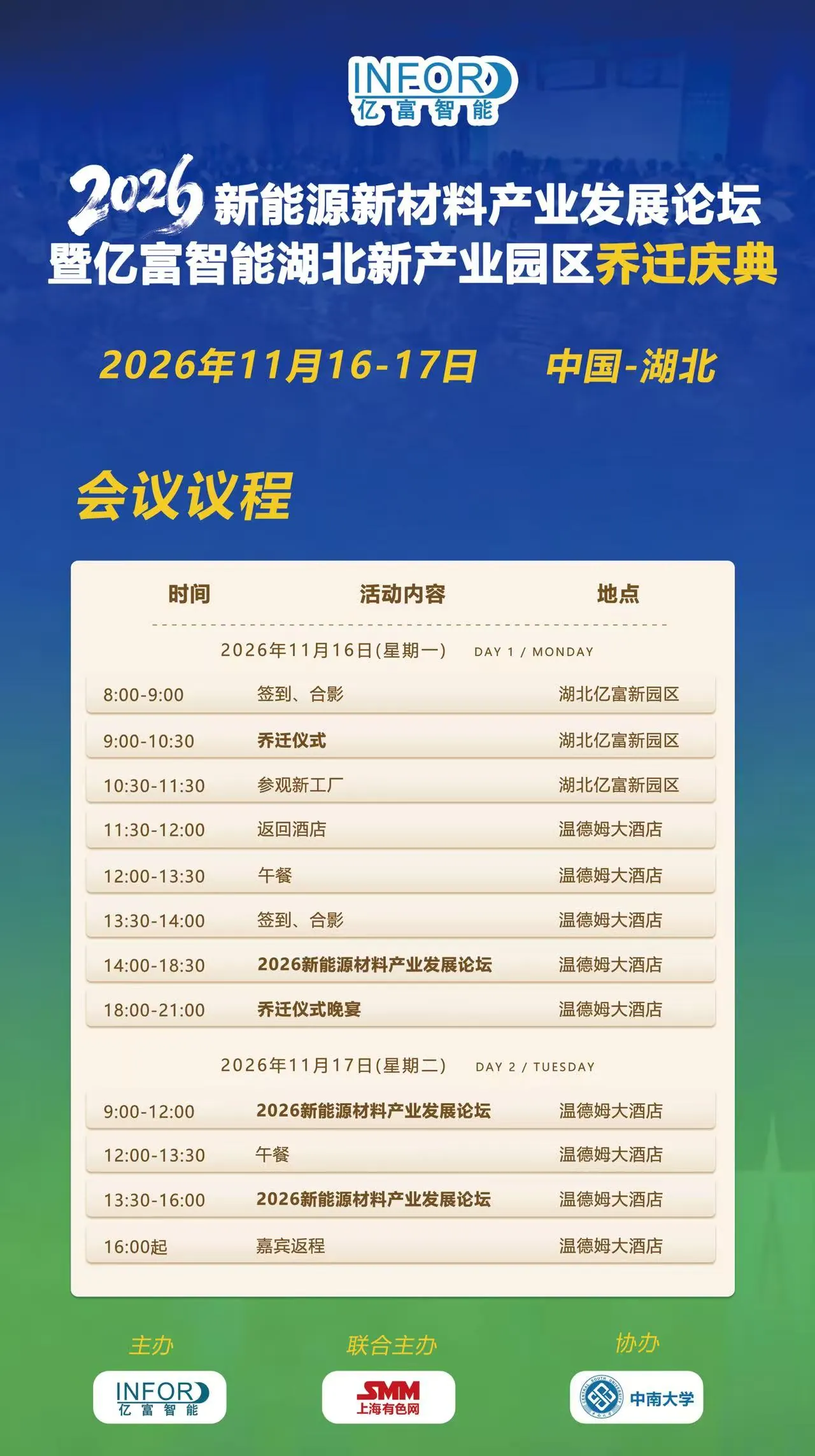
16-17 November 2026, Gucheng, Xiangyang, Hubei.
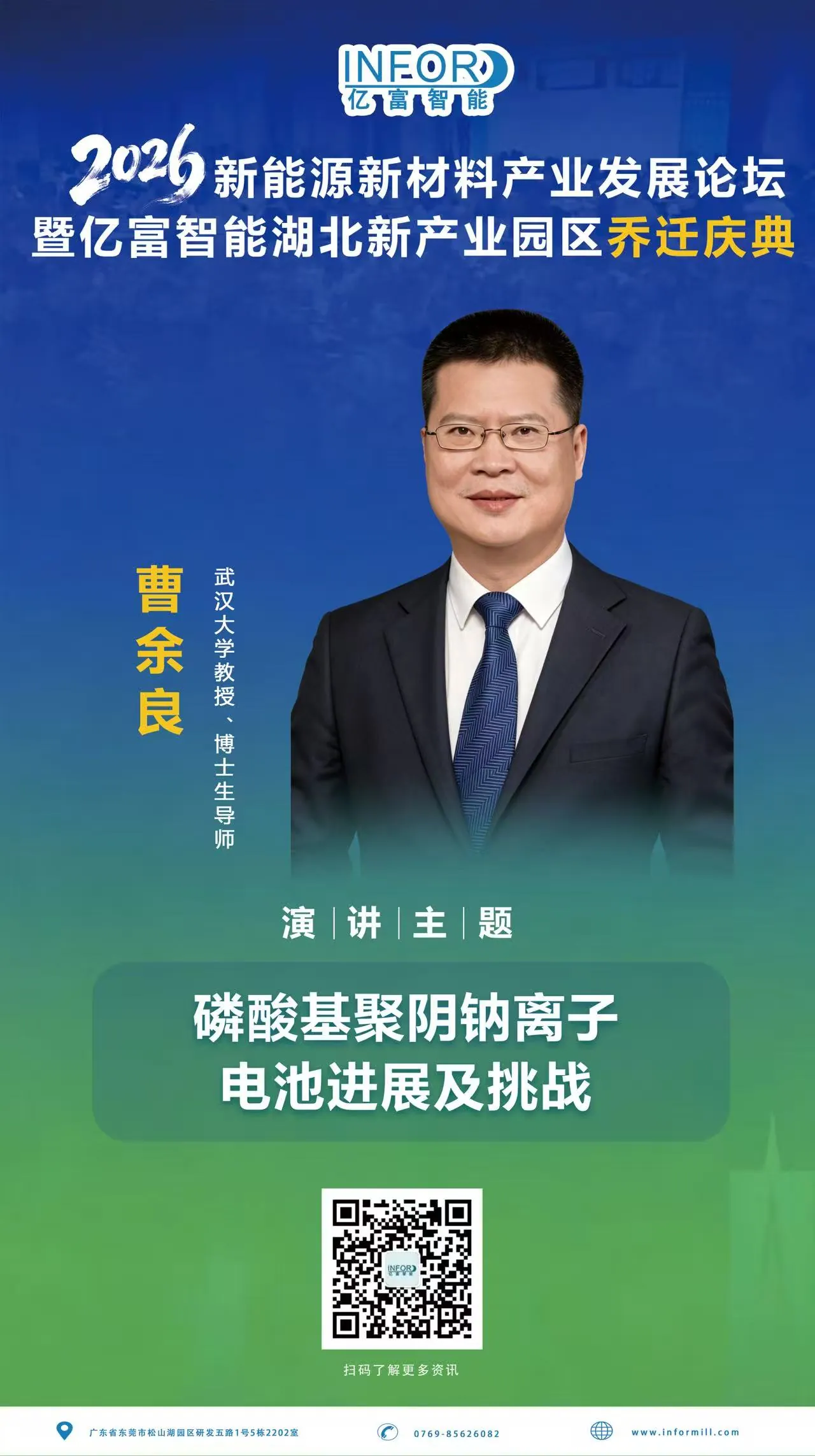
At the 2026 New Energy and New Materials Industry Development Forum and INFOR Hubei Industrial Park Opening Ceremony, a key figure who took the polyanion route for sodium-ion batteries from the laboratory to 10,000-tonne production lines has confirmed his attendance: Cao Yuliang, Grade II professor at the College of Chemistry and Molecular Sciences of Wuhan University, Changjiang Scholar Distinguished Professor of the Ministry of Education and chairman of Shenzhen Jiana Energy Technology, will give a talk on "Progress and Challenges of Phosphate-Based Polyanion Sodium-Ion Batteries".
A pioneer who wrote sodium-ion batteries into China's energy storage solutions
Cao Yuliang is a professor and doctoral supervisor at Wuhan University and a Changjiang Scholar Distinguished Professor. He received his PhD from Wuhan University in 2003, did postdoctoral research at Kyoto University in Japan and the University of California, Berkeley, and has taught at Wuhan University since 2006. He has long focused on key materials for sodium-ion batteries and electrochemical energy storage and was one of the first researchers in China to study sodium-ion batteries systematically.
He has published more than 300 SCI papers in leading journals including Nature Energy, J. Am. Chem. Soc., Angew. Chem. Int. Ed., Energy & Environmental Science and Advanced Materials, cited tens of thousands of times, and has been named a Clarivate Highly Cited Researcher for several consecutive years. He has led more than 20 national research projects, including National Key R&D Program topics and key projects of the National Natural Science Foundation of China.
In 2022 Prof. Cao founded Shenzhen Jiana Energy Technology to industrialize key sodium-ion battery materials. In just four years the company has built a thousand-tonne sodium-ion material line, and phase one of its 100,000-tonne-a-year sodium-ion cathode base in Zigong has started production, with products widely used in energy storage, two-wheelers and telecom backup power.
NFPP: the polyanion route most worth pursuing for sodium-ion batteries
Of the three main cathode routes for sodium-ion batteries, polyanion compounds (represented by NFPP) are considered best suited to large-scale energy storage thanks to high structural stability, long cycle life, good thermal safety and low raw material cost.
Prof. Cao's team has worked persistently on polyanion systems and solved several industrial pain points:
- Air stability: by tuning the ratio of PO₄³⁻ to SO₄²⁻ and optimizing Na/Fe site occupancy, the storage stability of the material in air is greatly improved;
- Cycle life: a stable three-dimensional framework enables retention over ten thousand cycles;
- Rate performance: carbon coating and particle size control significantly improve capacity retention at high rates;
- Batch consistency: a full process parameter window was established during scale-up from kilograms to tonnes, keeping product quality under control.
"It is like giving an energy storage system a long-lasting heart," Prof. Cao explains. The NFPP framework is like reinforced concrete: no matter how many times the battery is charged and discharged, it firmly secures the channels through which sodium ions move, ensuring a service life of more than ten years.
The results? Jiana Energy's in-house NFPP cathode material delivers an initial discharge capacity above 110 mAh/g, capacity retention above 90% after ten thousand cycles in coin cells, and above 85% after 3,000 cycles at 1C in pouch cells. Material cost is more than 20% lower than comparable products, and it has passed rigorous validation by several leading storage companies.
From laboratory to 10,000-tonne line: the speed of sodium-ion industrialization
Building on the deep expertise of Wuhan University's electrochemistry team, Prof. Cao has led Jiana Energy along a fast path from fundamental research to pilot validation to 10,000-tonne mass production:
- 2022: company founded, angel round completed and construction of a thousand-tonne pilot line started;
- 2023: first thousand-tonne NFPP line in production; samples sent to leading customers and validated;
- 2024: construction began on the 100,000-tonne-a-year sodium-ion cathode base in Zigong;
- 2025: phase one officially in production, making it one of the world's largest single plants for polyanion sodium-ion cathode materials;
- 2026: phase two expansion planning launched, targeting total capacity above 150,000 tonnes a year.
Behind this speed is the team's deep understanding of how material genetics, process windows and equipment adaptation interact. As he often says: "Sodium-ion batteries are not a bonsai in the laboratory but a forest that must grow on 10,000-tonne lines. Materials science must talk to equipment engineering to turn the intercalation curves in papers into batteries that run reliably on the grid."
November in Gucheng, Hubei, at INFOR's new industrial park.
As sodium-ion batteries move from technology reserve to large-scale commercial use, as NFPP evolves from laboratory star to mainstay of energy storage, and as materials scientists and intelligent equipment engineers meet at the same industrial site, Prof. Cao's nearly twenty years of dedication offer an answer that spans fundamental research to 10,000-tonne production.
2026 New Energy and New Materials Industry Development Forum and INFOR Hubei Industrial Park Opening Ceremony
Date: 16-17 November 2026 | Venue: Gucheng, Xiangyang, Hubei, China
Speaker: Prof. Cao Yuliang
Topic: Progress and Challenges of Phosphate-Based Polyanion Sodium-Ion Batteries
Host: INFOR
Co-host: Shanghai Metals Market (SMM)
Co-organizer: Central South University
Supported by: Gucheng County People's Government