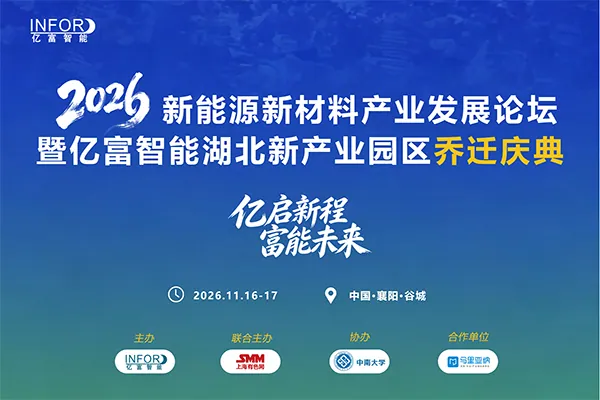
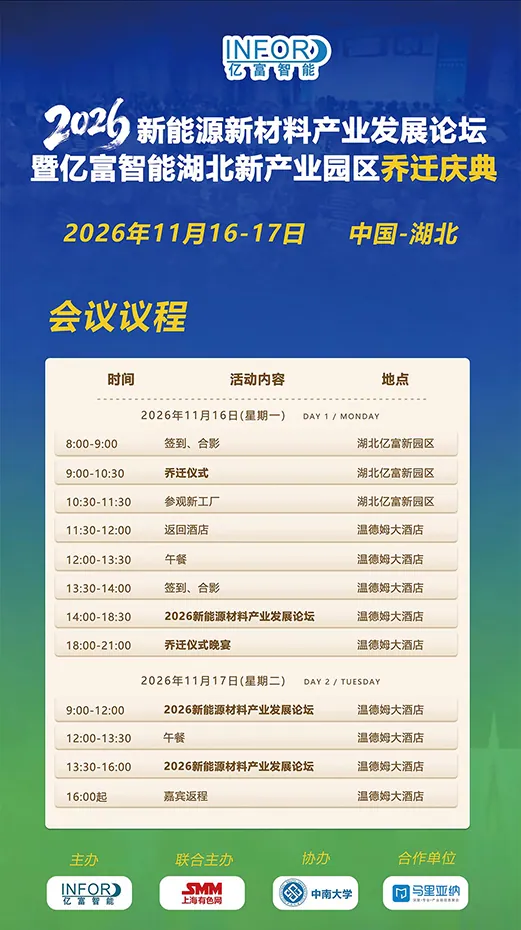
16-17 November 2026, Gucheng, Xiangyang, Hubei Province.
As the new energy industry moves beyond a single battery pathway toward multi-energy coupling of electricity, hydrogen, heat and storage, and as sodium-ion batteries, methanol-reforming hydrogen production and fuel cells start to be evaluated within one integrated energy system, an industry summit bringing together materials scientists, cell engineers and intelligent equipment manufacturers is moving from the forum agenda to the industrial site itself.
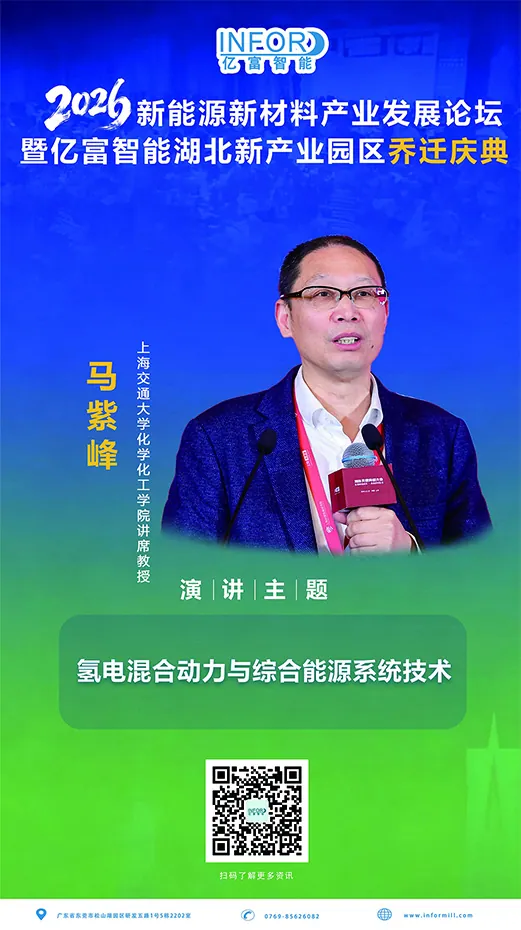
The 2026 New Energy and New Materials Industry Development Forum and INFOR Hubei Industrial Park Opening Ceremony has confirmed a speaker whose work spans lithium and sodium batteries, hydrogen energy and integrated energy systems, linking academia, research and industry: Prof. Ma Zifeng, Chair Professor at the School of Chemistry and Chemical Engineering, Shanghai Jiao Tong University, President of the Shaoxing Research Institute of Renewable Energy and Molecular Engineering, and founder of Zhejiang Natrium Energy. He will deliver a keynote titled Hydrogen-Electric Hybrid Power and Integrated Energy System Technology.
A systems-minded scholar who brings new energy chemical engineering into battery and hydrogen production lines
Prof. Ma Zifeng is a Chair Professor and doctoral supervisor at the School of Chemistry and Chemical Engineering, Shanghai Jiao Tong University. He serves as President of the SJTU Shaoxing Research Institute of Renewable Energy and Molecular Engineering, and is the founding director of the Shanghai Electrochemical Energy Devices Engineering Technology Research Center and of the Zhejiang Sodium-Ion Battery Technology Engineering Research Center. He has been chief scientist of China's National 973 Program, is a Fellow of the Chemical Industry and Engineering Society of China, and receives the State Council Special Government Allowance.
His research focuses on key materials and devices for lithium-ion and sodium-ion batteries, multifunctional electrolytes and interface engineering, methanol-reforming hydrogen production and fuel cell systems, and the optimized design of advanced electrochemical energy storage and green integrated energy systems. He has twice served as chief scientist of National 973 Program projects and has led numerous national programs, including key projects of the National 863 Program and the National Natural Science Foundation of China. He has published more than 300 papers in journals such as JACS, Energy & Environmental Science and Advanced Energy Materials, filed over 160 invention patents with more than 80 granted, and brought many results into industrial production.
His research follows a clear industrial thread: materials should not stay on paper. He invented an atom-economical synthesis route for LFP that broke through international patent barriers and underpinned the construction of China's 10,000-tonne nano-LFP production lines. He was an early mover in sodium-ion batteries, founding Zhejiang Natrium Energy and building 10,000-tonne production lines for sodium-ion cathode materials and electrolytes. He also took a different route by developing methanol-reforming hydrogen production with high-temperature proton exchange membrane fuel cells, turning hydrogen production, power generation and energy storage into a system solution in which sodium-ion batteries and hydrogen fuel cells work together within one integrated energy system.
From LFP and sodium-ion batteries to hydrogen-electric hybrid power
In the new energy materials community, Prof. Ma is known for being willing to turn laboratory reactions into process packages, and to integrate multiple technology routes into a single system:
• LFP engineering: He proposed new synthesis reactions and processes that address nano-sizing, low-temperature performance and high-rate capability. The work received the Second Prize of the 2018 National Science and Technology Progress Award, and the products entered the supply chains of BYD, CATL and others;
• Sodium-ion materials and electrolytes: He developed sodium ferrite-based cathodes, a scaled-up co-precipitation and sintering process and multifunctional electrolyte systems, and built 10,000-tonne sodium-ion materials production lines. These efforts earned the Technology Invention Award of the China Petroleum and Chemical Industry Federation and a First Prize for Science and Technology Progress in 2025, and led to a MWh-scale sodium-ion energy storage demonstration system built with BYD;
• Hydrogen-electric hybrid power: To address the pain points of high-pressure hydrogen storage, he proposed an integrated solution combining methanol-reforming hydrogen production with high-temperature PEM fuel cells, solving challenges in monolithic reforming microreactors, non-precious-metal catalysts and membrane electrode assembly manufacturing. He developed 300 W and 5 kW methanol-reforming hydrogen fuel cell power modules and built the world's first production line for these modules, with a capacity of 40,000 sets per year;
• Integrated energy systems: He led the development of the world's first integrated energy product combining sodium-ion batteries, methanol-reforming hydrogen production and fuel cells, pairing the peak-shaving capability of sodium-ion batteries with the continuous power supply of hydrogen fuel cells, and validating it for telecom base stations, outdoor operations, distributed energy and backup power;
• Battery systems: He established a Gaussian process regression coupled model for lithium battery SOC/SOH with 97% prediction accuracy, linking materials, BMS and hydrogen-electric energy management in a single calculation.
As he often emphasizes: “The new energy industry cannot get around chemical and electrochemical engineering. How a material reaction is designed determines how a production line grows; and how an energy system is configured depends on whether batteries, hydrogen and green power can work together on the same dispatch schedule.”
Closely aligned with the forum's “New Energy and New Materials” theme
In Prof. Ma's view, competition in next-generation energy storage is no longer just about which material is better, but about whether material systems, hydrogen-electric conversion, manufacturing processes and the equipment window can evolve together.
This aligns closely with the four main threads of this year's forum:
• Materials: how lithium and sodium cathodes, hard carbon anodes and multifunctional electrolytes can be recombined to deliver wide temperature range and high safety;
• Hydrogen-electric: with methanol as a hydrogen carrier, how reforming-based hydrogen production can be coupled with high-temperature PEMFC and sodium-ion battery packs to provide stable output;
• Equipment: how grinding, dispersion and coating processes support batch-to-batch consistency of powders, and how they can meet the scale-up needs of fuel cell catalysts and membrane electrode assemblies;
• Systems: from single cells to integrated “sodium-ion + hydrogen fuel cell” energy systems, where the real bottleneck lies: in materials, in controls, or on the production line.
This also reflects the positioning of INFOR's new industrial park: not only building grinding and dispersion equipment, but taking part in the collaboration across new energy materials, cell manufacturing, hydrogen-electric systems and intelligent equipment.
Gucheng in November: a new park opens, and a system-level energy session begins
During the forum, Prof. Ma will speak on Hydrogen-Electric Hybrid Power and Integrated Energy System Technology, drawing on his engineering experience with LFP power batteries, key sodium-ion battery materials, methanol-reforming hydrogen fuel cells and integrated sodium-ion/hydrogen energy systems, and sharing his view on how materials enter systems and how systems, in turn, shape materials.
For materials companies, cell manufacturers, and hydrogen equipment and system suppliers, the value of this session lies not in revisiting basic principles, but in hearing from someone who has turned patents into production lines and production lines into energy systems explain how materials reach industrial use, how hydrogen and electricity can be combined, and how the system economics add up.
2026 New Energy and New Materials Industry Development Forum and INFOR Hubei Industrial Park Opening Ceremony
Date: 16-17 November 2026 | Venue: Gucheng, Xiangyang, Hubei, China
Speaker: Prof. Ma Zifeng (Chair Professor, Shanghai Jiao Tong University; President, Shaoxing Research Institute of Renewable Energy and Molecular Engineering; Chief Scientist, National 973 Program)
Topic: Hydrogen-Electric Hybrid Power and Integrated Energy System Technology
Organizer: INFOR
Co-organizer: Shanghai Metals Market (SMM)
Supporting organizer: Central South University
Supported by: Gucheng County People's Government