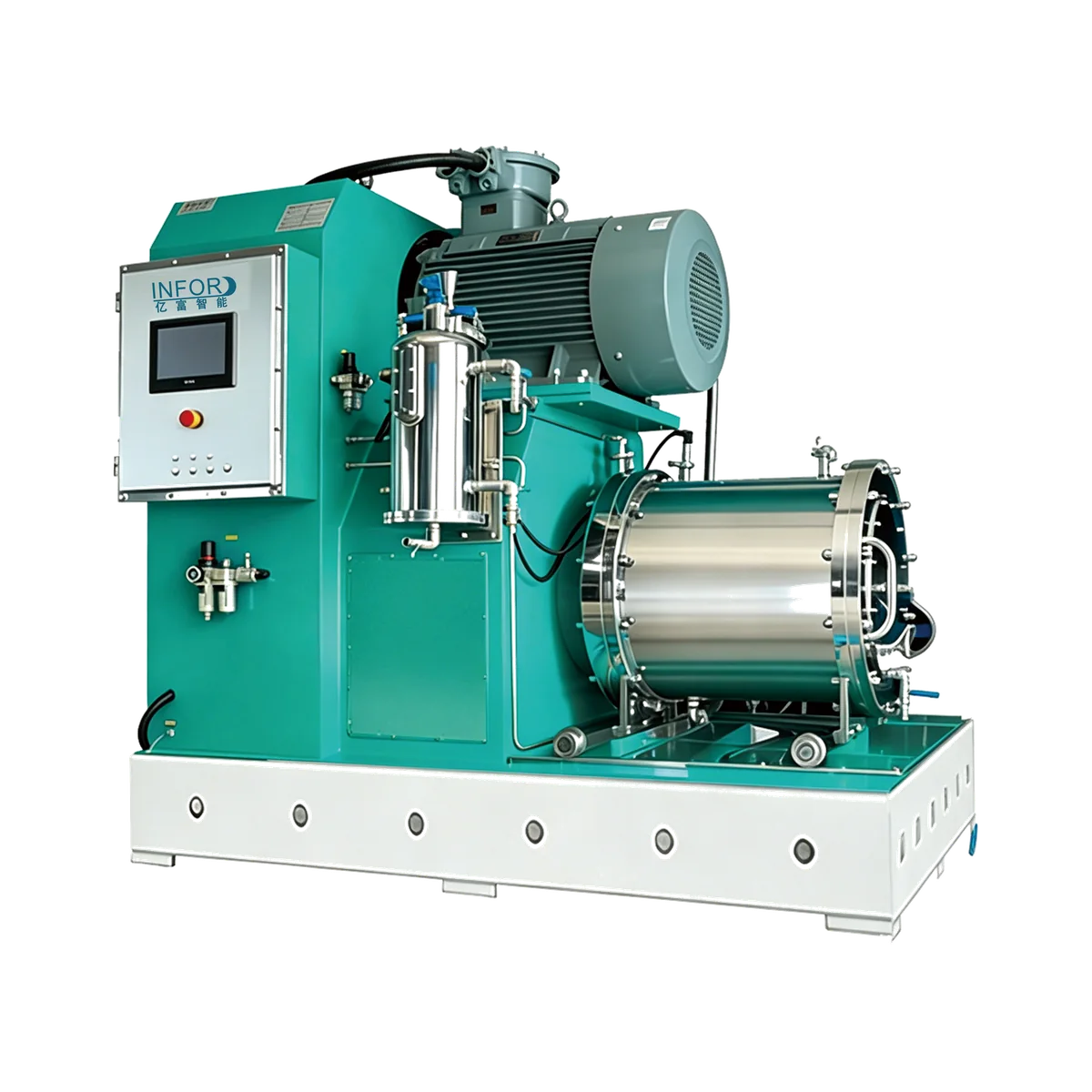
The rotor decides how a bead mill transfers energy to the beads. Disc rotors are the versatile, general-purpose choice; disc-pin rotors grind efficiently at lower temperature; pin-rod rotors give high energy and high flow for large production; turbine rotors give the beads high kinetic energy for nano grinding with a narrow distribution. The right rotor depends on the target fineness, the viscosity, how sensitive the product is to heat, and the output.
Rotor types at a glance
| Rotor | How it moves the beads | Strengths | Typical use | INFOR model |
|---|---|---|---|---|
| Disc | Flat or perforated discs stir the bead bed | Versatile, stable, easy to maintain | Coatings, inks, pigments; D50 down to 100 nm | Disc bead mill |
| Disc-pin | Discs with pins add impact while keeping heat low | Efficient at low grinding temperature | Heat-sensitive materials | Disc-pin bead mill |
| Pin-rod | Pins on the rotor work against pins or the chamber | High energy, large flow | LFP and other battery slurries at production scale | NCP pin bead mill |
| Turbine | Shaped turbine discs drive the beads at high kinetic energy | Narrow distribution, high efficiency | Nano materials and battery slurries | NCT turbine bead mill |
| Vertical with centrifugal separator | Vertical rotor with screen-free separation | Micro-beads, no clogging | Ultra-fine targets, 30-1000 nm | LPM vertical bead mill |
Disc rotors
Disc mills are the classic design that combines grinding and dispersion. INFOR's disc bead mill reaches D50 down to 100 nm with a narrow distribution, runs water-, oil-, solvent- and UV-based systems, and is available in explosion-proof versions, from laboratory to production.
Disc-pin rotors
Adding pins to the discs raises the grinding effect without raising the temperature as much. INFOR's disc-pin bead mill is built for temperature-sensitive materials, with chamber and rotor materials chosen for the product and a chamber that can be changed quickly on site.
Pin-rod rotors
Pin-rod rotors put more energy into the bead bed and keep high flow, which suits large production lines. INFOR's NCP pin-rod mill runs 6-1000 L chambers at catalogue feed flows of 300-12,000 L/h with 0.2-2.0 mm beads and a silicon carbide inner chamber, and is built for LFP and LMFP slurries.
Turbine rotors
A turbine rotor is shaped to give the beads the greatest kinetic energy. INFOR's NCT turbine mill uses it in a ceramic-lined chamber (zirconia or silicon carbide) for new nano materials and battery slurries, with 90-400 L production models.
How to choose
- Target fineness: nano targets favour turbine, pin-rod or vertical screen-free designs.
- Output: very high flow favours pin-rod rotors.
- Heat sensitivity: disc-pin rotors and strong cooling.
- Contamination: ceramic-lined chambers and rotors for battery and electronic materials.
- Versatility: disc rotors for plants that change products often.
Comparison tables for each family are on the turbine bead mill and vertical bead mill category pages, and the full selection method is in how to choose a bead mill for wet grinding. INFOR runs free material tests at its Dongguan and Hubei test bases; send your material, target fineness and output through the contact page.