NCT Turbine Bead Mills
Also known as: NCT turbine sand mills
Turbine-rotor ceramic grinding systems for high-energy nanoscale dispersion and narrow particle distribution.
The NCT series uses a turbine rotor in a ceramic grinding chamber for high-energy nano dispersion with a narrow particle size distribution. Three models, NCT-90, NCT-150 and NCT-400, cover 90–400 L chambers and 90–315 kW, and reach 100–1500 nm with 0.2–2.0 mm zirconia beads.
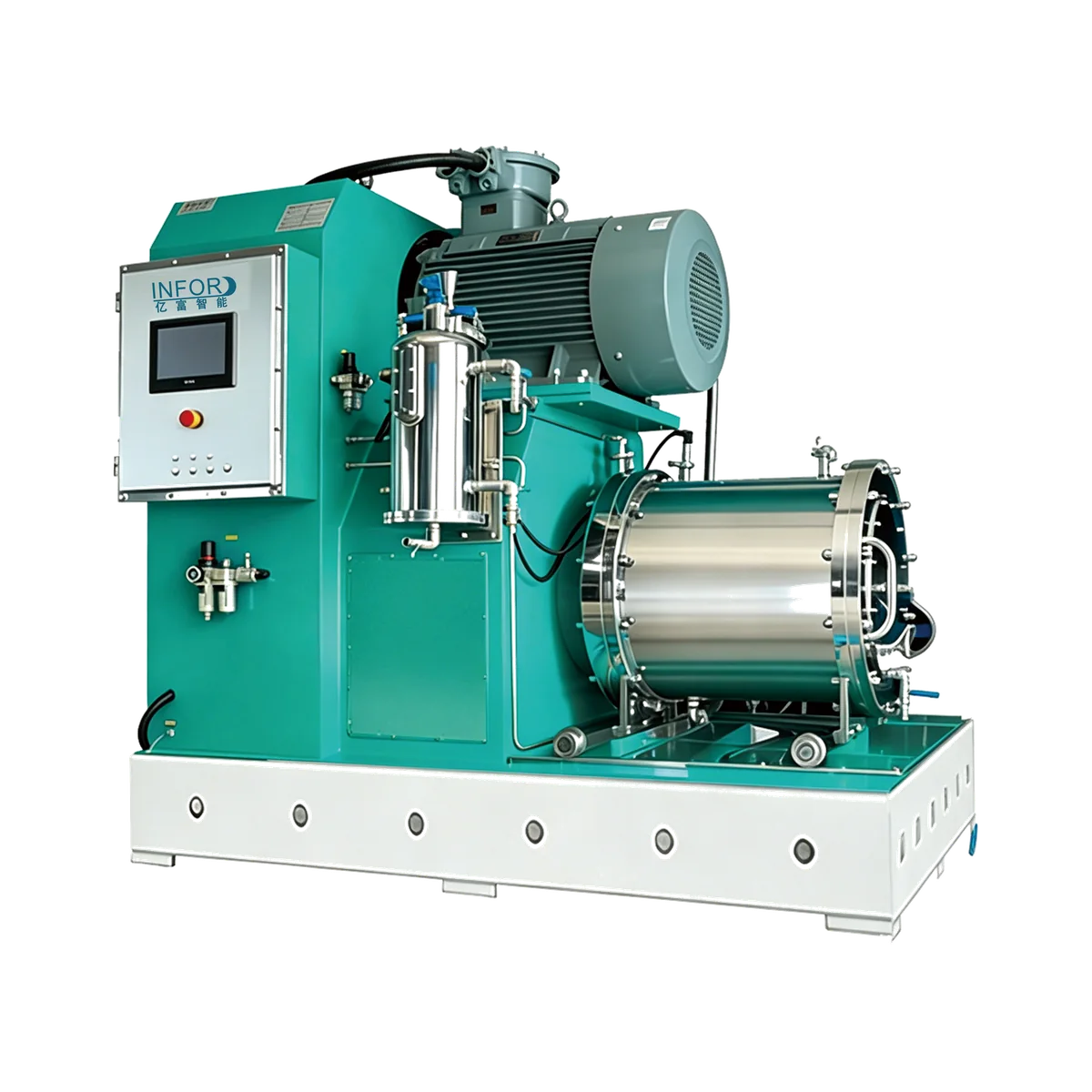
3 models side by side.
Figures from the current product catalogue. Final configuration depends on your material and process.
| Model | Motor Power (kW) | Grinding Chamber Volume (L) | Min. Production Volume (L) | Weight (kg) |
|---|---|---|---|---|
| NCT-90 | 90 | 90 | 150 | 4500 |
| NCT-150 | 132 | 150 | 300 | 6500 |
| NCT-400 | 315 | 400 | 800 | 7000 |
Turbine, pin or disc rotor?
Structure and typical use from the INFOR bead mill comparison; fineness and media from each product page. A test grind on your own material is the reliable way to decide.
| Series | Structure | Fineness | Grinding media | Best for |
|---|---|---|---|---|
| NCT turbine | Horizontal, turbine rotor, ceramic chamber | 100–1500 nm | 0.2–2.0 mm | High-energy nano dispersion with narrow distribution; CNT, nano ceramics, inkjet |
| NCP pin | Horizontal, pin-rod rotor | 100–1500 nm | 0.2–2.0 mm | High-throughput battery slurries: LFP, LMFP, carbon black, separator coating |
| Disc | Horizontal, disc agitator | D50 100 nm – 20 µm | 0.3–2.0 mm | Coatings, inks and pigments |
| LPM vertical | Vertical, screen-free centrifugal discharge | 30–1000 nm | 0.05–2.0 mm | Sub-100 nm targets with 0.05–0.1 mm micro-beads; LFP, sodium and silicon-carbon materials |
| Vertical dual-power | Vertical, dual-power drive | 50–2000 nm | 0.03–2.0 mm | Wide fineness window and difficult, high-viscosity slurries |
What is a turbine bead mill?
A turbine bead mill uses a turbine-shaped disperser instead of discs or pins to set the grinding beads in motion. In the INFOR NCT series the optimised turbine transfers more kinetic energy to the beads inside a ceramic grinding chamber, giving high-energy nano dispersion with a narrow particle size distribution and low energy consumption. Three models, NCT-90, NCT-150 and NCT-400, have 90, 150 and 400 L chambers with 90, 132 and 315 kW motors, need minimum batches of 150, 300 and 800 L, and reach 100–1500 nm with 0.2–2.0 mm zirconia beads.
Is a turbine bead mill suitable for large-scale continuous production?
The NCT turbine mills are production machines. NCT-90, NCT-150 and NCT-400 have 90, 150 and 400 L grinding chambers with 90, 132 and 315 kW motors and minimum production batches of 150, 300 and 800 L. For long runs they use a double-layer cooling-water circuit on the grinding barrel (3–25 m³/h depending on the model), a double mechanical seal with its own coolant circulation and PLC control that stops the mill with an alarm when a sensor trips, while the ceramic chamber keeps metal out of the product. Throughput depends on the material, solids content and target fineness, so INFOR confirms it with a free test grind. Where the priority is maximum flow on battery slurries such as LFP, the NCP pin-rod mill is built for high throughput, with feed flows of 300–12,000 L/h across its eight models.
Turbine, pin-rod or disc bead mill: what is the difference?
All three are horizontal mills, but the rotor changes how energy reaches the beads. The turbine rotor of the NCT gives high-energy nano dispersion with a narrow distribution and suits carbon nanotubes, nano ceramics and inkjet inks. The pin-rod rotor of the NCP is built for high throughput on battery slurries such as LFP, LMFP, carbon black and separator coating. A disc agitator is the economical choice for coatings, inks and pigments from D50 100 nm to 20 µm. For targets below about 100 nm, a screen-free vertical mill such as the LPM, which can retain 0.05 mm beads, is usually the better fit.
How does the NCT keep the product clean and the process safe?
The grinding chamber is built from ceramic materials (zirconia or silicon carbide) for contamination-free grinding and higher material purity. A self-developed double mechanical seal prevents leaks, and double-layer cooling water circulates through the grinding barrel with a separate seal coolant circuit. Sensors stop the mill and raise an audible and visual alarm on an anomaly, with detailed diagnostics on the PLC screen.
Which materials is the NCT turbine bead mill used for?
Typical materials are carbon nanotubes, nano ceramics, inkjet printing inks, barium titanate, alumina, zirconia, barium carbonate, varistor materials and catalysts, in water-based or oil-based systems.
Compare another grinding process.
Start with your material.
Share the material, target particle size and required output. INFOR offers material trials, process planning and equipment recommendations.
Test Your Material