LPM Vertical Bead Mills
Also known as: LPM vertical sand mills
Screen-free vertical nano ceramic mills for continuous production, micro-media and stable particle control.
LPM vertical bead mills separate the beads centrifugally without a screen, so micro-beads can be used without clogging. Four models from LPM-60 to LPM-1000 cover 60–1000 L chambers and feed flows of 2,000–8,000 L/h, reaching 30–1000 nm; the series is optimised for 0.05–0.3 mm micro-beads.
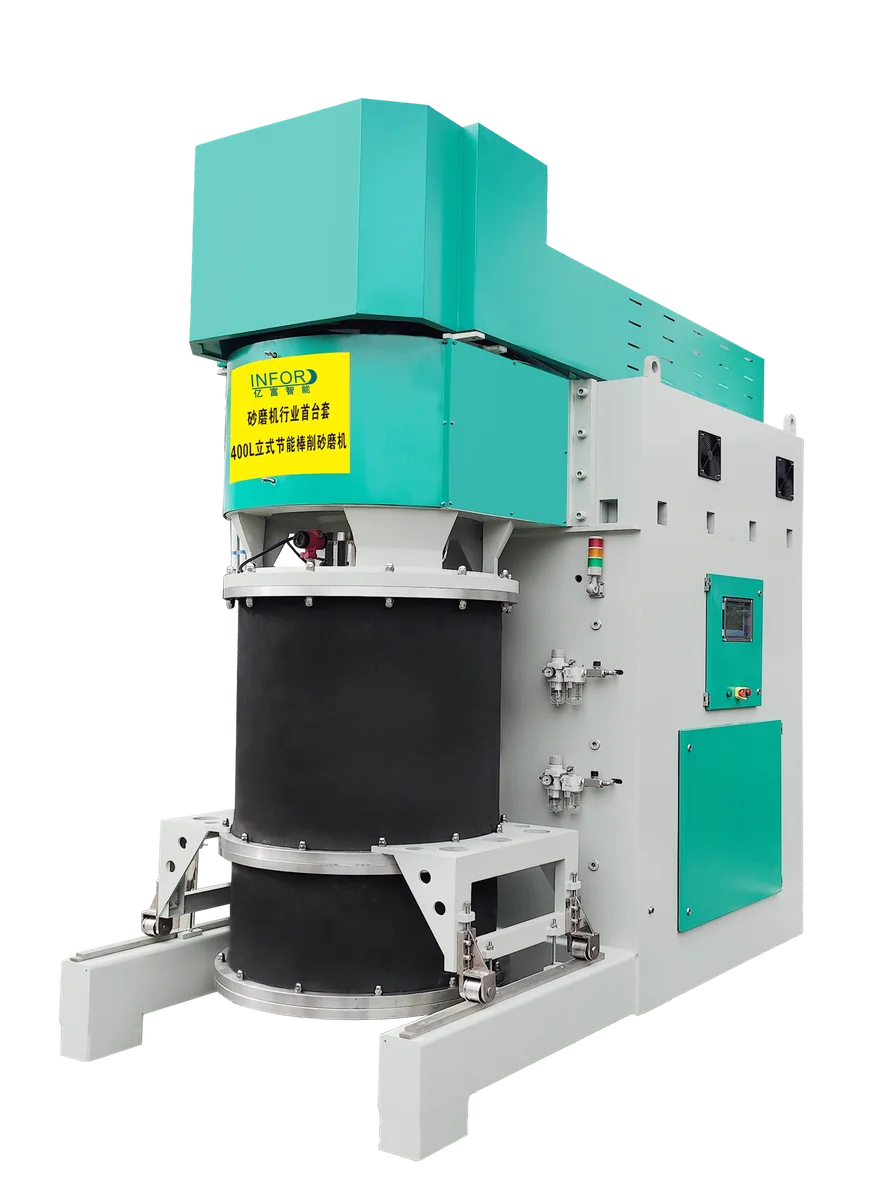
4 models side by side.
Figures from the current product catalogue. Final configuration depends on your material and process.
| Model | Motor Power (kW) | Grinding Chamber Volume (L) | Grinding Media (mm) | Feed Flow (L/h) | Weight (kg) |
|---|---|---|---|---|---|
| LPM-60 | 90 | 60 | 0.05-2.0 | 2000 | 4500 |
| LPM-150 | 160 | 150 | 0.05-2.0 | 4000 | 7500 |
| LPM-400 | 355 | 400 | 0.05-2.0 | 6000 | 9500 |
| LPM-1000 | 650 | 1000 | 0.1-2.0 | 8000 | 22000 |
Vertical or horizontal bead mill?
Structure and typical use from the INFOR bead mill comparison; fineness and media from each product page. A test grind on your own material is the reliable way to decide.
| Series | Structure | Fineness | Grinding media | Best for |
|---|---|---|---|---|
| LPM vertical | Vertical, screen-free centrifugal discharge | 30–1000 nm | 0.05–2.0 mm | Sub-100 nm targets with 0.05–0.1 mm micro-beads; LFP, sodium and silicon-carbon materials |
| Vertical dual-power | Vertical, dual-power drive | 50–2000 nm | 0.03–2.0 mm | Wide fineness window and difficult, high-viscosity slurries |
| NCT turbine | Horizontal, turbine rotor, ceramic chamber | 100–1500 nm | 0.2–2.0 mm | High-energy nano dispersion with narrow distribution; CNT, nano ceramics, inkjet |
| NCP pin | Horizontal, pin-rod rotor | 100–1500 nm | 0.2–2.0 mm | High-throughput battery slurries: LFP, LMFP, carbon black, separator coating |
| Disc | Horizontal, disc agitator | D50 100 nm – 20 µm | 0.3–2.0 mm | Coatings, inks and pigments |
How does the LPM vertical bead mill work?
The LPM is a vertical bead mill with a vertical main shaft, which keeps the shaft from deforming and the machine running steadily. Instead of a screen it separates the grinding beads centrifugally, so the outlet cannot clog and beads as small as 0.05 mm can be used. A centrifugal classifier lets smaller particles leave first, which narrows the particle size distribution. Four models, LPM-60, LPM-150, LPM-400 and LPM-1000, cover 60–1000 L chambers, 90–650 kW and feed flows of 2,000–8,000 L/h, and the series is specified for 30–1000 nm.
Vertical or horizontal bead mill: which should I choose?
The target fineness is the main deciding factor. Below about 100 nm a process usually needs micro-beads of 0.05–0.1 mm and a screen-free vertical mill that can retain them, which is what the LPM is optimised for. From 100 nm to 1.5 µm, horizontal turbine and pin mills such as the NCT and NCP are the workhorses, and micron-range coatings and inks are economical on disc mills. INFOR rates the LPM at 20–30% higher efficiency than conventional horizontal sand mills, but a grinding trial on your own material is the reliable basis for the choice.
Does the LPM need a separate coarse grinding stage?
No. The LPM is designed for direct fine grinding without a coarse-grind stage, which lowers the cost of building a line. It also reaches up to 90% media utilisation without periodic bead sieving or replacement, and its grinding barrel lifts automatically for disassembly, so one person can maintain several machines.
Which materials is the LPM used for?
Typical materials are lithium iron phosphate, sodium-ion materials and silicon-carbon anode, as well as nanomaterials, ink, alumina, zirconia, silica, ATO / ITO and graphene. The grinding chamber is available in zirconia or silicon carbide ceramics.
Compare another grinding process.
Start with your material.
Share the material, target particle size and required output. INFOR offers material trials, process planning and equipment recommendations.
Test Your Material