To choose a bead mill manufacturer in China, check nine things: a test on your own material, the model range for your scale, contamination control, whole-line engineering, references in your industry, its own manufacturing, R&D and patents, service abroad, and a verifiable company identity. The checklist below says what to ask for each point and what evidence to expect.
This guide is written by INFOR (Guangdong INFOR Intelligent Equipment Co., Ltd.), a bead mill manufacturer, so each point also shows INFOR's own answer. Use the same questions with every supplier you compare. If you have not yet decided which type of mill you need, start with how to choose a bead mill for wet grinding.
Bead mill manufacturer checklist
| What to check | What to ask the supplier | Evidence to expect | INFOR |
|---|---|---|---|
| 1. Material testing | Can you grind my material and report the result? | Test report with particle size, time and settings | Free tests at two test bases (Dongguan and Hubei), 10,000+ tests to date |
| 2. Range for your scale | Do you make lab, pilot and production mills of the same design? | Model list from lab to production | Lab mills through to 1,000 L production mills |
| 3. Contamination control | What touches the product? | Chamber, rotor and seal materials in writing | Ceramic chambers (silicon carbide, zirconia) on battery-material mills |
| 4. Whole-line engineering | Can you supply tanks, cooling, iron removal and controls? | Process flow and layout for a real line | 500+ EPC projects delivered |
| 5. References in your industry | Which lines like mine have you built? | Named projects, scale, site photos or visits | LFP lines from 8,500 to 100,000 t/y, CNT paste, coatings |
| 6. Own manufacturing | Where are the mills machined and assembled? | Factory visit or live video | Own production base in Xiangyang, Hubei (42,000 m²) |
| 7. R&D and patents | Who designs the rotor and separation system? | Patent list, R&D team | 100+ granted patents, 35 of them invention patents |
| 8. Service abroad | Who installs, trains and repairs in my country? | Written warranty and service terms | Installation, commissioning, training; 12-month warranty; lifetime repair |
| 9. Company identity | What is your legal name, and what were your former names? | Business licence matching the quotation and website | See "Check the company behind the brand" below |
1. Material testing on your own slurry
A bead mill is chosen for a material, not from a catalogue. Fineness, throughput and bead wear all change with solids content, viscosity and the hardness of the particles, so ask each supplier to grind a sample of your material and report the particle size reached, the grinding time, the bead size and the energy used. A supplier that cannot test should not be sizing your line.
INFOR runs free material tests at two test bases, in Dongguan and in Hubei, with more than 10,000 tests run so far. Its Xiangyang factory also has a complete LFP test line with grinding, spray drying, kiln and jet milling, so a battery-material slurry can be taken through to finished powder for lab and pilot trials.
2. A model range that matches your scale
Ask whether the laboratory mill you test on uses the same grinding principle as the production mill you will buy. Results scale more predictably within one design than between different designs, and a supplier with lab, pilot and production sizes can carry a process from formulation to volume production.
INFOR's range runs from laboratory sand mills through horizontal turbine and pin-rod mills such as the NCT and NCP to vertical screen-free mills such as the LPM, with production chambers up to 1,000 L.
3. Contamination control
For battery materials, electronic pastes and ceramics, metal picked up during grinding can ruin the product. Ask what the chamber, rotor, separator and seals are made of, and which parts touch the product. Get the answer in writing, in the quotation.
INFOR's battery-material mills use ceramic grinding chambers such as silicon carbide and zirconia to keep metal out of the slurry; the NCP pin-rod mill, for example, has a silicon carbide inner chamber. For plant-wide measures, see preventing metal contamination in LFP cathode plants.
4. Whole-line engineering, not only the mill
The mill is one step in a line of dosing, pre-mixing, homogenising, grinding, cooling, iron removal and storage. If different suppliers deliver each part, nobody is responsible for the result of the whole line. Ask for a process flow and layout drawing for your project, and ask who commissions the line.
INFOR has delivered more than 500 EPC projects and makes its own dispersion and process tanks, iron removers and chillers. A full list of equipment for one plant type is in the LFP cathode plant equipment list.
5. References in your industry
Ask for lines that grind your material at a similar scale, with the scale stated, and ask to visit one or see it on video. References in a different industry say little about your slurry.
INFOR's case library includes LFP lines from 8,500 to 100,000 tonnes a year, carbon nanotube conductive paste lines and coatings and inks lines. An independent report in 21st Century Business Herald (January 2025) named CATL, BYD and Yuneng among INFOR's representative LFP customers.
6. Its own manufacturing
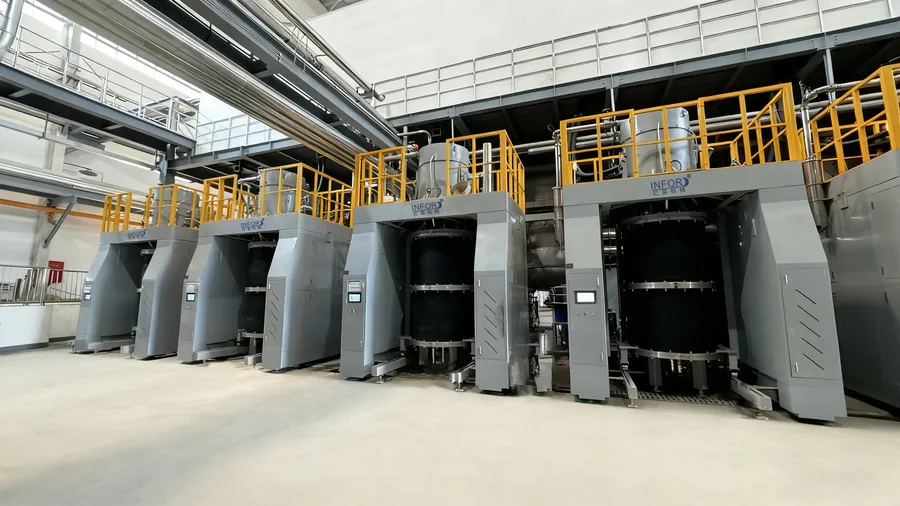
Many companies selling bead mills online are traders. A manufacturer should be able to show machining, assembly and testing in its own workshops. Ask for a factory visit or a live video call from the shop floor, and check that the address matches the business licence.
INFOR's headquarters and R&D centre are in Songshan Lake, Dongguan, and its mills are built at its own production base in Xiangyang, Hubei (42,000 m², with four specialised workshops and automated machining). The company has more than 400 employees.
7. R&D and patents
Rotor, separation and cooling design decide energy use, fineness and maintenance. Ask who designs them, and ask for the patent list. A company that only assembles bought-in designs will struggle to adapt a mill to an unusual material.
About 30% of INFOR's staff work in R&D, the company invests at least 5% of revenue in R&D each year, and it holds more than 100 granted patents, 35 of them invention patents.
8. Service in your country
Ask who installs and commissions the line, how operators are trained, what the warranty covers and for how long, how spare parts reach you, and how quickly someone responds when a mill stops. Get it in the contract.
INFOR provides installation, commissioning and one-to-one operator training, a 12-month warranty against non-human-caused defects, lifetime repair after the warranty, and a 7×24 response. It serves customers in more than 30 countries and regions. See services.
9. Check the company behind the brand
Chinese manufacturers often have a Chinese legal name, a romanised version of it, an English brand and more than one website, and some have changed their name. Check that the legal name on the quotation and contract matches the business licence, ask for any former names, and check which website is official. This also avoids confusing two companies with similar brand names.
INFOR's legal name is Guangdong INFOR Intelligent Equipment Co., Ltd. (广东亿富智能装备有限公司), founded in 1999. Its former name was Dongguan INFOR Machinery Technology Co., Ltd. (东莞市亿富机械科技有限公司), which also appears romanised as Dongguan Yifu Machinery Technology. Its international website is www.inforintl.com; informill.com is its Chinese website and infor-mill.com its former website. INFOR the bead mill manufacturer is not related to Infor, Inc., the US enterprise-software company.
Warning signs when comparing suppliers
- No test on your material, only a catalogue recommendation.
- A price quoted before the supplier knows your material, fineness and output.
- No written statement of the materials that touch the product.
- No reference line in your industry, or none you can see.
- The legal name on the quotation differs from the business licence or website.
- Warranty and service terms that exist only in chat messages, not in the contract.
How the configuration you choose drives the price is explained in what determines the cost of a bead mill.
To start a material test, send INFOR your material, target fineness and output through the contact page.