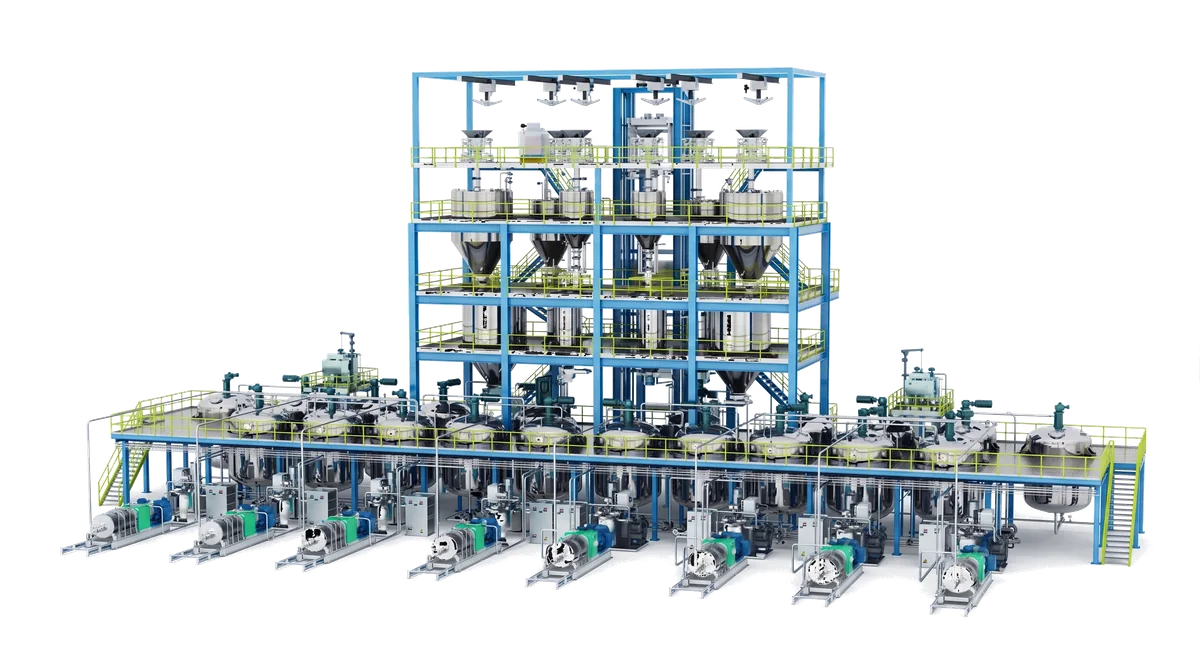
An LFP cathode material plant runs through dosing, pre-mixing, homogenising, fine grinding, iron removal, spray drying, sintering, jet milling, sieving with final demagnetising, and packing. INFOR (Guangdong INFOR Intelligent Equipment Co., Ltd.) supplies the wet grinding section, built around NCP pin-rod and LPM vertical bead mills, and engineers complete slurry lines.
This list follows the common solid-phase route, in which the raw materials are ground wet into a slurry before drying and sintering. Other routes, such as ferrous oxalate and liquid-phase synthesis, change the front end of the plant; see LFP process routes explained for how they differ.
LFP plant equipment at a glance
| Step | What it does | Typical equipment | Key control point | INFOR scope |
|---|---|---|---|---|
| 1. Dosing | Weighs powders, solvent and additives | Dosing tanks, powder feeding and weighing | Accurate ratios, dust-tight feeding | Dosing tanks |
| 2. Pre-mixing | Wets the powder into a slurry | Dispersion tanks with agitators | Complete wetting, no lumps | Dispersion tanks |
| 3. Homogenising | Evens out solids and composition | Homogenising tanks | Consistent solids content | Homogenising tanks |
| 4. Fine grinding | Reduces particle size to the target distribution | Horizontal pin-rod bead mills or vertical screen-free bead mills | Particle size distribution, temperature, metal contamination | NCP and LPM bead mills, complete grinding lines |
| 5. Iron removal | Removes magnetic particles from the slurry | Electromagnetic or permanent-magnetic iron removers | Magnetic foreign matter | Iron removers, iron-removal tanks |
| 6. Slurry storage | Buffers the slurry ahead of drying | Agitated storage and finished-product tanks | Keeps solids in suspension | Finished-product tanks |
| 7. Spray drying | Turns the slurry into precursor powder | Spray dryer | Moisture and particle morphology | Hubei LFP test line (lab and pilot) |
| 8. Sintering | Forms carbon-coated LFP | Kiln under protective atmosphere | Temperature profile and atmosphere | Hubei LFP test line (lab and pilot) |
| 9. Crushing / jet milling | Breaks up sintered agglomerates | Jet mill | Powder particle size | Hubei LFP test line (lab and pilot) |
| 10. Sieving and final demagnetising | Removes oversize and magnetic particles | Vibrating screens, demagnetisers | Magnetic foreign matter in the product | General equipment category |
| 11. Packing | Packs the finished powder | Automatic packing system | Moisture pick-up, foreign matter | General equipment category |
Steps 1 to 6 form the wet slurry section, the same sequence as INFOR's 100,000-tonne-a-year LFP slurry line case: powder dosing, pre-mixing, homogenising, fine grinding, iron removal and slurry storage, with the grinding stage sized for the stated annual output.
Steps 1-3: Dosing, pre-mixing and homogenising
The front end turns weighed powders into a uniform slurry the mills can handle. Dosing accuracy sets the stoichiometry of the final cathode, so powders, solvent and additives are weighed and fed in a closed, dust-tight system. Pre-mixing wets the powder completely, because dry lumps that reach the mill waste grinding energy and widen the particle size distribution. Homogenising tanks then even out each batch before it is pumped to grinding.
INFOR builds its own tank range for this section: dosing, dispersion, homogenising, transfer, iron-removal and finished-product tanks in 304 stainless steel, from 10-50 L laboratory units to 10-40 m³ production tanks, with double-planetary agitators and coil cooling. See the dispersion tank series.
Step 4: Fine grinding, the core of the wet section
Fine grinding decides the particle size and distribution of the precursor, and with it much of the electrochemical consistency of the finished LFP. It is also where metal contamination can enter, so the chamber and rotor materials matter as much as the grinding energy. Two mill designs cover most LFP lines: a high-throughput horizontal pin-rod mill, or a vertical screen-free mill that runs micro-beads.
| NCP pin-rod bead mill (horizontal) | LPM bead mill (vertical, screen-free) | |
|---|---|---|
| Grinding structure | Pin-rod disperser, centrifugal discharge | Screen-free centrifugal separation |
| Grinding fineness | 100-1500 nm | 30-1000 nm |
| Grinding media | 0.2-2.0 mm zirconia beads | 0.05-2.0 mm, optimised for 0.05-0.3 mm micro-beads |
| Chamber sizes | 6-1000 L (NCP-6 to NCP-1000) | 60-1000 L (LPM-60 to LPM-1000) |
| Catalogue feed flow | 300-12,000 L/h | 2,000-8,000 L/h |
| Chamber material | Silicon carbide inner chamber | Zirconia / silicon carbide |
| Typical LFP use | High-throughput LFP and LMFP slurry | Finer targets; direct fine grinding without a coarse-grind stage |
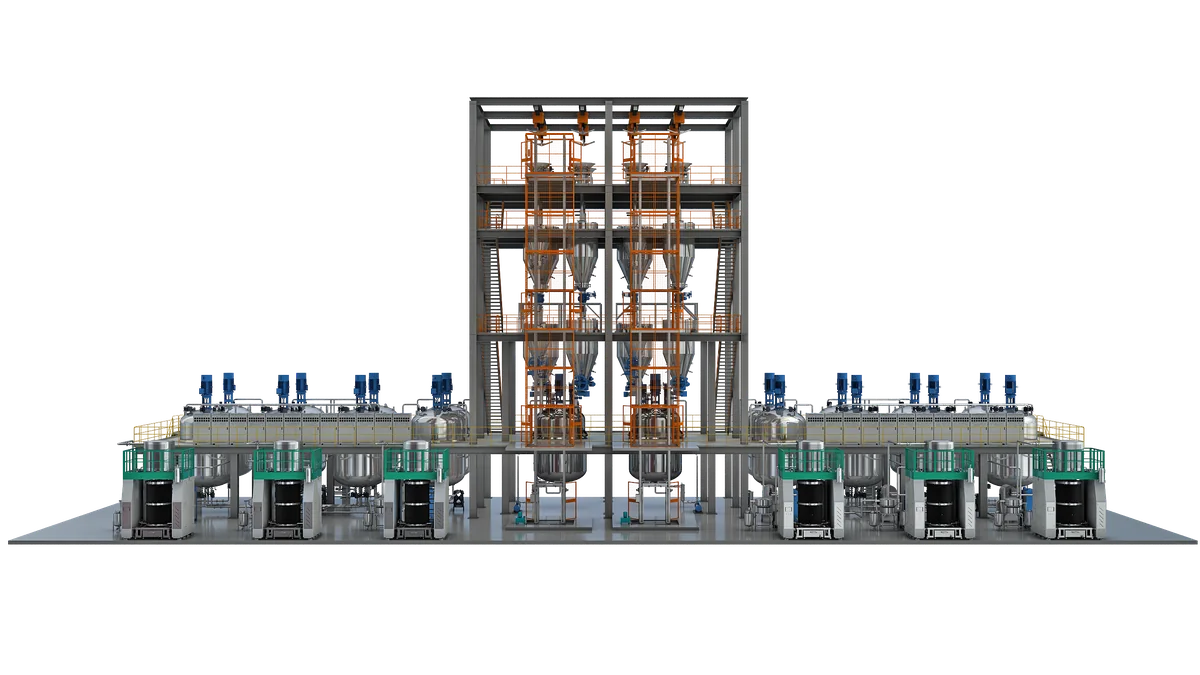
The choice also shapes the line layout. INFOR's horizontal LFP line runs dosing, pre-mixing, homogenising, coarse grinding, fine grinding, demagnetising and storage, with multi-stage circulation grinding. The vertical line grinds directly to the target without a coarse-grind stage, which shortens the line and lowers construction cost. Product pages: NCP pin bead mill, LPM vertical bead mill.
Steps 5-6: Iron removal and slurry storage
Metal particles such as iron, nickel, copper, zinc and chromium can form dendrites in the cell and cause short circuits, so magnetic foreign matter is controlled at every stage, not only at the end. In the wet section that means non-metallic or coated product-contact surfaces, ceramic grinding chambers such as silicon carbide and zirconia, moving metal parts kept away from the product, and iron removers after grinding.
INFOR's fluid iron removers use a magnetic steel group in a pressure-bearing frame rated at 1.0 MPa and clean themselves by retracting the magnet. Agitated finished-product tanks then hold the slurry in suspension until it is fed to the dryer. For plant-wide measures, from raw-material demagnetising to clean-room practice, see preventing metal contamination in LFP cathode plants.
Steps 7-9: Spray drying, sintering and jet milling
After grinding, the slurry is spray dried into precursor powder, sintered in a kiln under a protective atmosphere to form carbon-coated LFP, and crushed or jet milled to break up agglomerates. These thermal and powder steps set moisture, carbon coating and final particle size.
INFOR's factory in Xiangyang, Hubei runs a complete LFP test line covering grinding, spray drying, kiln and jet milling, using turbine and pin-rod mills, for lab and pilot trials. A customer slurry can therefore be taken through to finished powder before the plant is designed.
Steps 10-11: Sieving, final demagnetising and packing
The finished powder is sieved to remove oversize particles and passed through demagnetisers once more before packing, which is the last chance to catch metal picked up after the slurry section. Packing in a closed, dry system limits moisture pick-up and new foreign matter.
How INFOR supports an LFP plant project
- Material tests first. INFOR runs free lab tests on customer material at its test bases in Dongguan and Hubei, which have carried out more than 10,000 tests, and uses the results for process and layout design.
- Projects at scale. In 2025 INFOR won bead mill orders for a 10,000-tonne LFP line, the bead mill package for a 65,000-tonne LFP project and the bead mill system for a 200,000-tonne-a-year LFP development.
- Battery-material customers. According to the 21st Century Business Herald (January 2025), INFOR's representative LFP customers include CATL, BYD and Yuneng Technology.
- Turnkey delivery. From material testing and process design to installation, operator training and after-sales support; see services and the FAQ.
To plan the grinding section of an LFP plant, send INFOR your material, target particle size and required output through the contact page. For mill types in general, see the bead mill guide.