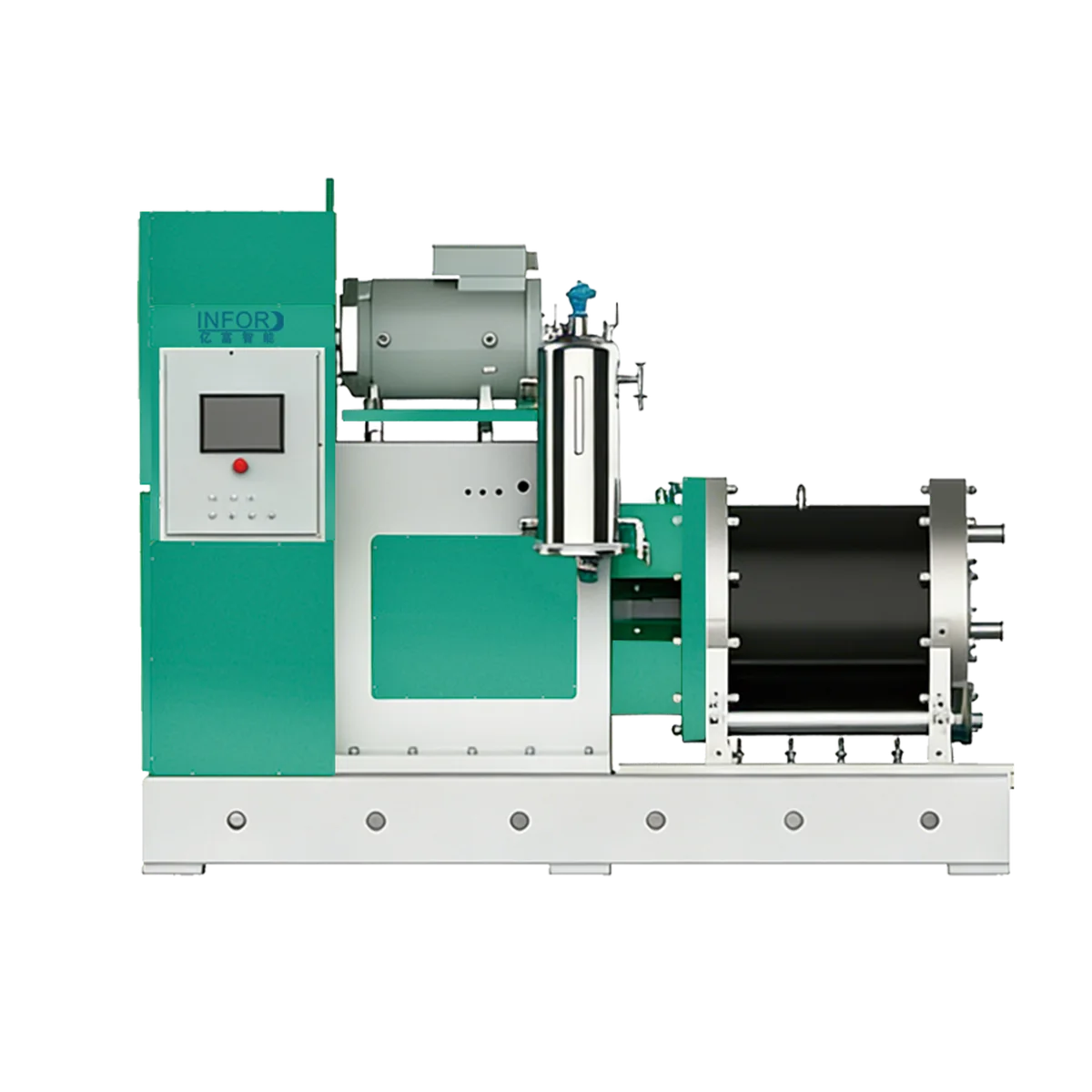
A bead mill's price is set by its configuration: chamber volume and machine class, the materials that touch the product, single or dual drive, explosion protection, automation, and whether you buy one mill or a complete line. The running cost then comes from energy, grinding beads, seals and wear parts, and downtime. This article explains each factor, so that quotations from different suppliers can be compared.
INFOR (Guangdong INFOR Intelligent Equipment Co., Ltd.) quotes each project after reviewing the material, so this article lists no prices. It explains what moves the price up or down, and what to send for a quotation that is accurate the first time.
What drives the price of a bead mill
| Factor | Options | Why it changes the price |
|---|---|---|
| Machine class and chamber volume | Laboratory, pilot or production; from a few litres to 1,000 L | Larger chambers need bigger motors, frames, seals and cooling |
| Grinding structure | Disc, turbine, pin-rod, vertical screen-free | Rotor and separation design differ in complexity and in the throughput and fineness they reach |
| Product-contact materials | Stainless steel, wear-resistant alloy, polyurethane, ceramic (silicon carbide, zirconia) | Ceramic chambers and rotors cost more but keep metal out of the product |
| Drive | Single drive, dual drive, energy-saving or permanent-magnet motor | Dual drive and high-efficiency motors cost more to buy and can reduce energy use |
| Explosion protection | Standard or explosion-proof motors and controls | Needed for solvent-based slurries; adds certified components |
| Cooling and seals | Chamber cooling, chiller, single or double mechanical seal | Heat-sensitive or high-viscosity materials need more cooling and stronger seals |
| Automation | Manual, PLC control, online monitoring | Sensors, controls and software add cost and reduce labour and batch variation |
| Scope of supply | Single mill, or a line with tanks, pumps, iron removal, chillers and controls | A complete line is quoted as a project, including engineering and commissioning |
Machine class and chamber volume
The first split is between laboratory, pilot and production mills. A lab mill such as INFOR's experimental horizontal sand mill grinds small batches for formulation work; a production mill is sized for continuous output, and its chamber volume follows the throughput you need. Ask suppliers to size the chamber from your required output and a test result, not from a guess, because an oversized mill costs more to buy and to run.
Grinding structure
Different rotor and separation designs suit different jobs. Disc mills are a common general-purpose design. Turbine and pin-rod mills, such as INFOR's NCT turbine and NCP pin-rod mills, are built for high throughput and high grinding energy. Vertical screen-free mills such as the LPM can run micro-beads for very fine targets. Choose the structure for the material and target first; comparing prices across different structures compares different machines. The bead mill selection guide explains the choice.
Materials that touch the product
Stainless steel is the baseline. Wear-resistant alloys and polyurethane linings extend part life, and ceramic chambers and rotors in silicon carbide or zirconia keep metal out of battery materials, electronic pastes and ceramics. Ceramic parts raise the purchase price, but for these materials metal contamination is usually not acceptable. See preventing metal contamination in LFP cathode plants.
Drive, explosion protection and cooling
A dual-power mill drives the rotor and the separator separately, which costs more than a single drive and gives more control over fine grinding. Energy-saving and permanent-magnet motors cost more to buy and lower the power bill. Solvent-based slurries need explosion-proof motors and controls. Heat-sensitive and high-viscosity materials need more chamber cooling, a chiller and stronger mechanical seals.
Automation and scope of supply
A mill with manual controls costs less than one with PLC control, online monitoring and data logging, but the automated mill needs less operator attention and gives more consistent batches. The biggest difference is scope: a single mill is a machine price, while a complete grinding line adds dosing, dispersion and storage tanks, pumps, iron removers, chillers, piping, controls, engineering and commissioning.
Running costs: what you pay after delivery
The purchase price is only part of the cost. Over the life of a mill, compare:
- Energy: energy-saving and permanent-magnet motors, and a mill sized to the job, reduce the power used per tonne.
- Grinding beads: bead wear depends on the bead material, the rotor design and the operating settings; ask for the expected bead consumption on your material.
- Seals and wear parts: mechanical seals, rotor parts, separators and linings are replaced over time; ask for the replacement interval and the price list for spare parts.
- Downtime: a mill that is quick to clean and service, with local support, loses fewer production hours.
How to get comparable quotations
Quotations differ most when suppliers are guessing. Send every supplier the same information:
- Material, solvent or carrier, solids content and viscosity if known.
- Target particle size, for example D50 or D90, and how it is measured.
- Required output per hour or per year, and batch or continuous operation.
- Whether the area is explosion-proof, and the local voltage and frequency.
- Single mill or complete line, and what the line must include.
- What the quotation must state: product-contact materials, motor power, warranty, training, spare parts and delivery terms.
For how to judge the suppliers themselves, see how to choose a bead mill manufacturer in China.
INFOR can run a free test on your material first and then quote the configuration that reaches your target. Send your material, target fineness and output through the contact page.