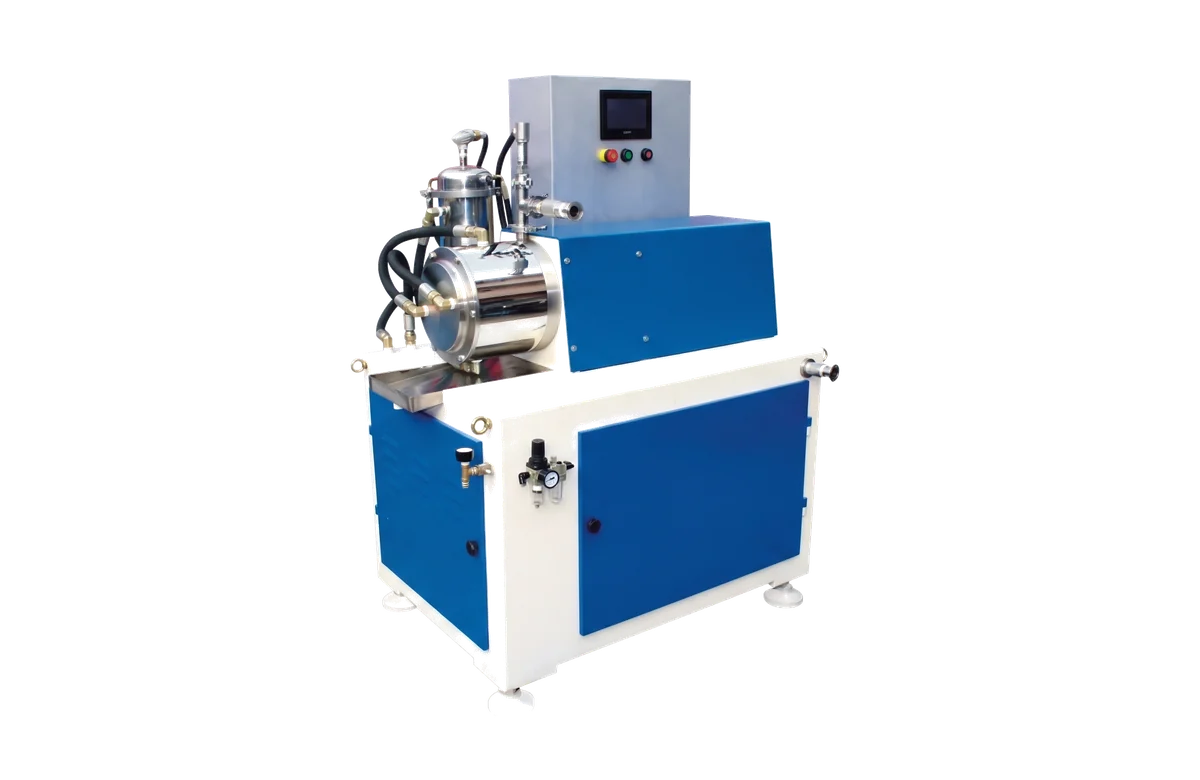
Bead mills grind pigments and color paste by breaking pigment agglomerates down to the particle size that gives full color strength, gloss and transparency. The key controls are fineness and distribution, viscosity of high-pigment pastes, and temperature, because many organic pigments are heat-sensitive. INFOR supplies disc, disc-pin and pin-rod bead mills, dispersion tanks and complete coating and color paste lines for this work.
What the process needs
| Requirement | Why it matters | How the bead mill meets it |
|---|---|---|
| Fineness and narrow distribution | Sets color strength, gloss and transparency | Small beads, enough energy, circulation mode |
| High pigment loading | More pigment per batch, but higher viscosity | Strong rotor and separator that tolerate viscous paste |
| Temperature control | Organic pigments and resins are heat-sensitive | Chamber cooling, disc-pin rotor |
| Batch-to-batch consistency | Color must match every batch | PLC control and data logging |
| Quick color changes | Plants run many shades | Easy cleaning and chamber access |
Organic and inorganic pigments
Inorganic pigments such as iron oxides and titanium dioxide are dense and abrasive, so bead wear and chamber wear matter. Organic pigments are lighter and often need finer grinding for transparency and strength, and they are more sensitive to heat. Both need a good premix so the mill grinds rather than wets.
Color paste and tinting paste
Color pastes for paints and plastics carry a high pigment content in a small amount of carrier, which makes them viscous. The mill must keep flowing at high viscosity, and the dispersant system decides how fine the paste can go before it thickens.
Process steps
Weighing and premixing in a dispersion tank, grinding in one or more bead mills in circulation or multi-pass mode, then letdown, filtering and filling. Fineness is checked by a grind gauge or laser diffraction, and color strength against a standard.
Recommended INFOR equipment
| Stage or need | INFOR equipment | Why |
|---|---|---|
| Premix | Dispersion tank | Complete wetting before grinding |
| General pigment grinding | Disc bead mill | Versatile; D50 down to 100 nm; water, oil, solvent and UV systems; explosion-proof versions |
| Heat-sensitive pigments | Disc-pin bead mill | Efficient grinding at low temperature |
| Fine, transparent grades | LPM vertical bead mill | Micro-beads with screen-free separation |
| Complete plant | Chemical coating production line | Dosing, dispersion, grinding and storage as one line |
See the coatings and inks dispersion line case and bead mills for coatings, inks and pigments. INFOR runs free material tests at its Dongguan and Hubei test bases; send your material, target fineness and output through the contact page.