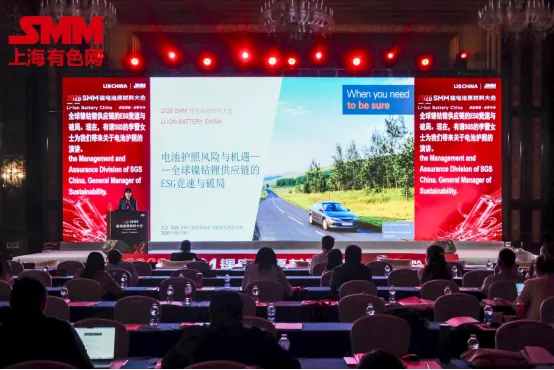
On 15-16 October, the 2026 SMM Lithium Battery Raw Materials Conference, hosted by Shanghai Metals Market (SMM), was held at the Agile Howard Johnson Hotel in Chengdu.
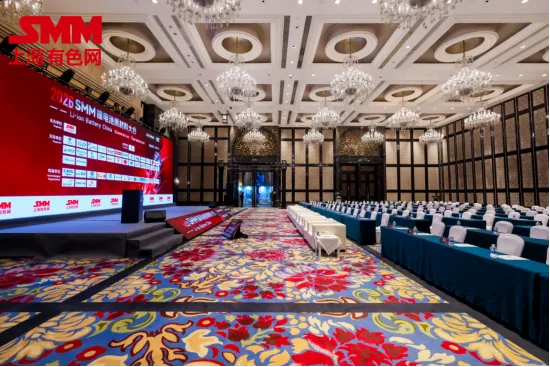
Over the two-day agenda, topics ranged from global lithium salt supply and demand, nickel and cobalt resource policy and the restructuring of automakers' battery supply chains, to high-compaction LFP, lithium-rich manganese-based materials and battery recycling. The central thread was clear: competition in lithium batteries has moved from "who secures the resources" to "who turns those resources into stable, low-energy, deliverable yield."
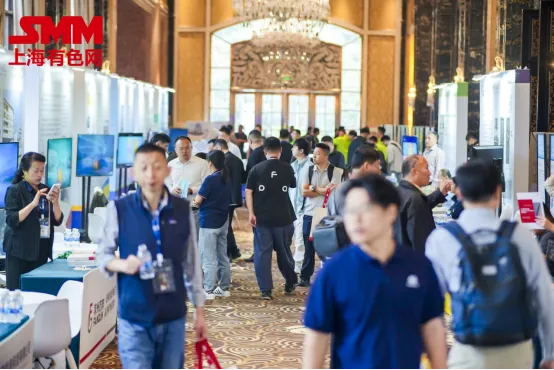
Outside the halls were market prices and policy; inside were processes and equipment. INFOR's clearest takeaway at booth A20: equipment is no longer back-end support but the final gate for turning resources into value.
Booth A20: more valuable than business cards were the customers who brought production line sketches
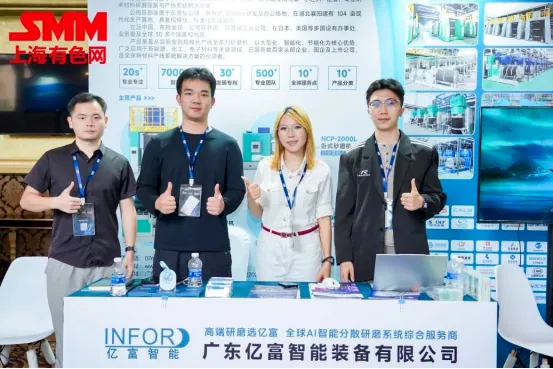
INFOR was on site at booth A20 throughout the conference. Over two days, conversations moved between resource suppliers, material producers, battery makers and equipment vendors, and these were the real questions raised at SMM:
① "As we push high-compaction LFP even further, where exactly is front-end grinding the bottleneck?"
It's not just fineness, but D50 distribution width, secondary agglomeration and temperature rise. The LPM series uses a screenless design with special centrifugal separation: small particles discharge first while larger ones continue grinding. A narrower particle size distribution leaves room for error in downstream sintering and calendering.
② "Our silicon-carbon anode pilot runs beautifully, so why does the slurry thicken and then agglomerate when we scale up to 400L/1000L?"
Maxing out the speed isn't the answer. The shear field, residence time and media size distribution must be tuned together. The AI intelligent grinding system closes the loop on current, temperature, flow rate and viscosity, avoiding the "looks fine, fails inspection" problem.
③ "Our old horizontal mills need monthly screen cleaning and replacement of small zirconia beads. Labor and consumables are unsustainable. How do we upgrade?"
We ran the same numbers for several customers on site: after switching to a vertical screenless design, media utilization rises above 90%, regular bead screening is no longer needed, unit energy consumption is more than 20% lower than conventional equipment, and maintenance goes from "several people every month" to "one person every six months."
④ "Solid-state electrode slurries are high-solids and high-viscosity. Ordinary bead mills clog as soon as throughput increases. What can we do?"
It comes down to the separation structure and the chamber flow field. INFOR's LPM series can handle micro-beads finer than 0.03 mm to push grinding limits further, while also controlling metallic contamination and clogging risk.
The hidden theme of this year's conference was clear: lithium batteries are shifting from an "expansion narrative" to an "operating narrative." Equipment is not a purchase item at the end of the line but the invisible foundation of material yield and manufacturing cost.
In lithium battery raw materials, INFOR delivers an equipment solution "from resources to yield"
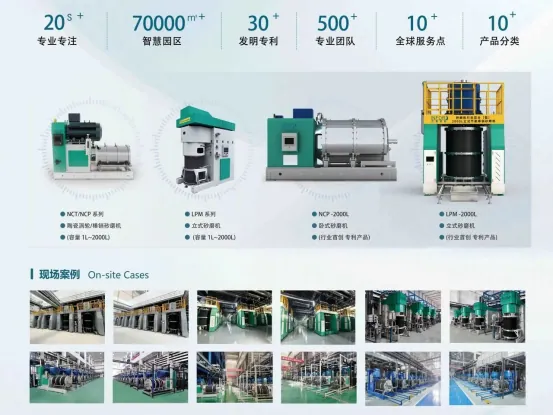
With high-compaction LFP, silicon-carbon anodes and sodium-ion, manganese-based and solid-state chemistries all ramping up in parallel, INFOR showcased four capability lines at booth A20 in Chengdu:
🔹 LPM Series Vertical Nano Ceramic Bead Mills (1L-1000L/2000L)
Laboratory results scale up to production on the same principle, relying not on re-tuning but on reusing the separation structure and media kinematics.
🔹 High-compaction LFP precursor dispersion, grinding and classification system
Addresses viscosity changes, screen clogging and batch-to-batch D50 drift, helping customers achieve target fineness without damaging the crystal structure.
🔹 Wet grinding platform for silicon-carbon, hard carbon and artificial graphite anodes
A shared baseline for multiple material systems reduces equipment idle time, so new projects can expand without buying duplicate lines.
🔹 High-solids dispersion solution for solid-state battery electrode slurries
Controls temperature rise, metallic contamination and slurry stability, supporting all-solid-state and semi-solid-state batteries from pilot to mass production.
Savings won at the resource end are wasted if they leak away in front-end grinding. INFOR builds the gate that turns resources into yield.
The close of the show marks the start of one-on-one production line diagnostics
The two days in Chengdu are over, but we are still working through the samples, production line sketches and energy consumption records left at our booth. SMM's industry event is no longer just about prices and supply and demand: procurement, process, engineering and production line leaders now attend together, and equipment suppliers are being brought into project kickoff meetings earlier and earlier.
INFOR's goal is not to chase market swings, but to grind every bit of the resource premium in lithium battery materials into production yield with consistent batches and controlled energy consumption.
Next stop: Shaoxing. Join INFOR at the China Renewable Energy Conference!