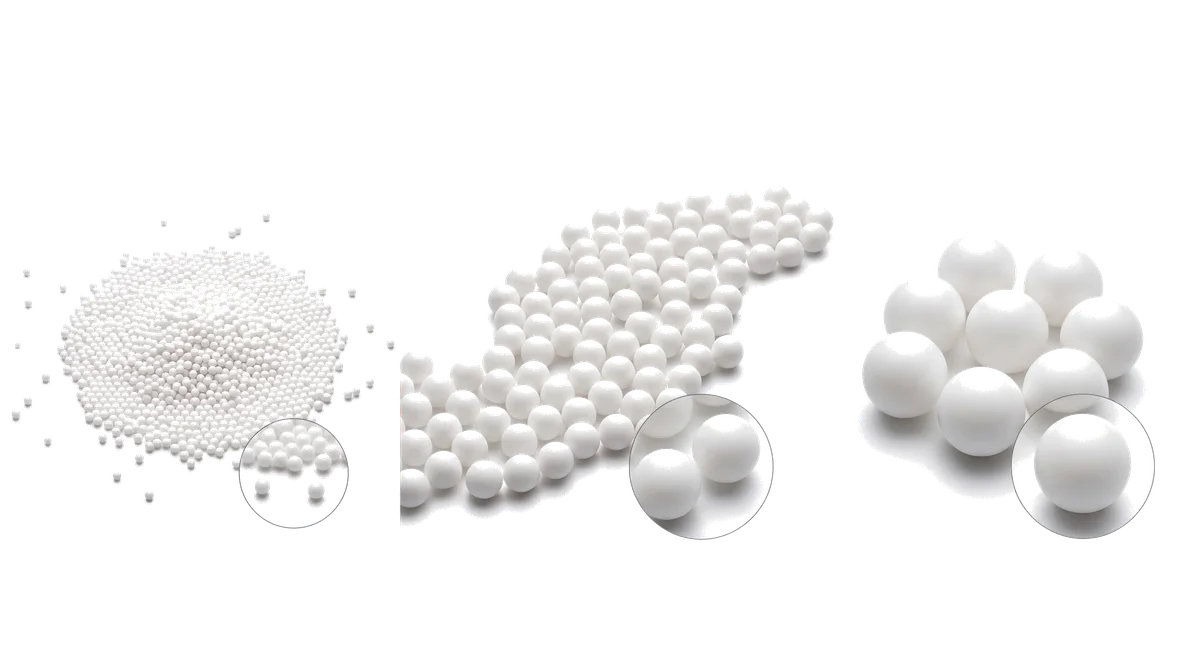
Choosing the right grinding bead size is one of the most important decisions in wet grinding. The right beads get your product to the target particle size quickly; the wrong beads leave grinding stuck at a plateau no matter how long the mill runs. This guide explains how bead size affects the result, gives a practical bead size chart, and covers the other media choices that matter: bead material, filling ratio and separation.
Quick answer: what bead size should you use?
A widely used rule of thumb is that the final particle size you can reach is roughly 1/1000 of the bead diameter:
- 1.0 mm beads typically grind to around 1 µm
- 0.3 mm beads typically grind to around 300 nm
- 0.1 mm beads typically grind to around 100 nm
At the same time, the beads must be large enough to break your largest feed particles. A common guideline is that beads should be at least 10 times larger than the top feed particle size, which is why many processes use two or more grinding steps.
Bead size chart for wet grinding
| Bead diameter | Typical target particle size (D50) | Typical use |
|---|---|---|
| 1.5-2.0 mm | 5-20 µm | Pre-grinding, coarse or agglomerated feed |
| 0.8-1.0 mm | 1-5 µm | Fine grinding of pigments and fillers |
| 0.3-0.6 mm | 0.3-1 µm | Ultrafine grinding of inks and ceramics |
| 0.1-0.2 mm | 100-300 nm | Nano grinding, including battery materials |
| 0.03-0.05 mm | below 100 nm | Nano dispersion in mills built for micro-media |
These are typical ranges. The real result depends on material hardness, solids content, viscosity and energy input, so always confirm with a lab test on your own material.
Why smaller beads grind finer
Smaller beads create many more contact points per unit of volume: in the same chamber, 0.1 mm beads give about 1,000 times more beads than 1.0 mm beads. More contact points mean more frequent, gentler impacts, which is what you need to break fine particles without over-stressing them.
Larger beads carry more energy per impact. They are better at breaking coarse particles and agglomerates, but they become inefficient once the particles are very small.
Why you often need two grinding steps
If the feed contains 50 µm particles and the target is 200 nm, no single bead size does both jobs well. Beads small enough to reach 200 nm cannot break 50 µm particles efficiently, and beads large enough for 50 µm particles will never reach 200 nm.
The solution is staged grinding: a coarse step with larger beads, for example 0.8-1.2 mm, followed by a fine step with smaller beads, for example 0.1-0.3 mm. This is common for battery cathode and anode materials, functional ceramics and high-end inks.
Which bead material should you choose?
| Bead material | Approx. density | Notes |
|---|---|---|
| Yttrium-stabilised zirconia | about 6.0 g/cm³ | Standard for fine and nano grinding; high wear resistance |
| Zirconium silicate | about 4.0 g/cm³ | Lower cost; less demanding applications |
| Alumina | about 3.6 g/cm³ | Where zirconia contamination is not acceptable |
| Glass | about 2.5 g/cm³ | Low cost and gentle dispersion, but higher wear |
| Steel | about 7.8 g/cm³ | High energy, but a risk of metal contamination |
For battery materials, contamination control matters as much as particle size: low-wear zirconia beads and suitable chamber linings help keep impurities such as Zr and Fe within specification. For a detailed comparison, see zirconia beads vs glass beads.
Bead filling ratio
Most horizontal bead mills run with beads filling about 70-85% of the free chamber volume. Too few beads waste energy and slow grinding; too many raise temperature and wear and can overload the separation system. Find the optimum in a lab trial, then keep it consistent in production. To work out the bead charge in kilograms, see how to calculate grinding bead filling.
Bead separation: match the separator to the bead size
The separation screen or gap must hold the beads back while letting the product through. A common guideline is a gap of about one third of the bead diameter. When you move to smaller beads, check that the mill's separation system supports them: micro-beads of about 0.1 mm and below are usually run in screen-free mills. See bead mill separation systems.
Common mistakes when choosing bead size
- Using one bead size for everything: coarse feed and nano targets need different beads.
- Going too small too early: fine beads cannot break large particles, so grinding stalls.
- Ignoring viscosity: as particles get finer, slurry viscosity often rises, and fine beads in a thick slurry lose movement and efficiency.
- Not checking wear and contamination: cheap beads can cost more through contamination and frequent replacement.
INFOR grinding media and bead mills
INFOR's grinding media are yttrium-stabilised zirconia beads from 0.1 to 2.2 mm. Across the mill range, NCP runs 0.2-2.0 mm beads, LPM 0.05-2.0 mm, and the dual-power mills 0.03-0.1 mm micro-media.
INFOR runs free material tests at its Dongguan and Hubei test bases to help find the right bead size, media and process before you invest. Send your material, target particle size and output through the contact page.