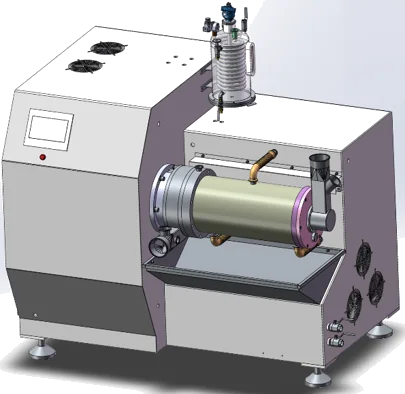
Wet grinding mills particles suspended in a liquid; dry grinding mills them as powder. Wet grinding reaches finer sizes, into the sub-micron and nano range, because the liquid removes heat and the dispersant keeps particles apart. Dry grinding skips the liquid and the drying step, which suits products needed as powder or that must not contact water or solvent.
Dry vs wet grinding compared
| Wet grinding | Dry grinding | |
|---|---|---|
| Typical fineness | Micron to nano | Mostly micron range |
| Process steps | Dispersing, grinding, then drying if a powder is needed | Grinding and classifying; no drying |
| Heat removal | The liquid carries heat away | Through the chamber wall and air flow |
| Agglomeration of fine particles | Controlled with dispersants | Fine powders re-agglomerate more easily |
| Dust and explosion risk | Low dust; solvent systems need explosion protection | Dust control; inert gas for sensitive powders |
| Typical products | Battery slurries, inks, coatings, pigments, ceramics | Powders that must stay dry |
When wet grinding is the right choice
Choose wet grinding when the target is sub-micron or nano, when the next step uses a slurry anyway (coating, spray drying, ink or paste), or when the particles must be kept apart by a dispersant. Most of INFOR's range, from the NCP and NCT horizontal mills to the LPM vertical mills, is wet grinding equipment.
When dry grinding is the right choice
Choose dry grinding when the product is needed as a powder and drying would add cost or change the product, when it must not contact water or solvent, or when the target is in the micron range.
INFOR dry bead mill
INFOR's dry bead mill grinds in the dry state with a built-in turbo classifier and negative-pressure discharge of qualified particles, so oversize returns to the grinding zone. Chamber and rotor are ceramic or wear-resistant steel, multi-channel water cooling with PID control holds chamber temperature within ±2 °C, and inert-gas sealed explosion-proof versions are available.
| Model | 2 L | 25 L | 60 L | 150 L |
|---|---|---|---|---|
| Motor power (kW) | 7.5 | 22 | 45 | 90 |
| Catalogue capacity (kg/h) | 5-20 | 40-80 | 100-180 | 300-500 |
Not sure which route fits? A test on your material shows the fineness each route reaches. Related: what determines bead mill throughput. INFOR runs free material tests at its Dongguan and Hubei test bases; send your material, target fineness and output through the contact page.