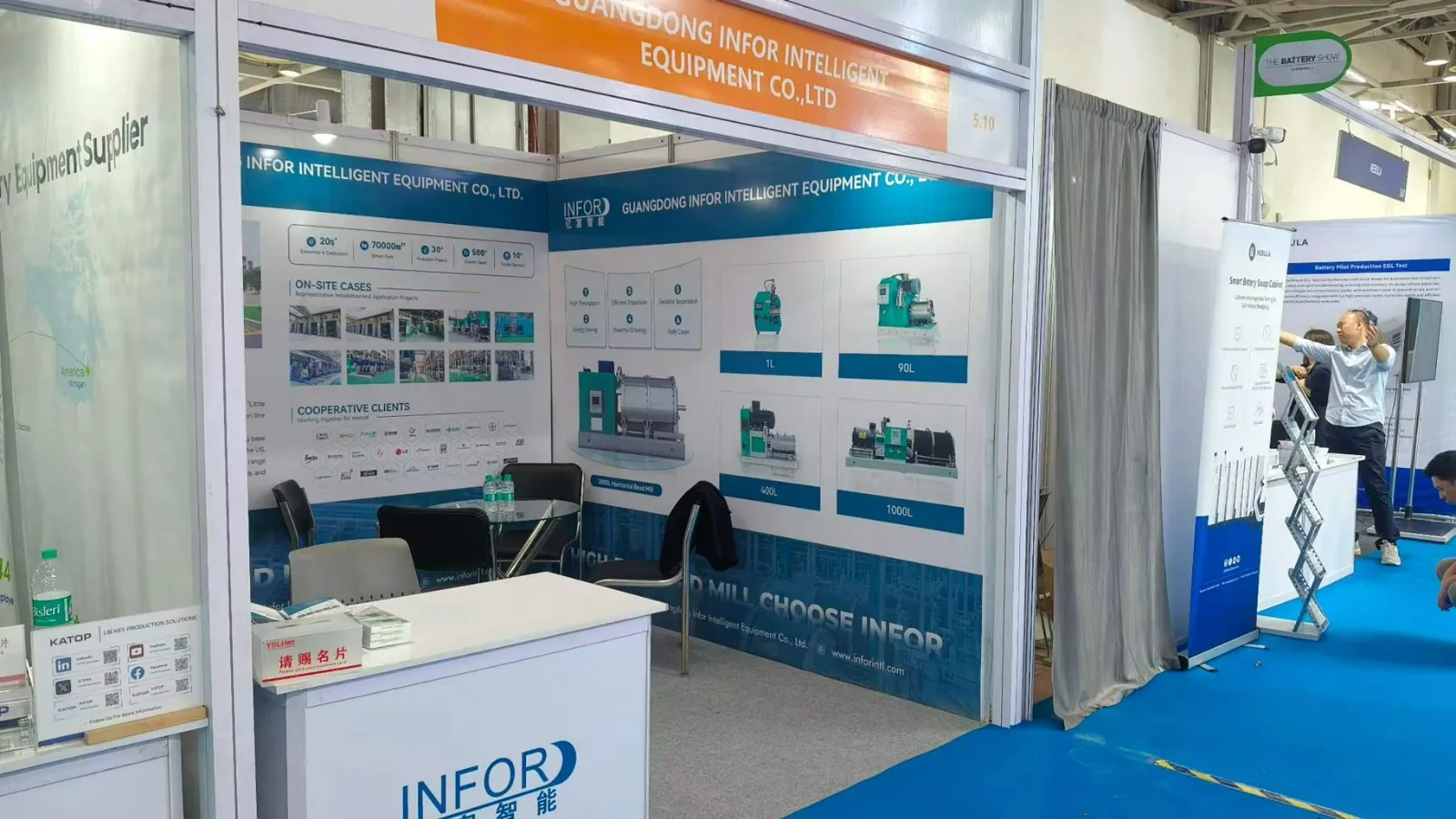
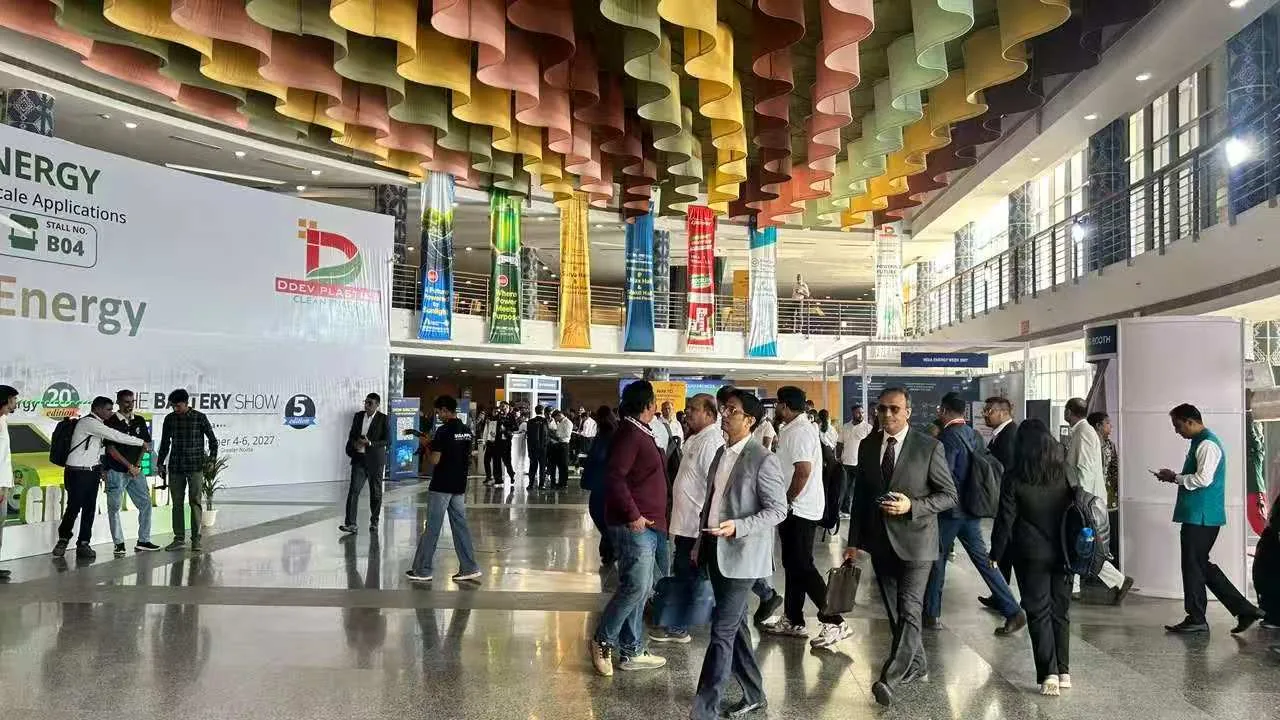
INFOR is exhibiting at The Battery Show India 2026, held October 22-24 at India Expo Mart & Centre in Greater Noida. You can find us at Booth 5.10 in Hall 5. Our team is at the show to meet cathode, anode and conductive paste manufacturers and talk through bead mill (sand mill) selection, laboratory trials and complete wet grinding lines.
India is not a new market for us. INFOR has a subsidiary in India, alongside its subsidiary in Korea and offices in Indonesia, the United States and Spain. The exhibition is a chance to meet the team in person and discuss projects at any stage, from a first formulation trial to a production line. Our show invitation explains why the Indian market matters to us.
Exhibition at a Glance
- Event: The Battery Show India 2026
- Dates: October 22-24, 2026
- Venue: India Expo Mart & Centre, Greater Noida, Uttar Pradesh
- Booth: 5.10, Hall 5
- Topics: bead mills for LFP, LMFP and silicon-carbon materials, CNT conductive paste, laboratory trials and integrated wet grinding lines
Bead Mills for Battery Materials
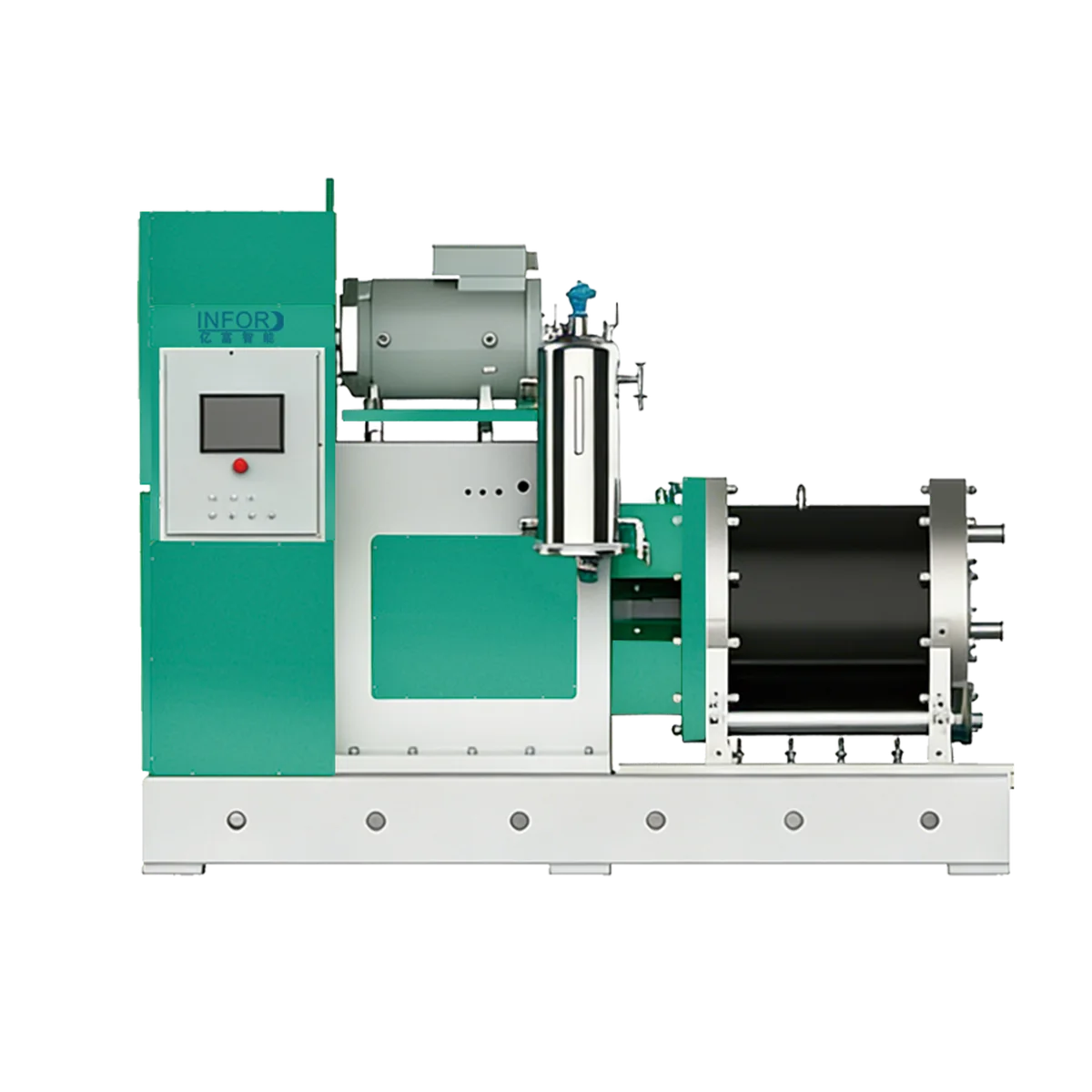
Different battery materials call for different grinding structures. These are the INFOR series most often discussed for battery projects:
- NCP pin bead mills: a pin-rod disperser with a silicon carbide inner chamber, built for large flow rates. Used for LFP, LMFP, carbon black, carbon nanotubes, silicon-carbon and separator coating slurry. Grinding fineness 100-1500 nm with 0.2-2.0 mm zirconia beads.
- NCT turbine bead mills: an optimized turbine disperser that transfers more kinetic energy to the media, for high-energy dispersion of electrode and nano materials. Grinding fineness 100-1500 nm with 0.2-2.0 mm beads.
- LPM vertical bead mills: screen-free centrifugal separation designed for 0.03-0.3 mm micro beads, so the media does not clog the outlet at very fine particle sizes. Grinding fineness 30-1000 nm, with models from 1 to 1000 L.
- Laboratory bead mills: vertical and horizontal lab models for formulation trials before a production machine is sized.
All of these use ceramic contact parts (zirconia or silicon carbide) to keep metal contamination out of the slurry, which matters for cathode electrochemistry.
LFP and LMFP: From Powder to Slurry
For lithium iron phosphate and lithium manganese iron phosphate, the mill is one stage in a longer chain. A typical INFOR line runs dosing, pre-mixing, homogenizing, fine grinding, demagnetization (iron removal) and slurry storage as one continuous process.
There are two main ways to build that line:
- A horizontal bead mill line uses coarse and fine grinding stages with multi-stage circulation. It suits high-volume plants with strict capacity and stability targets.
- A vertical bead mill line grinds directly to the fine stage without a separate coarse-grind step. The footprint is smaller and the line costs less to build.
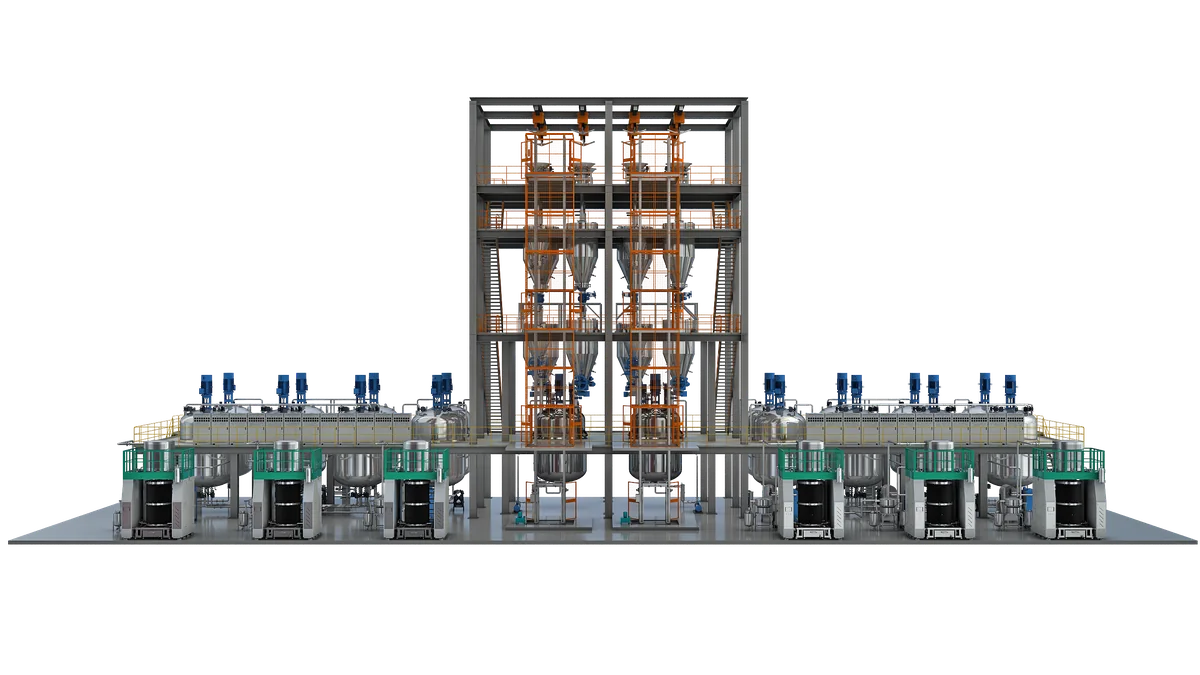
INFOR has delivered powder-to-slurry LFP installations from 8,500 t/y up to 100,000 t/y, running NCT turbine and NCP pin bead mills. Some of these projects are described on our case studies page.
CNT Conductive Paste
Carbon nanotube conductive paste needs more than fine grinding. The tubes have to be dispersed evenly without excessive damage, and the slurry has to move through the mill at a useful flow rate.
INFOR's CNT conductive paste bead mill uses a CNT-specific rotor, a dynamic screen for high flow, a full stainless-steel exterior and anti-explosion barrel treatment. For larger volumes, the mill can be built into a complete CNT conductive paste production line with pre-dispersion, grinding and storage.
What to Bring to the Conversation
A target particle size alone does not define a grinding process. To give useful advice at the show, our engineers will ask about:
- The material, and whether the slurry is water-based or solvent-based.
- Feed particle size and target D50/D90.
- Solids content, viscosity and maximum process temperature.
- Required output per hour or per batch.
- Contamination limits and any restrictions on contact materials.
If some of these numbers are not known yet, that is normal at an early stage. A laboratory trial on your own material is usually the next step. Its results are what a production machine and line should be sized from, rather than chamber volume alone.
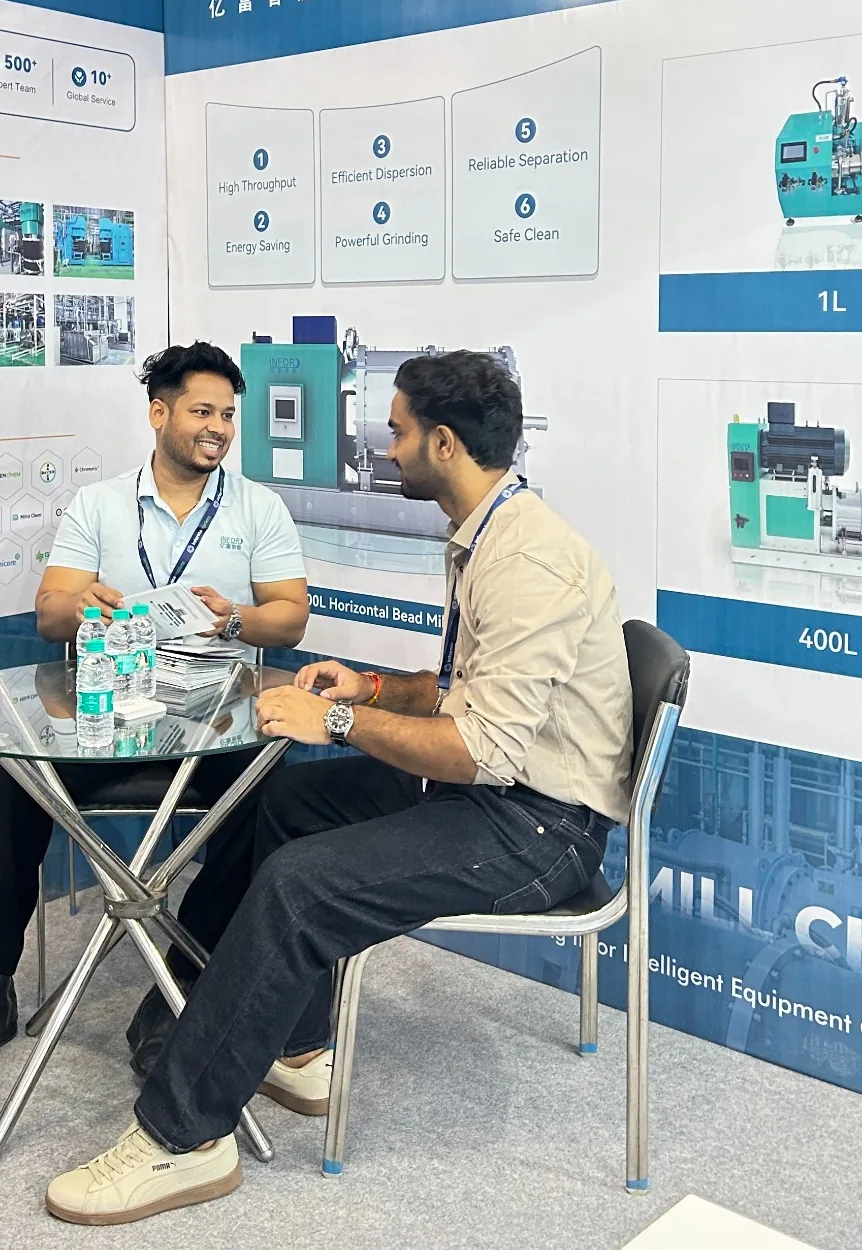
Meet INFOR in Greater Noida
If you are visiting The Battery Show India 2026, visit us at Booth 5.10 in Hall 5 and talk to us about LFP or LMFP grinding, CNT dispersion, laboratory testing or a complete wet grinding line. For an existing process, tell us what you want to fix, such as temperature control, dispersion consistency or capacity.
Can't make it to the show? Send us your material and process details and our engineering team will follow up.
Email: sales@inforintl.com
Frequently Asked Questions
When and where is The Battery Show India 2026?
October 22-24, 2026, at India Expo Mart & Centre in Greater Noida, Uttar Pradesh.
Is a bead mill the same as a sand mill?
Yes. Both names describe a wet grinding machine that uses small beads, usually zirconia, agitated inside a chamber to reduce particle size and disperse solids in a liquid. "Sand mill" is the more common term in China's battery industry, while "bead mill" is more widely used in Europe and North America. Our bead mill guide explains the main types.
Should an LFP plant use a horizontal or a vertical bead mill line?
It depends on capacity, layout and the target particle size. Horizontal lines are a mature choice for very high, continuous output. Vertical lines can grind directly to the fine stage, which takes up less floor space and costs less to build. Trial results on the actual material are the best basis for the decision.
Does INFOR have a presence in India?
Yes. INFOR has a subsidiary in India and serves customers in more than 30 countries and regions.