Intelligent AI Bead Mills
Also known as: intelligent AI sand mills
AI voice-controlled sand mills that understand spoken commands for hands-free, multi-task operation.
The INFOR intelligent AI bead mill accepts spoken commands with semantic understanding and switches between offline and online modes. Seven SWT models cover 1–400 L chambers and feed flows of 120–11,000 L/h.
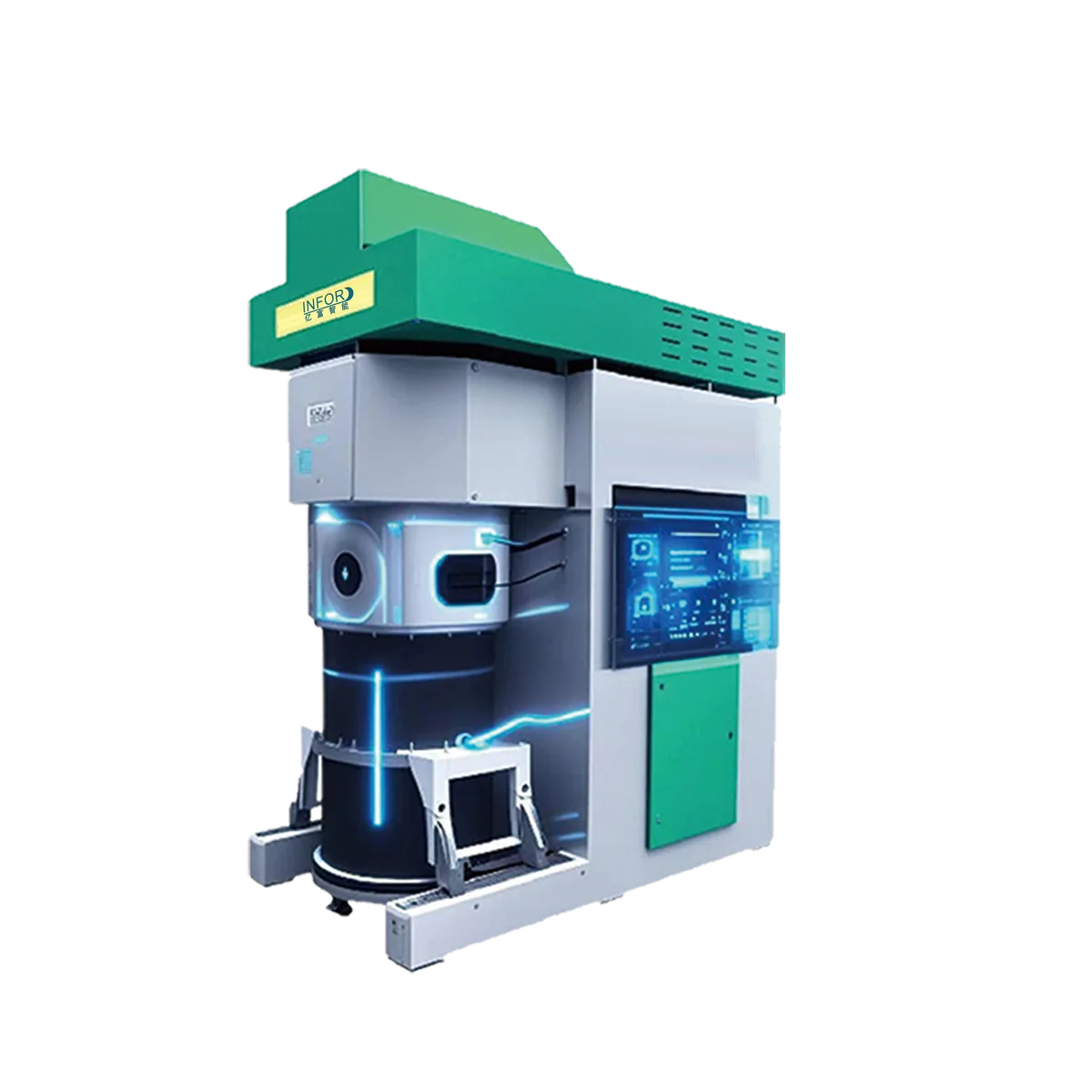
7 models side by side.
Figures from the current product catalogue. Final configuration depends on your material and process.
| Model | Motor Power (kW) | Grinding Chamber Volume (L) | Grinding Media (mm) | Feed Flow (L/h) | Weight (kg) |
|---|---|---|---|---|---|
| SWT-1 | 5.5 | 1 | 0.3-2.0 | 120 | 300 |
| SWT-5 | 11 | 5 | 0.3-2.0 | 300 | 700 |
| SWT-15 | 22 | 15 | 0.3-2.0 | 600 | 1000 |
| SWT-30 | 45 | 30 | 0.3-2.0 | 1000 | 2100 |
| SWT-60 | 90 | 60 | 0.3-2.0 | 3000 | 4500 |
| SWT-150 | 132 | 150 | 0.3-2.0 | 6000 | 7000 |
| SWT-400 | 315-355 | 400 | 0.3-2.0 | 11000 | 9500 |
AI voice sand mill questions.
What is an AI voice-controlled sand mill?
The INFOR SWT series understands spoken commands through AI semantic understanding, so operators can run the mill hands-free. It switches between offline and online modes, handles several tasks together and asks again when a command is ambiguous to prevent mis-operation.
What sizes does the SWT series come in?
Seven models, from SWT-1 to SWT-400, cover grinding chambers of 1–400 L and motors of 5.5–355 kW, all using 0.3–2.0 mm grinding media.
Which materials is the AI voice sand mill used for?
Typical materials are nanomaterials, sodium-ion materials, silicon-carbon anode, lithium iron phosphate, ink, alumina, zirconia and silica.
Guides for this equipment.
Compare another grinding process.
Start with your material.
Share the material, target particle size and required output. INFOR offers material trials, process planning and equipment recommendations.
Test Your Material