Dual-Power Bead Mills
Also known as: dual-power sand mills
Vertical and horizontal dual-drive mills with independent rotor and separator drives for precise, flexible control.
Dual-power bead mills drive the rotor and the separator with independent motors, so energy input and separation can be set separately. The vertical series (30, 60 and 150 L chambers, 45–160 kW) is specified for 50–2000 nm and the horizontal series for 100–1500 nm.
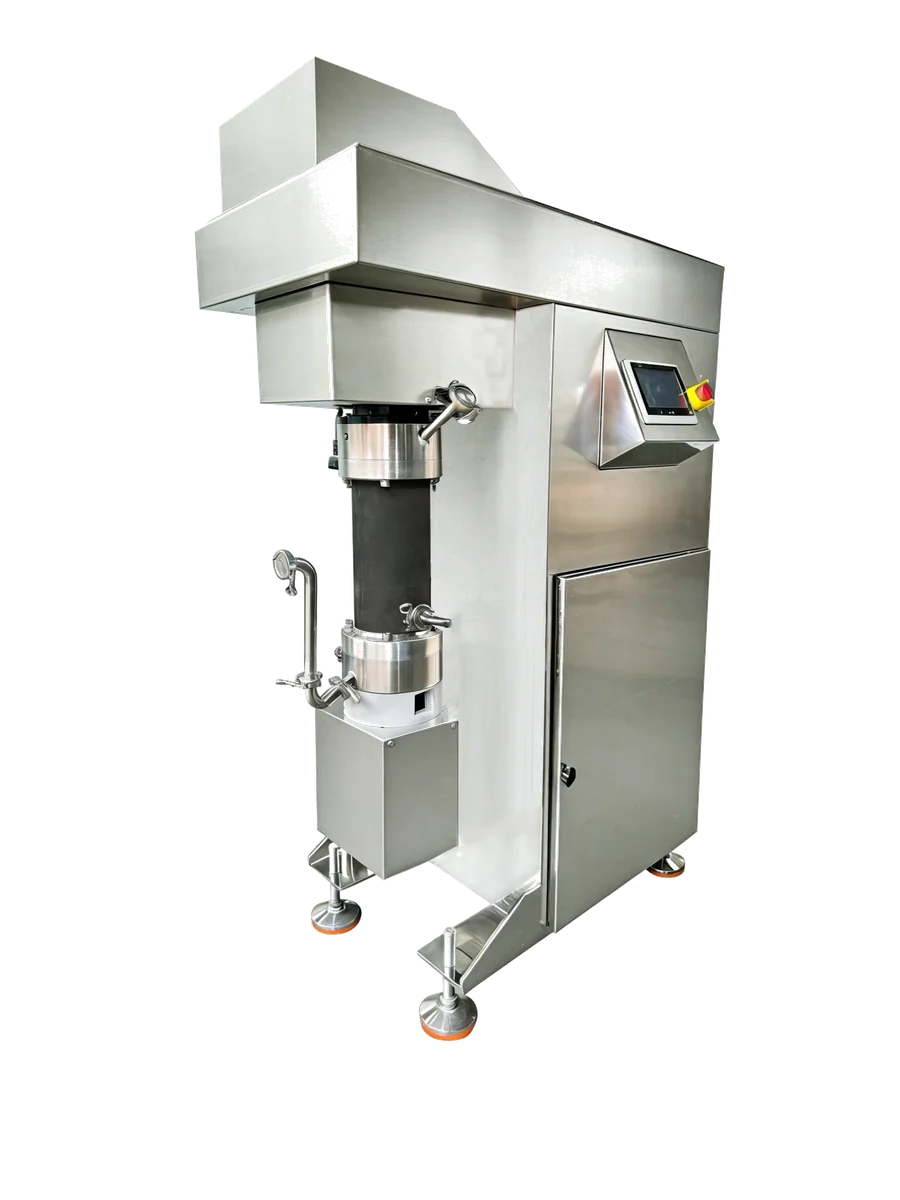
Vertical Dual-Power Bead Mill Series
Dual independent-drive vertical sand mill with separate motors for the rotor and separator for precise, flexible control.
View series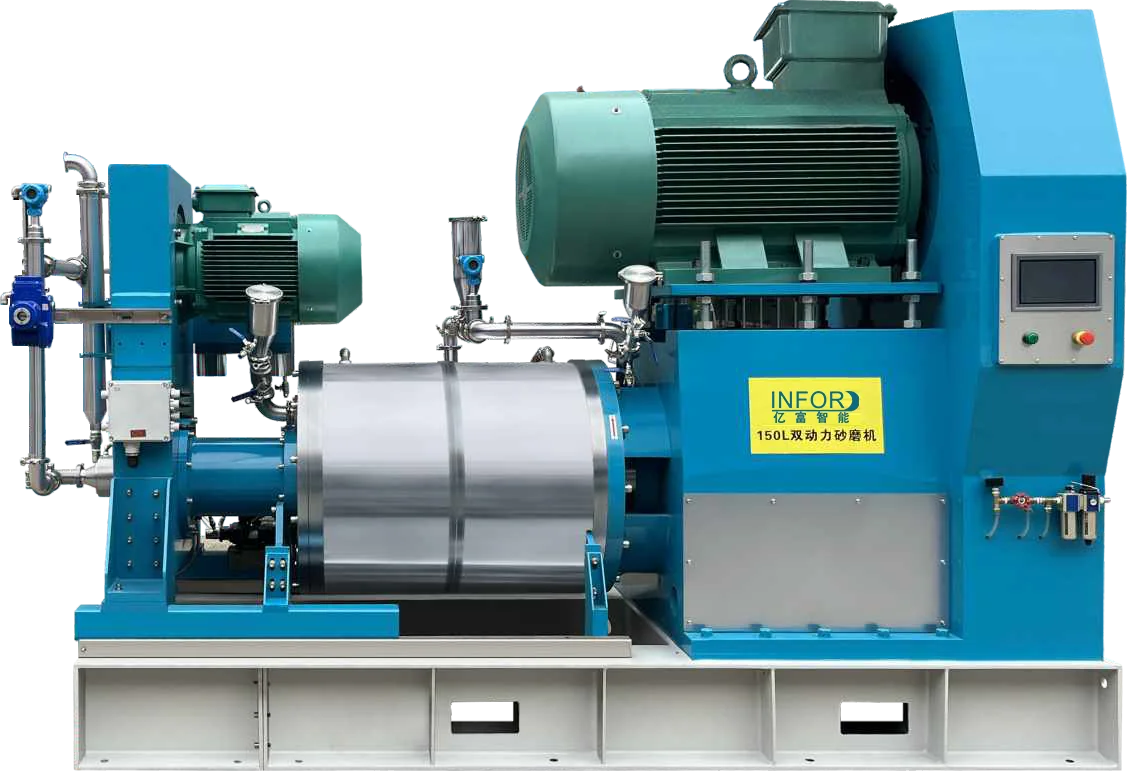
Horizontal Dual-Power Bead Mill Series
Horizontal dual-drive sand mill with independent rotor and separator drives for forced circulation and precise control.
View series3 models side by side.
Figures from the current product catalogue. Final configuration depends on your material and process.
| Model | Series | Motor Power (kW) | Grinding Chamber Volume (L) | Min. Production Volume (L) | Weight (kg) |
|---|---|---|---|---|---|
| 30L | Vertical Dual-Power Bead Mill Series | 45 | 30 | 70 | 2200 |
| 60L | Vertical Dual-Power Bead Mill Series | 90 | 60 | 150 | 4500 |
| 150L | Vertical Dual-Power Bead Mill Series | 160 | 150 | 350 | 7500 |
Dual-power or a standard bead mill?
Figures from the current product pages. A test grind on your own material is the reliable way to decide.
| Series | Drive | Grinding structure | Fineness | Grinding media |
|---|---|---|---|---|
| Vertical dual-power | Rotor and separator motors | Vertical, screen-free separation | 50–2000 nm | 0.03–2.0 mm |
| Horizontal dual-power | Rotor and separator motors | Horizontal, screen-free separation | 100–1500 nm | — |
| LPM vertical | Single motor | Vertical, screen-free separation | 30–1000 nm | 0.05–2.0 mm |
| NCT turbine | Single motor | Turbine disperser | 100–1500 nm | 0.2–2.0 mm |
| NCP pin | Single motor | Pin-rod disperser | 100–1500 nm | 0.2–2.0 mm |
What is a dual-power sand mill?
A dual-power sand mill (dual-power bead mill) has two independent drive systems: the rotor that moves the grinding media and the separator wheel that holds the media back each have their own motor and shaft. Grinding energy and separation can therefore be set to different speeds for each material. INFOR builds it in two layouts. The vertical series has 30, 60 and 150 L chambers with 45, 90 and 160 kW motors and is specified for 50–2000 nm; the horizontal series is specified for 100–1500 nm. Both use centrifugal, screen-free separation, so there is no screen to clog.
When is a dual-power mill worth it compared with a standard bead mill?
On a single-shaft mill the separator turns with the rotor, so changing the rotor speed also changes how well the beads are held back. A dual-power mill removes that link. It is most useful when the process runs very fine media (the vertical dual-power series is rated for stable use of 0.03–0.1 mm beads), when one line has to handle slurries with different characteristics, or when the rotor speed that gives the best particle size distribution is not the speed at which the separator works well. If your recipe already reaches its target with 0.2 mm or larger beads at one fixed speed, an LPM, NCT or NCP mill may be enough. A test grind shows which.
Vertical or horizontal dual-power sand mill?
Both share the same dual independent drive and screen-free separation. In the vertical mill the material flows bottom-up through the chamber, which avoids the dead zones of a horizontal chamber; it covers 50–2000 nm with 0.03–2.0 mm media, and the 30, 60 and 150 L models need a minimum batch of 70, 150 and 350 L. The horizontal mill offers the same control in a horizontal configuration for 100–1500 nm. Floor space, existing line layout and the target fineness usually decide between them.
Which materials are dual-power sand mills used for?
Typical uses are new-energy slurries (lithium electrode slurry, separator coating, conductive slurry, energy-storage slurry and battery binder), coatings and inks (industrial and automotive coatings, nano colour paste, UV and digital ink) and new materials such as nano ceramic slurry, graphene and carbon nanotube dispersion and nano metal oxides. Chamber linings are available in silicon carbide, polyurethane, zirconia or high-purity alumina to suit the material.
Compare another grinding process.
Start with your material.
Share the material, target particle size and required output. INFOR offers material trials, process planning and equipment recommendations.
Test Your Material