NCP Pin Bead Mills
Also known as: NCP pin sand mills
Pin-rod ceramic mills for high-flow impact grinding, challenging formulations and consistent industrial output.
NCP pin bead mills use a pin-rod rotor for high-flow impact grinding in continuous production. Eight models from NCP-6 to NCP-1000 span 6–1000 L chambers, 11–650 kW and feed flows of 300–12,000 L/h, with a fineness of 100–1500 nm on 0.2–2.0 mm beads.
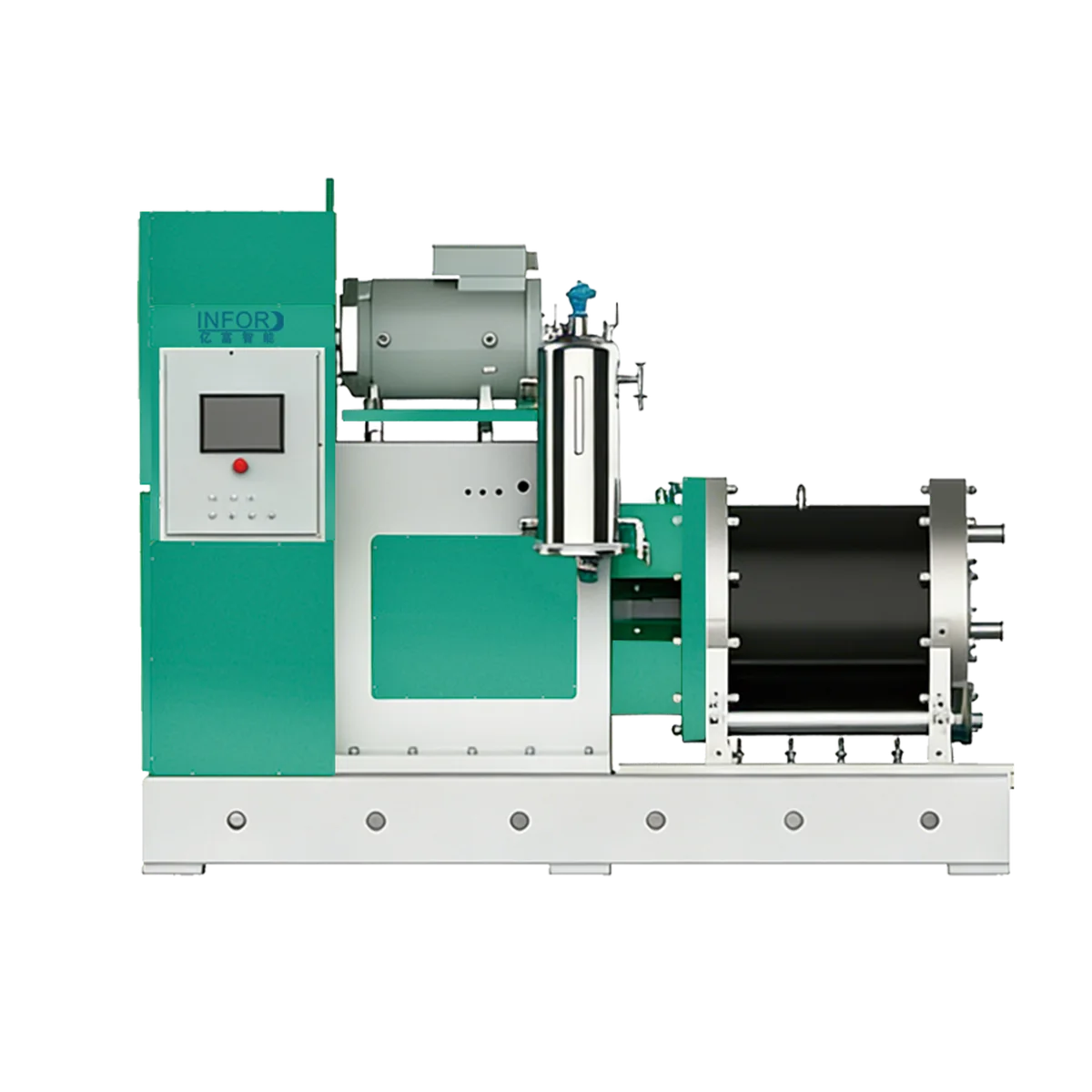
8 models side by side.
Figures from the current product catalogue. Final configuration depends on your material and process.
| Model | Motor Power (kW) | Grinding Chamber Volume (L) | Grinding Media (mm) | Feed Flow (L/h) | Weight (kg) |
|---|---|---|---|---|---|
| NCP-6 | 11 | 6 | 0.2-2.0 | 300 | 800 |
| NCP-15 | 22 | 15 | 0.2-2.0 | 800 | 2500 |
| NCP-30 | 45 | 30 | 0.2-2.0 | 1200 | 2800 |
| NCP-60 | 90 | 60 | 0.2-2.0 | 3000 | 4500 |
| NCP-150 | 132-160 | 150 | 0.2-2.0 | 4000 | 6500 |
| NCP-300 | 315-355 | 300 | 0.2-2.0 | 5000 | 8000 |
| NCP-400 | 315-355 | 400 | 0.2-2.0 | 6000 | 9500 |
| NCP-1000 | 650 | 1000 | 0.2-2.0 | 12000 | 11000 |
Pin bead mill questions.
What is a pin-rod (pin-type) bead mill?
A pin-rod bead mill uses pins on the rotor and in the chamber to drive the grinding beads, giving strong shear for high-flow production. The INFOR NCP series combines a pin-rod disperser, centrifugal discharge and a silicon carbide inner chamber, and reaches 100–1500 nm with 0.2–2.0 mm zirconia beads.
What sizes does the NCP pin mill come in?
Eight models, from NCP-6 to NCP-1000, cover grinding chambers of 6–1000 L and motors of 11–650 kW, all using 0.2–2.0 mm media. The HMI monitors material temperature, pressure, cooling water, seal level and motor temperature independently.
Which materials is the NCP pin mill used for?
Typical uses are lithium iron phosphate, lithium manganese iron phosphate, carbon black, carbon nanotubes, graphene composite slurry, separator coating slurry, battery coating and silicon-carbon materials.
Compare another grinding process.
Start with your material.
Share the material, target particle size and required output. INFOR offers material trials, process planning and equipment recommendations.
Test Your Material