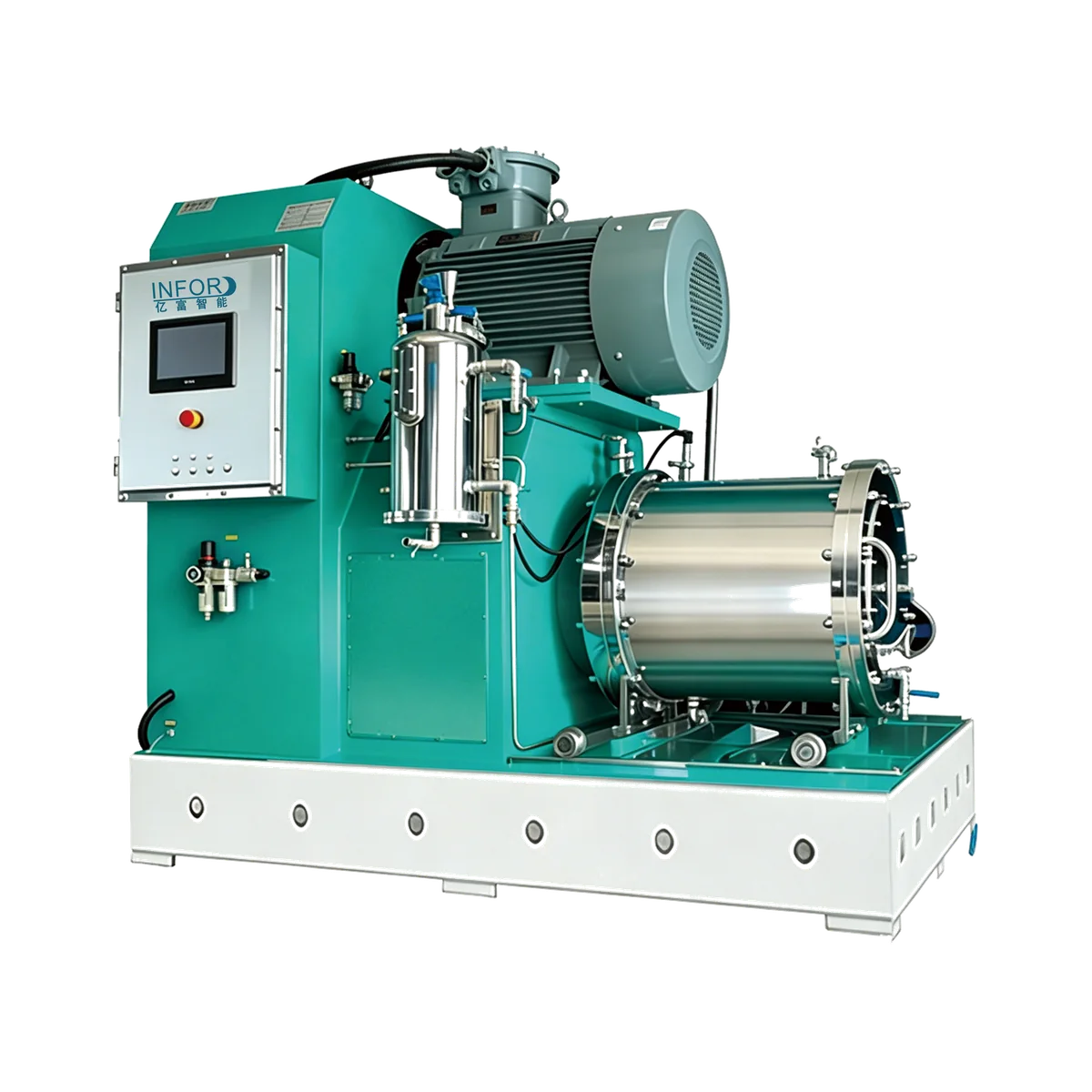
When a bead mill (sand mill) stops performing, the symptom usually points to a small set of causes. The table below summarises the common problems; the sections after it explain what to check first. Stop the mill whenever a change is sudden or unexplained, and follow the safety procedures in your operating manual before opening any part of the machine.
| Symptom | Common causes | Check first |
|---|---|---|
| Product temperature too high | Low cooling water flow or warm inlet water, scale in the jacket, speed or flow too high for the material | Cooling flow and temperatures, then speed and feed flow |
| Chamber pressure rising | Separator or screen blocked, viscosity or solids too high, feed flow too high | Separator and outlet, slurry viscosity, feed flow |
| Particle size off target or distribution too wide | Worn or wrong-size beads, low bead fill, short residence time, poor pre-dispersion | Bead size and fill, feed flow, pre-mix |
| Leakage at the seal | Worn seal faces, low seal fluid, seal cooling failure, incompatible elastomer, dry running | Seal fluid and coolant, then seal parts |
| Fast bead wear or contamination | Bead or lining material unsuited to the slurry, speed too high, running with too little slurry | Bead and lining materials, operating speed |
| Vibration or unusual noise | Loose fasteners, bearing wear, belt tension, running without material | Stop the mill and inspect |
| Beads in the product | Worn or damaged separator, broken bead fragments passing the gap | Separator condition, bead breakage |
Product temperature too high
Check the cooling water flow and inlet temperature to the chamber jacket first; scale in the jacket reduces heat transfer even when the flow looks normal. If cooling is in order, the energy input may be too high for the material, so reduce the rotor speed or adjust the feed flow. Heat-sensitive materials may need lower speed with more passes.
Chamber pressure rising
Rising pressure usually means the flow out of the chamber is restricted. On screen mills, broken beads or agglomerates can block the screen; inspect and clean it and check the beads for breakage. A slurry that is more viscous or has higher solids than specified, or a feed flow that is too high, also raises pressure. Centrifugal screen-free separation, used on the INFOR LPM and dual-power series, is designed to avoid clogging.
Particle size off target or distribution too wide
Worn beads, a low bead fill or beads that are too large for the target all reduce fine grinding. A feed flow that is too high shortens the time the slurry spends in the chamber, and poor pre-dispersion leaves agglomerates the mill cannot break down efficiently. Check the bead size and fill, reduce the flow or add passes, and review the pre-mixing step. If the target is below about 100 nm, the process may need 0.05-0.1 mm micro-beads and a screen-free vertical mill that can retain them; see our bead mill selection guide.
Leakage at the mechanical seal
Check the seal fluid level and seal coolant first, because a seal that runs hot or without its fluid wears quickly. If the support systems are in order, the seal faces or elastomers may be worn, or the elastomer may not be compatible with the solvent. Our article on selecting mechanical seals for sand mills covers face and elastomer materials.
Fast bead wear or product contamination
Beads and chamber linings must suit the slurry. An abrasive material, a speed that is higher than necessary or running with too little slurry in the chamber accelerates wear and can contaminate the product. Review the bead material and the lining; INFOR chambers are available in silicon carbide, zirconia, polyurethane or alumina depending on the series, and the NCT uses a ceramic grinding chamber for contamination-free grinding.
Vibration, noise or beads in the product
Stop the mill and inspect it before continuing. Loose fasteners, worn bearings, incorrect belt tension or running the mill without material can all cause vibration. Beads in the product point to a worn or damaged separator, or to broken bead fragments small enough to pass through it.
When to call for service
If a problem returns after these checks, record the operating data (speed, flow, temperatures, pressure and motor current) and the time it started, and contact INFOR with the model and serial number. For routine prevention, use the bead mill maintenance checklist and the start-up and shutdown procedure.