Several Chinese government departments are giving priority support to solid-state batteries, with technology focused on sulfide all-solid-state cells and demonstration vehicle operation targeted for 2027; small-batch production may come forward to 2026-27.
With leading companies and the supply chain investing, both equipment and materials have advanced. In equipment, dry and wet routes for electrolyte film forming are developing in parallel, isostatic presses now run continuously, and new processes keep emerging across the front, middle and back end. In materials, lithium sulfide performance meets requirements, sulfide electrolyte films have reached kilometre-scale rolls, stack pressure can be reduced to 1-2 MPa, and new vapour-deposition processes are being developed for lithium metal.
The battery material system is largely settled: sulfide all-solid-state is the mass-production trend, with silicon-carbon anodes in the short to medium term and lithium metal in the long term. Sulfide solid electrolytes have the greatest potential, with very high ionic conductivity, relatively good interfacial contact and flexibility for processing, making them the main route for leading manufacturers.
All-solid-state progress has been better than expected. With the material system settled and raw materials meeting mass-production requirements, we expect late 2025 to early 2026 to be the key period for pilot lines at battery makers.
Vertical bead mills are moving from behind the scenes into the spotlight. Particle size determines performance: the ionic conductivity of solid electrolytes is directly related to particle specific surface area, and in some processes materials must be ground to sub-micron size (D50 <100 nm) to improve sintering activity and ion transport. Conventional ball mills are inefficient, give a broad distribution and easily introduce impurities, so they struggle to meet mass-production needs. With their wet ultrafine grinding capability, vertical bead mills have become key equipment for scaling up solid electrolytes.
INFOR's vertical bead mill solves blockage with its screen-free design, improves ionic conductivity through ultrafine nano grinding and lowers production cost with an energy-saving direct-drive system. As classified grinding and atmosphere control mature, vertical bead mills will help solid-state batteries overcome cost and performance barriers and bring EVs into the 1,000 km range era.
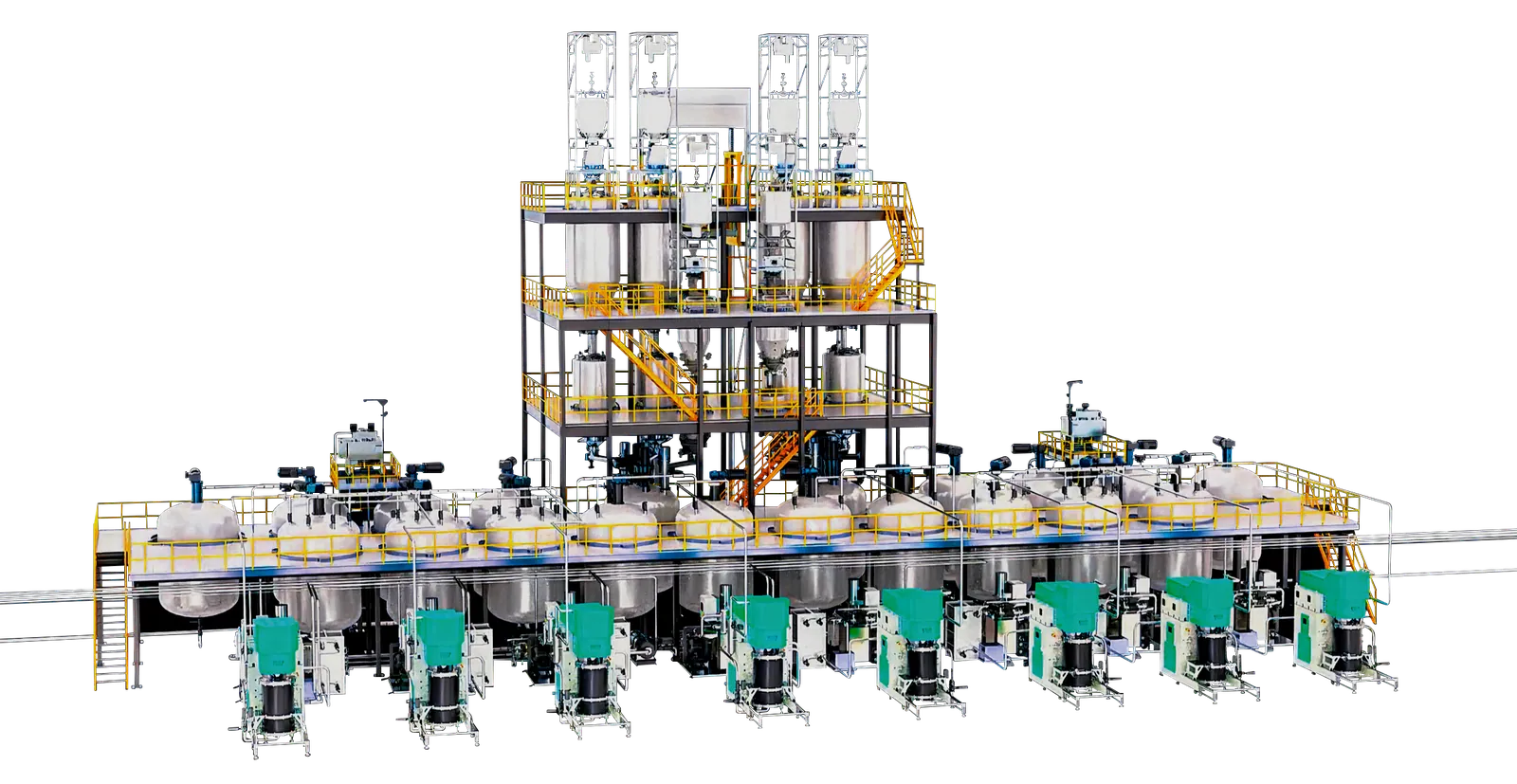
Solid-state batteries have a bright future, and the vertical bead mill, as an important production tool, will develop hand in hand with the industry to advance new energy vehicles and energy storage.