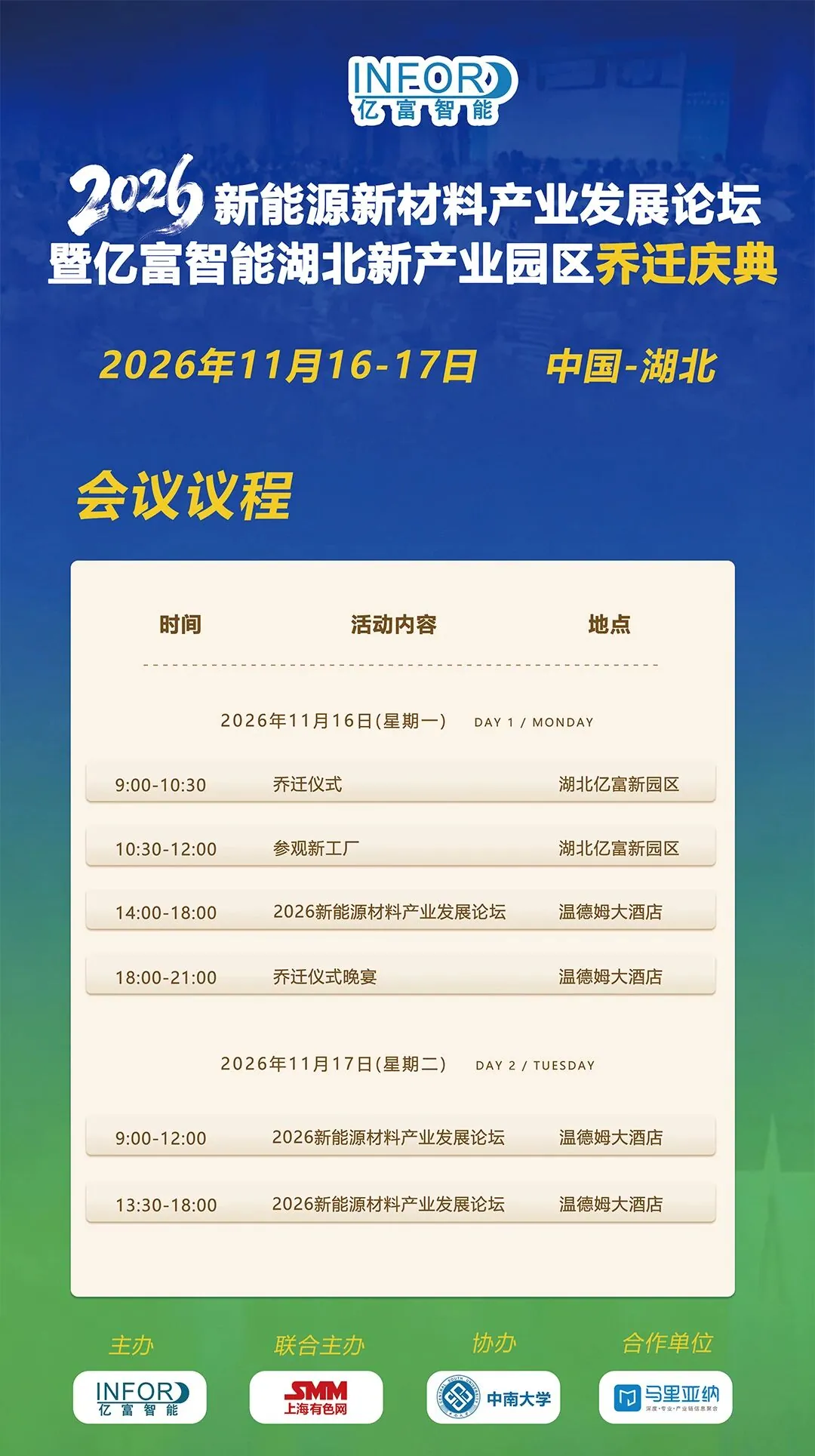
November 16-17, 2026, Gucheng, Xiangyang, Hubei.

A new park in Hubei, and a dedicated sodium-ion session to go with it. As INFOR's new Hubei industrial park moves from blueprints to production, competition in new energy materials is shifting from “can it be made” to “can it perform reliably over wide temperatures, at high rates and across long cycle life”.
At this moment of a new park opening alongside an industry forum, we welcome a young scientist who has long focused on layered oxide cathodes for sodium-ion batteries and on turning crystal structure control into cell performance: Professor Xiao Yao of the College of Chemistry and Materials Engineering at Wenzhou University has confirmed that he will attend the 2026 New Energy Materials Industry Development Forum and INFOR Hubei Industrial Park Opening Ceremony, where he will deliver a keynote titled “Mechanisms and Applications of Adaptive Layered Oxide Cathodes for Sodium-Ion Batteries”.
From Charge Redistribution to Adaptive Structures: A Researcher Who Knows Layered Oxides Inside Out
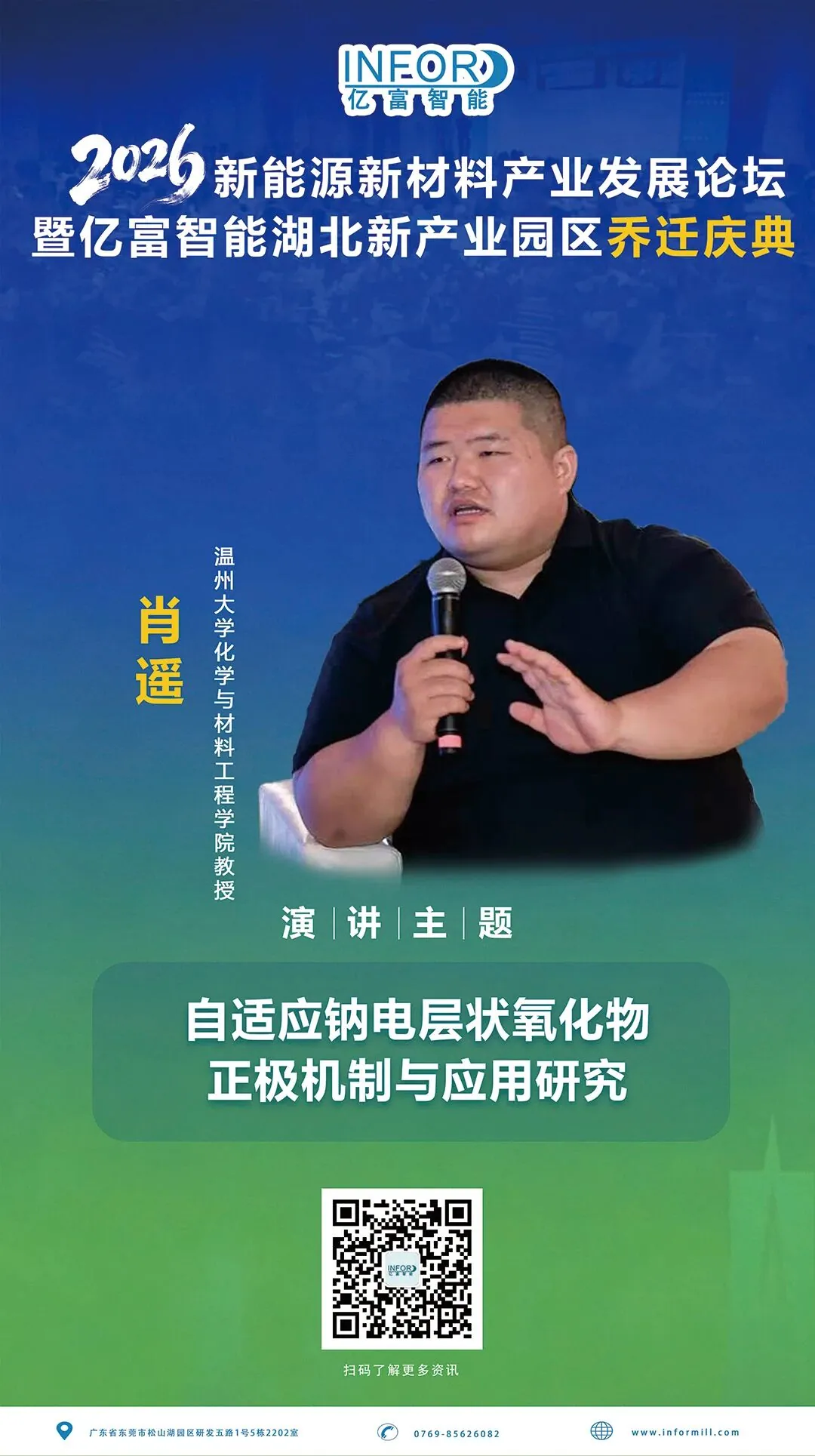
Xiao Yao is an Oujiang Distinguished Professor (Class A) and doctoral supervisor at Wenzhou University, Executive Vice Dean of its Carbon Neutrality Research Institute, and Deputy Secretary-General of the Academic Committee of the World Young Scientist Summit. He has been selected for the youth program of a major national talent initiative and has been named repeatedly to Stanford University's list of the world's top 2% scientists.
His work focuses on the fundamental science and industrial application of layered oxide cathode materials for sodium-ion batteries, with systematic research along three lines: structural stability control, interfacial electrochemical reaction mechanisms and ion transport kinetics.
• Adaptive structure mechanism: He proposed a multi-element strategy for tuning the local electronic structure between transition metals and oxygen, allowing the material to actively adjust its lattice volume and internal stress during sodium insertion and extraction. The resulting adaptive “expand first, then contract” evolution suppresses phase transitions and microcracks at high voltage;
• Interface and doping engineering: Using non-metal modification such as boron doping, he builds a strong B-O-TM bond network, moving from bulk doping to interface reconstruction to improve air stability, high-temperature stability and rate performance together;
• Advanced characterization guiding material design: Using 4D-STEM, in situ electrochemistry and other techniques, he resolves charge density and electric field distribution at the atomic scale, translating “invisible” interlayer stress into structural parameters that can be designed;
• Industrial application: He leads a Young Scientist project under the National Key R&D Program, General and Youth projects of the National Natural Science Foundation of China, and major research projects of Zhejiang Province and Wenzhou City, helping move layered oxide cathodes from coin-cell validation toward pouch cells and energy storage applications.
Peers note a clear trait of Xiao Yao's team: they don't just explain why materials are stable in journals such as Nature Communications, JACS, Angewandte Chemie, Advanced Materials and Energy & Environmental Science; they also care how much of that stability survives powder scale-up, slurry dispersion and electrode calendering.
Closely Aligned with the Forum's New Energy Materials Theme
Professor Xiao's keynote, “Mechanisms and Applications of Adaptive Layered Oxide Cathodes for Sodium-Ion Batteries”, speaks directly to the core concerns of this year's new energy materials forum:
Looking beyond a purely academic perspective, the talk will explain from an industrial standpoint how layered oxide cathodes degrade structurally over wide temperature ranges and at high rates, and will focus on how the adaptive evolution of the crystal structure directly determines cell cycle life and gas suppression. As sodium-ion batteries move into energy storage and power applications, this research addresses a key pain point in scaling cathodes from the lab to mass production: performance fading caused by inconsistent powders and uncontrolled interfacial side reactions.
It points material companies toward molecular-level design of highly stable cathodes and gives the whole supply chain a valuable basis for discussion.
A New Park Opens with a Live Lesson on “Self-Healing” Cathodes
At the opening, Professor Xiao will distill this research into a talk for industry.
Rather than repeating textbook crystallography, he will explain three things:
• In which voltage range adaptive layered oxides actually “adapt”;
• What margins cathode slurry and powder processes need to leave when moving from lab coin cells to Ah-level pouch cells;
• How structural innovation on the material side defines the process window for front-end equipment such as grinding, dispersion and drying.
For cathode producers, cell engineers and equipment buyers in the audience, the value of the talk lies in hearing how a scholar who understands both charge redistribution and precursor batch variation translates “layered oxide cathodes” from a paper title into production line parameters.