This glossary explains 30 terms used in bead milling and wet grinding, from bead filling and separation systems to specific energy, stress energy and D50. Each entry is a short definition with a link to a fuller INFOR guide where one exists.
For the basics of how bead mills work and how the types differ, start with the bead mill guide.
Bead mill (sand mill, agitator bead mill)
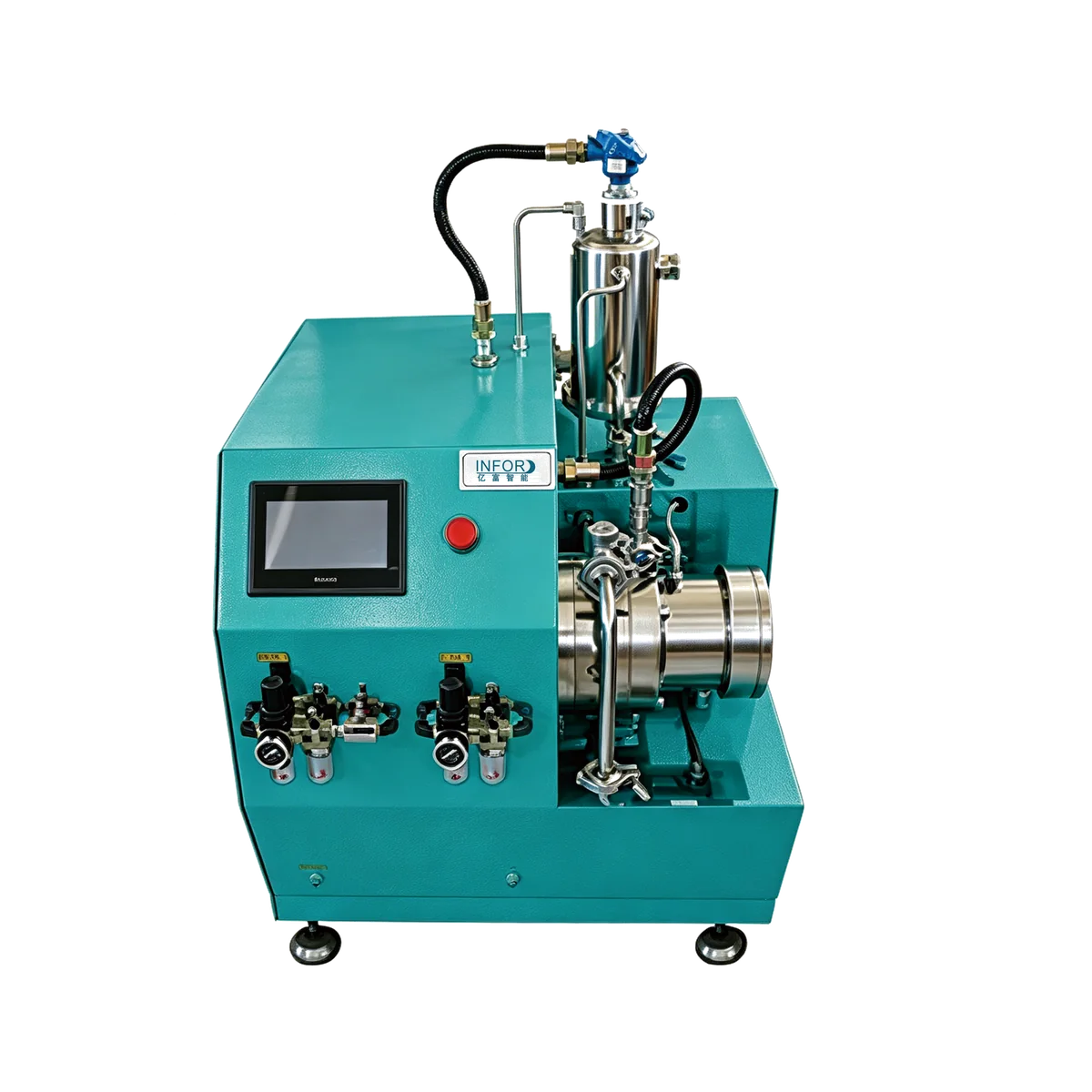
A wet grinding machine in which a rotor stirs small grinding beads in a closed chamber; the beads break and disperse particles in a slurry pumped through the chamber. "Sand mill" is the older name from when sand was used as the media.
Grinding media (grinding beads)
The small balls that do the grinding, usually zirconia, zirconium silicate or glass, from a few hundredths of a millimetre to about 2-3 mm. Read more.
Filling ratio
The share of the free chamber volume filled with beads. See how to calculate bead filling. Read more.
Bulk density
The weight of one litre of poured beads, including the gaps between them; used to calculate the bead charge. INFOR zirconia beads: 3.75 kg/L.
True density
The density of the bead material itself. INFOR zirconia beads: 6.03 g/cm³.
Rotor (agitator)
The rotating shaft with discs, pins or turbine elements that moves the beads. See bead mill rotor types. Read more.
Separation system (separator)
The device at the outlet that keeps beads in the chamber and lets product out: screens, gaps or a screen-free centrifugal separator. Read more.
Screen-free centrifugal separation
Separation by a rotating wheel that throws dense beads back into the chamber while finer product leaves through the centre; nothing to clog, and it classifies particles.
Dual-power (dual-drive) mill
A bead mill in which the rotor and the separator wheel have separate motors and shafts, so grinding and separation speeds can be set independently.
Tip speed
The peripheral speed of the rotor elements, in m/s; together with bead size and density it sets the energy of bead impacts.
Specific energy
The grinding energy put into each kilogram of product, in kWh/kg or kWh/t. For a given material and target it is roughly fixed, so it is the basis for scaling from lab to production.
Stress energy
The energy of a single bead impact, which depends on bead size, bead density and tip speed. Too low and particles do not break; too high wastes energy and wears beads.
Stress number
How many times each particle is hit. Fineness depends on both stress energy and stress number.
Residence time
How long the slurry spends in the grinding chamber, set by chamber volume and flow.
Single-pass, multi-pass and circulation mode
Ways to run a mill: through once; several times through the same or a series of mills; or continuously between the mill and a tank until the target is reached. Circulation gives a narrow distribution.
Particle size distribution (PSD)
The spread of particle sizes in a product, usually measured by laser diffraction.
D10, D50, D90
Particle sizes below which 10%, 50% and 90% of the particles (by volume) lie. D50 is the median size; D90 shows the coarse tail.
Primary particles, aggregates and agglomerates
Primary particles are the smallest units; aggregates are primary particles bonded firmly together; agglomerates are loosely held clusters. Dispersion breaks agglomerates; grinding also breaks aggregates and primary particles.
Dispersion
Breaking agglomerates and distributing particles evenly in a liquid, without necessarily making the primary particles smaller.
Wet grinding vs dry grinding
Grinding in a liquid vs as a powder. See dry grinding vs wet grinding. Read more.
Suspension and slurry
A suspension is solid particles in a liquid; slurry is the industry word for a suspension being processed, such as a battery slurry.
Solids content
The weight share of solids in the slurry; higher solids gives more product per litre but higher viscosity.
Viscosity and rheology
Viscosity is resistance to flow. Many slurries are shear-thinning: thinner when stirred hard. Viscosity rises as particles get finer, which affects flow and cooling.
Wetting
Replacing air on the particle surface with liquid; the first step of dispersion and the job of the premix stage.
Dispersant
An additive that stops fine particles from re-agglomerating, by charge or by a polymer layer.
Sedimentation
Settling of particles or beads under gravity; a problem in feed tanks and in stopped horizontal mills. Read more.
Pre-dispersion (premix)
Mixing powder into the liquid with a high-speed disperser before the bead mill, so the mill only grinds.
Ceramic-lined chamber
A grinding chamber lined with zirconia or silicon carbide to keep metal out of the product.
Mechanical seal
The seal where the rotor shaft enters the chamber; double mechanical seals with seal liquid are common on bead mills.
Scale-up
Moving a process from a lab mill to a production mill, usually by keeping specific energy and stress energy similar. Read more.
Missing a term? Ask INFOR's engineers through the contact page.